This guide covers everything you need to make smart decisions about your sloped yard: how to read your slope, which structural solutions apply to your grade, creative design ideas that actually work on hillsides, plant selection, drainage, and realistic cost expectations.
Key Takeaways
- Slope grade (under 10%, 10–25%, over 25%) determines which solutions are safe — assess this first
- Poor drainage — not poor materials — causes most retaining wall failures
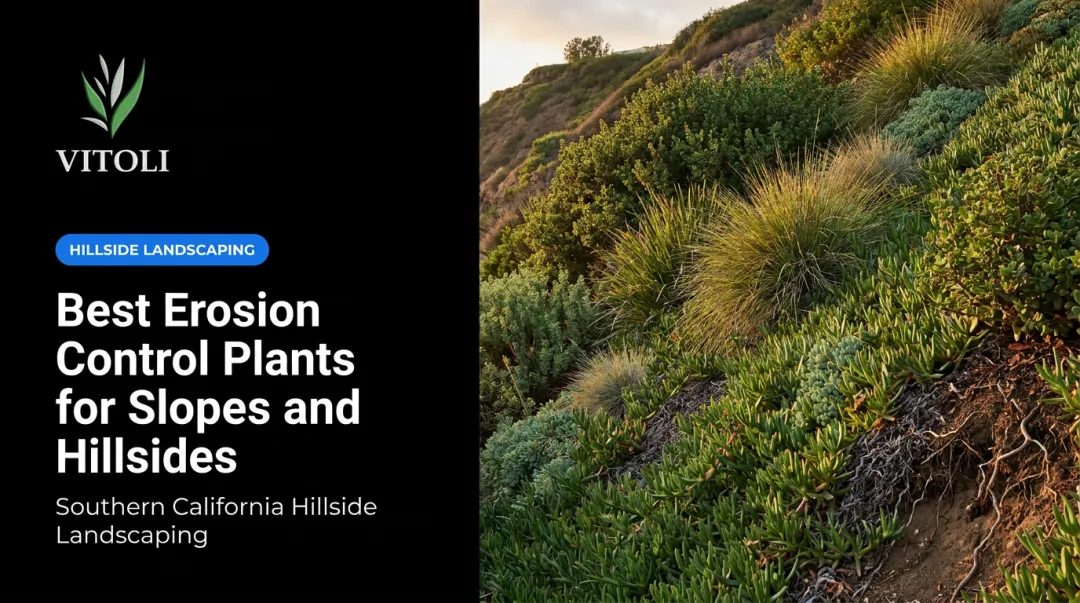
- Deep-rooted natives like ceanothus, coffeeberry, and California buckwheat anchor soil and resist drought
- Retaining walls over 4 feet require permits in most California jurisdictions — check local rules before building
- Engineered solutions cost more upfront but save significantly compared to repairing erosion damage or wall failure
Start With an Assessment: Reading Your Slope
Before choosing any solution, you need to understand your slope's grade — and what it means structurally.
How to Estimate Your Slope at Home
You can get a reliable measurement with a level, tape measure, and a long board:
- Place one end of the board on the high point of the slope
- Hold it level and measure the height from the board's lower end to the ground
- Divide that height by the board's length, then multiply by 100 to get percent grade
What Your Grade Means for Design
California jurisdictions don't all use the same thresholds, but the City of Calabasas offers a useful framework. California jurisdictions don't all use the same thresholds, but the City of Calabasas offers a useful benchmark:
- Over 10% — triggers hillside development standards
- 20–30% — requires special foundation approaches
- 30–50% — calls for stepped or post-and-beam foundations
- Over 50% — development should be avoided except in isolated locations

Soil and Drainage: What You're Working With
Southern California hillsides commonly feature decomposed granite, clay-heavy soils, or unstable fill — each with different failure modes. USGS research in the Santa Monica Mountains found that destructive debris flows most commonly originate on slopes of 27–56 degrees. The trigger: at least 10 inches of seasonal rainfall at intensities above 0.25 in/hr. That's why drainage controls on hillside properties are safety measures, not cosmetic details.
Before any digging, check for:
- Underground utilities — California law requires contacting 811 at least two working days before excavation
- Local permit triggers — Los Angeles, Calabasas, and Ventura County each have distinct grading and wall permit requirements
- Existing drainage patterns — where does water naturally flow during heavy rain?
Structural Solutions: Retaining Walls, Terracing, and Slope Stabilization
Retaining Walls
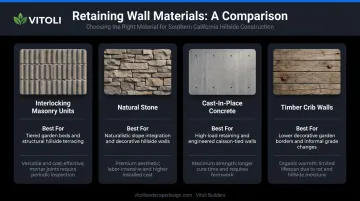
Retaining walls hold back soil and create level planes on a slope. Common materials include:
| Material | Best For | Notes |
|---|---|---|
| Concrete block (masonry) | Classic aesthetic, proven load capacity | Versatile across slope grades |
| Natural stone | Premium appearance, natural integration | Higher material and labor cost |
| Poured-in-place concrete | Maximum strength, steep or heavy-load sites | Monolithic; resists significant lateral pressure |
| Timber | Budget-friendly, naturalistic | Limited lifespan; not ideal for severe grades |
Permit reality: The California Building Code baseline exempts walls not over 4 feet (measured from footing bottom to wall top), but Los Angeles excludes walls supporting sloping earth or walls on slopes steeper than 20% from that exemption. Calabasas has separate design limits. Check your specific jurisdiction before assuming any wall is permit-free.
Drainage is not optional — hydrostatic pressure from saturated backfill can roughly double the lateral force a wall must resist. Vitoli Builders, a Calabasas-based hillside specialist with over 1,800 completed projects across Los Angeles and Ventura Counties, treats gravel backfill, perforated drain lines, and weep systems as standard on every retaining wall for exactly this reason.
Terracing
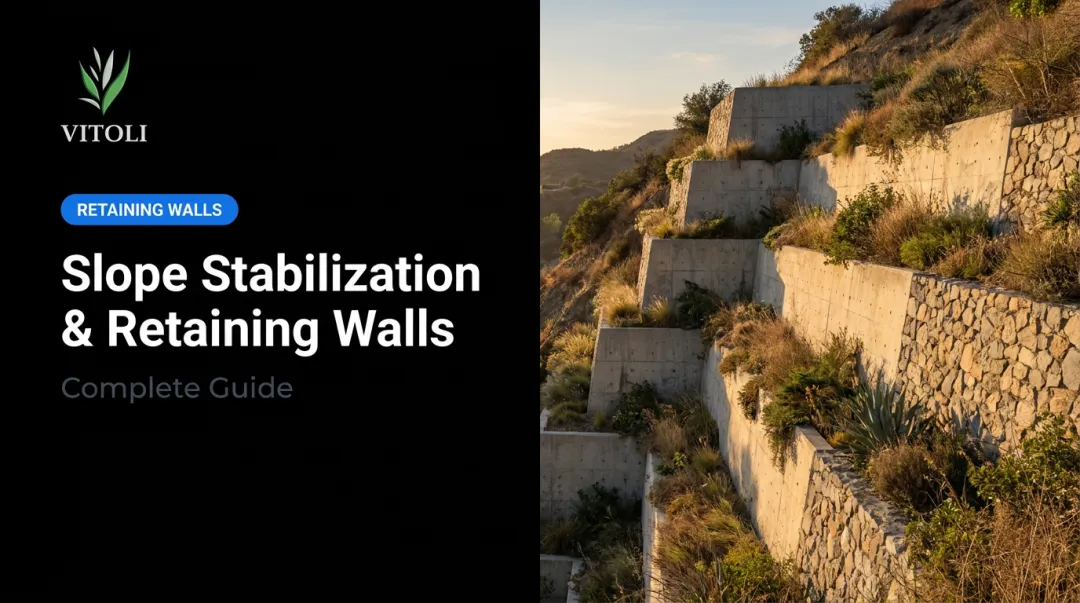
Terracing cuts a slope into a series of flat "steps" separated by retaining walls. Benefits include:
- Expanding usable surface area on otherwise unusable terrain
- Slowing runoff velocity and encouraging water infiltration
- Creating planting zones at multiple elevation levels
This is not a simple DIY raised bed project. Steep hillside terracing requires engineering, proper drainage behind each wall, and careful sequencing to avoid destabilizing the slope during construction.
Caissons: When Standard Walls Aren't Enough
On very steep or geologically unstable hillsides, conventional retaining walls may be insufficient. Caissons — drilled concrete piers reinforced with steel — transfer structural loads down to stable soil or bedrock below the unstable surface layer. They're commonly specified where slope movement, weak near-surface soils, or significant lateral loads make standard footings inadequate. For any of these conditions, a geotechnical engineer determines the need, depth, and diameter on a site-specific basis.
Lighter Stabilization for Mild Grades
For slopes under 10–15%, more approachable options include:
- Ground-anchored boulders and rock arrangements
- Landscape fabric under coarse mulch
- Deep-rooted groundcovers planted densely to anchor surface soil
These approaches work well on gentle grades. Once a slope exceeds 25%, they need to be paired with — or replaced by — engineered structural solutions like those described above. Access across those steeper grades is a separate but related challenge.
Stairways and Pathways
A well-designed stair system does more than provide access — it reduces surface runoff by intercepting sheet flow and directing it laterally. Stone slab staircases suit formal designs; compacted gravel or stepping stones work for more naturalistic settings. Switchback paths reduce the effective grade for gentler walking and help manage water velocity on longer slopes.
Hillside Landscaping Ideas to Transform Your Slope
Terraced Garden Beds and Planting Levels
Multi-level terraced beds create a layered visual effect that mirrors iconic hillside gardens while putting previously unusable soil to work. A practical approach:
- Upper tiers (drier, more exposed): ornamental borders, drought-tolerant groundcovers
- Mid-level tiers: structural shrubs, natives, seasonal color
- Lower, more accessible tiers: herbs, vegetables, or high-maintenance plants you'll tend regularly
For a contemporary look, choose clean parallel walls in concrete or cut stone. For a naturalistic feel, organic curved edges in timber or stacked fieldstone soften the geometry. The right choice depends on your home's exterior architecture — forcing a modern wall system against a rustic craftsman house will look wrong regardless of how well it's built.
Outdoor Living and Entertainment Zones
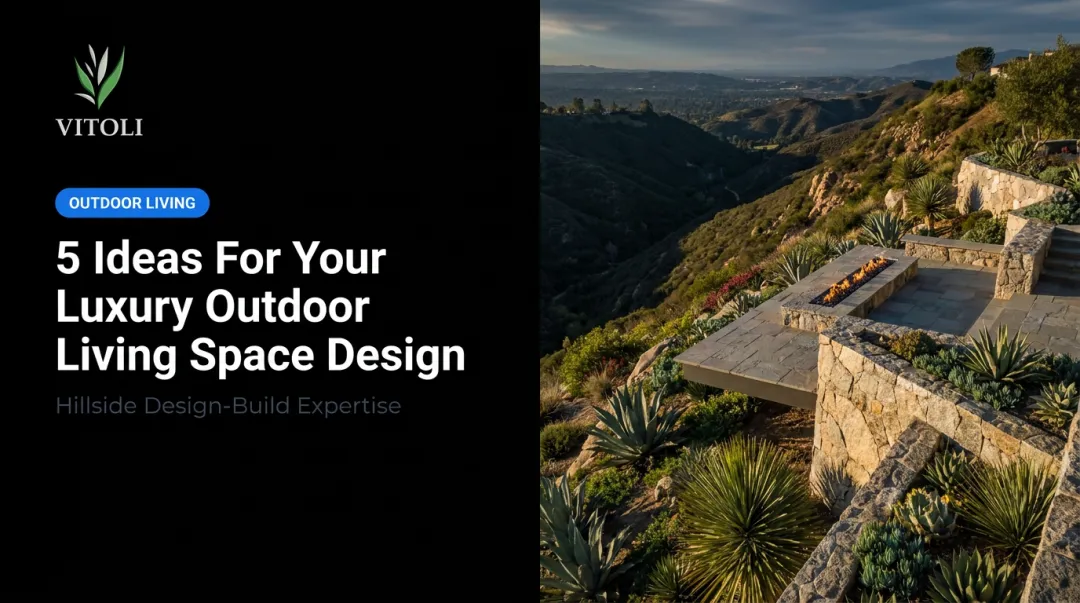
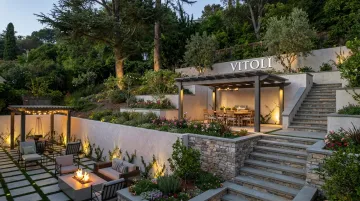
Terracing's highest-value application isn't gardening — it's carving out flat outdoor living platforms at different elevations. Each level can serve a distinct purpose:
- Upper terrace: lounge zone with hill views
- Mid-level: dining area or fire pit gathering space
- Lower level: pool or garden access
The NAR 2023 Remodeling Impact Report puts cost recovery at 95% for new patios and 100% for outdoor kitchens — and terraced hillside outdoor spaces often add value beyond what flat-yard additions can, because they transform a perceived liability into a genuine asset.
Design elements that elevate these spaces:
- Built-in bench seating along retaining wall faces
- Pergolas with string lighting anchored into terraced levels
- Consistent hardscape materials (pavers, concrete, wood decking) that visually connect different elevations
Vitoli Builders' hillside projects commonly feature stone-and-concrete patios, modern fire pits with decorative surrounds, and pergola-covered dining areas — all sitting on engineered terraced platforms with integrated drainage below the surface.
Pathways, Steps, and Water Features
A well-designed stair system defines the character of a hillside landscape. The right style depends on grade and aesthetic:
- Wide stone slab staircases suit formal entries and shorter runs
- Switchback paths handle longer grades without steep climbs
- Step lighting recessed into risers improves nighttime safety and visual appeal
The natural elevation change also makes sloped yards ideal for gravity-fed water features. Cascading waterfalls, rill channels, and tiered fountains follow the slope downward naturally. Coordinated with drainage infrastructure, they serve a dual purpose — directing water away from structures while adding movement and sound to the design.
Best Plants for a Sloped Yard in Southern California
Plant selection on a slope starts with one principle: root system depth and spread matter more than appearance. Shallow-rooted annuals on an exposed slope will wash away. Deep-rooted perennials, native shrubs, and spreading groundcovers anchor the soil between rain events.
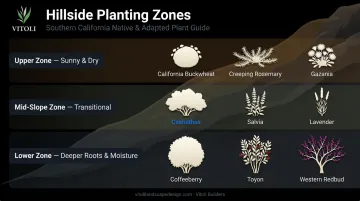
Plant Recommendations by Zone
Upper slopes (drier, more exposed):
- California buckwheat (Eriogonum fasciculatum) — tough, drought-tolerant, thrives in well-drained sunny sites
- Creeping rosemary — low-maintenance once established, covers hillsides effectively
- Gazania — handles dry, sandy exposures well
Mid-slope (structural anchoring):
- Ceanothus 'Yankee Point' — widely used as large-scale groundcover, stabilizes slopes once established
- Salvia / creeping sages — excellent slope-holding plants; allow establishment water before transitioning to low irrigation
- Lavender — drought-tolerant once established, deer-resistant
Lower zones (deeper roots, more moisture):
- Coffeeberry (Frangula californica) — accepted for bank stabilization, takes low water once established
- Toyon (Heteromeles arbutifolia) — California native, grows in sun or part shade, supports local wildlife
- Western redbud (Cercis occidentalis) — deep-rooted native tree, tolerates dry slopes, provides seasonal color
Fire-Resistant Planting
CAL FIRE Zone 1 (0–30 feet from structures) requires "Lean, Clean and Green" management. Key requirements include:
- Remove dead and dry vegetation regularly, especially before fire season
- Maintain clear spacing between plants rather than allowing continuous cover
- Keep slope plantings actively maintained during drought periods
Near-home erosion control must also be fire-conscious. Dense, unmaintained cover close to structures is not a safe strategy even if it controls erosion. Species like ceanothus, buckwheat, and sages align with both erosion control and fire-wise planting goals.
Mulch on Slopes
A 2–3 inch layer of coarse wood chip mulch slows runoff, retains moisture, and suppresses weeds. In Zone 1 fire areas, UC guidance limits mulch depth to 2 inches. On steep grades, mulch alone washes away without anchoring plants or erosion fabric beneath it — use it to support an established plant and fabric system, not to replace one.
Drainage and Erosion Control on a Hillside
Drainage is where most hillside landscaping problems start — and where the costliest failures happen. Retaining wall collapse, foundation damage, and soil loss trace back to water in almost every case.
Why Water Management Can't Be Improvised
Caltrans documents that saturated backfill can impose roughly twice the lateral pressure of water-free soil on a retaining wall. If drainage behind a wall cannot be relied upon, the wall must be engineered for full hydrostatic load — or it will eventually fail. This is why Vitoli Builders treats drainage integration as non-negotiable on every retaining wall project, regardless of wall material or height.
Active Drainage Systems
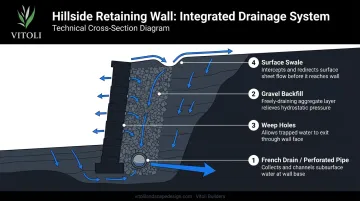
Water on a hillside must be actively directed, not left to find its own path. Core systems include:
- French drains and perforated pipe behind retaining walls to capture and redirect water before it accumulates
- Gravel backfill placed directly behind walls for free percolation without soil migration
- Weep holes as pressure-relief points — skipping them on taller walls is one of the most common and costly omissions
- Surface swales to intercept and redirect sheet flow across the slope
Erosion Control During Construction
Bare soil on a hillside during construction poses a serious erosion risk, particularly if rain arrives before planting is complete. Phased construction, temporary erosion control blankets, and silt fencing help manage this exposure.
California's Construction Stormwater General Permit requires regulated sites to implement approved stormwater controls. On larger projects, that means a formal Stormwater Pollution Prevention Plan.
Hillside Landscaping Cost Considerations
Hillside landscaping costs vary more than almost any other residential project category. Slope severity, soil conditions, permit requirements, site access, and structural engineering all compound in ways flat-yard work never faces — and in Southern California, local factors push those numbers higher still.
Benchmark Ranges (National Context)
HomeAdvisor's 2026 data puts average retaining wall installation at $6,065, with a typical range of $3,193–$9,182. These are national residential figures. Southern California hillside projects routinely exceed these figures — the section below explains why.
What Drives Costs Higher in SoCal
- Permit fees — grading permits, retaining wall permits, and geotechnical reviews all add cost; Angi reports most homeowners spend around $2,700 for a geotechnical report, with ranges from $150–$5,400
- Caisson requirements — deep foundation work on unstable terrain is specialized and material-intensive
- Site access — equipment access on steep or constrained hillside lots often requires specialized machinery or increases labor time significantly
- Engineering requirements — geotechnical reports, structural engineer stamps, and seismic considerations are common on LA County and Ventura County hillside projects
- Fire-hardening plant choices — CAL FIRE-compliant species sometimes carry higher material costs
The Cost Efficiency Argument
These SoCal-specific costs have a counterpart worth understanding: the cost of not investing properly. Retaining wall failure, soil erosion, and foundation damage from poorly managed hillside water routinely cost far more to repair than engineered prevention would have. On a hillside, the savings from cutting corners tend to arrive as repair bills.
Frequently Asked Questions
What is a terraced hill?
A terraced hill is a slope reshaped into a series of flat, level platforms — like wide steps — separated by retaining walls or embankments. This allows the land to be used for planting, outdoor living, or other purposes while controlling erosion and slowing runoff.
How do I stop erosion on a steep hillside?
Erosion control works in layers:
- Deep-rooted plants and groundcovers anchor surface soil
- Engineered retaining walls hold back earth on steep grades
- Drainage systems (French drains, weep holes) redirect water
- Mulch protects bare soil between plants
Severe slopes require professional engineering — planting alone is insufficient.
What plants work best for a sloped yard in Southern California?
Deep-rooted, drought-tolerant, and fire-resistant natives perform best: ceanothus, California buckwheat, creeping rosemary, coffeeberry, salvia, and toyon. These species stabilize soil, require minimal irrigation once established, and support local wildlife.
Do I need a permit for a retaining wall in California?
In most California jurisdictions, the baseline exemption covers walls 4 feet or under (measured from footing to top), but Los Angeles excludes walls on slopes steeper than 20% from that exemption. Calabasas and Ventura County have their own specific thresholds. Always check with your local building department before starting.
How much does hillside landscaping cost?
Costs depend on slope severity, materials, drainage complexity, and required engineering. National benchmarks for retaining walls start at $3,000–$9,000+, but Southern California hillside projects routinely exceed those figures once permitting, site access, and caisson requirements are factored in. Get multiple qualified bids.
Should I DIY hillside landscaping or hire a professional?
Gentle slopes with simple planting and mulching can be DIY-friendly. Moderate-to-steep grades involving retaining walls, terracing, drainage systems, or structural work require a licensed contractor — ideally one with specific hillside experience — to ensure safety, code compliance, and results that last.