Why Soil Erosion Is a Serious Threat for Hillside Homeowners
Soil erosion occurs when water runoff and wind dislodge topsoil, weaken ground stability, and — on steep grades — can trigger slope failure. Water erosion is particularly destructive: rainfall impact loosens soil particles, and runoff carries them downhill. Wind erosion removes dry, unprotected topsoil during the hot summer months.
Southern California hillside properties face a punishing seasonal cycle. Dry summers leave slopes bare and poorly aggregated. When winter rains arrive, often as intense, concentrated events, water hits unprotected ground and accelerates rapidly down steep grades. According to USGS research on Southern California landslides, as little as 5–6 mm of rain in a single hour can trigger slope failures after winter rainfall has already saturated the ground.
For hillside homeowners in Los Angeles County and Ventura County, that seasonal pattern repeats every year. Proactive erosion control isn't optional — the terrain demands it.
Key Takeaways
- Deep-rooted native vegetation provides lasting, low-maintenance erosion control on slopes.
- Mulch and erosion control blankets protect bare soil during the critical plant establishment phase.
- Retaining walls and terracing are necessary on steep grades where plants alone can't stabilize the slope.
- Proper drainage systems prevent concentrated runoff — the leading cause of serious erosion damage.
Ways 1 & 2: Establish Vegetation and Ground Cover on Slopes
Plant Deep-Rooted Native Species
Plant roots act as a natural anchor system: they bind soil particles together, absorbing excess water, and reinforcing the slope against shallow movement. Not all vegetation performs equally here. Shallow-rooted turf grass provides minimal protection against slope failure, while deep-rooted woody shrubs offer significantly greater mass-movement resistance through root reinforcement and soil-water uptake.
USDA-NRCS bioengineering research confirms that brushlayering — a technique using live woody cuttings — can improve slope stability to 4–5 feet deep, compared to herbaceous cover (grasses and low plants), which protects only the soil surface.
For Southern California slopes, the California Native Plant Society recommends several high-performing native options:
- Eriogonum fasciculatum (California buckwheat) — deep-rooted, drought-tolerant, thrives on hot, sunny slopes
- Baccharis pilularis 'Pigeon Point' — stays under 18 inches tall, spreads over 6 feet wide, excellent slope holder
- Ceanothus 'Centennial' — tough, low-maintenance groundcover suited to slopes
- Native bunch grasses — effective at surface erosion control with good root architecture
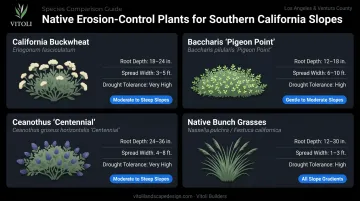
California's Model Water Efficient Landscape Ordinance (MWELO) restricts turf on slopes exceeding 25% grade (4:1). On steeper grades, low-growing non-grass groundcover is both more effective and code-compliant.
Build a Dense Ground Cover Layer
Low-growing, spreading plants fill the gaps between larger shrubs and prevent raindrops from making direct contact with bare soil — sharply cutting "splash erosion," where impact alone dislodges surface particles.
The most effective approach combines two layers:
- Woody shrubs intercept rainfall at mid-height, slowing its velocity before it reaches the ground
- Dense groundcover below (such as native sedges or spreading sages) shields the soil surface
- Mulch between plants fills any remaining gaps during the establishment period, buying time while roots develop
Together, these layers ensure water loses most of its erosive energy well before it reaches exposed soil.
Ways 3 & 4: Mulch and Erosion Control Blankets
Mulch is one of the simplest and most immediate erosion control tools available. A 2–3 inch layer of shredded wood chips or straw — per Caltrans erosion control specifications — cushions raindrop impact, slows water runoff, and retains soil moisture to support plant establishment.
On steeper slopes, UC ANR Master Gardener guidance recommends going deeper: up to 4–6 inches to compensate for the faster runoff that steep grades create.
Mulch works well on moderate slopes, but steeper or freshly graded terrain is a different problem — loose material simply slides off before plants can anchor it. That's where erosion control blankets (also called geotextile mats) come in. Caltrans specifies their use on slopes steeper than 1:3 (vertical to horizontal), in high-erosion-potential areas, and on sites where vegetation establishes slowly.
A few practical points:
- Straw mulch typically provides temporary protection for 6–12 months — enough time for plants to root in and take over erosion control duties
- Reapplication threshold: once 10% or more of a treated area becomes exposed, temporary stabilization should be refreshed
- Both mulch and blankets work best in combination with vegetation — they are establishment tools, not permanent solutions
Way 5: Build Retaining Walls and Terraces
How Retaining Structures Reduce Erosion
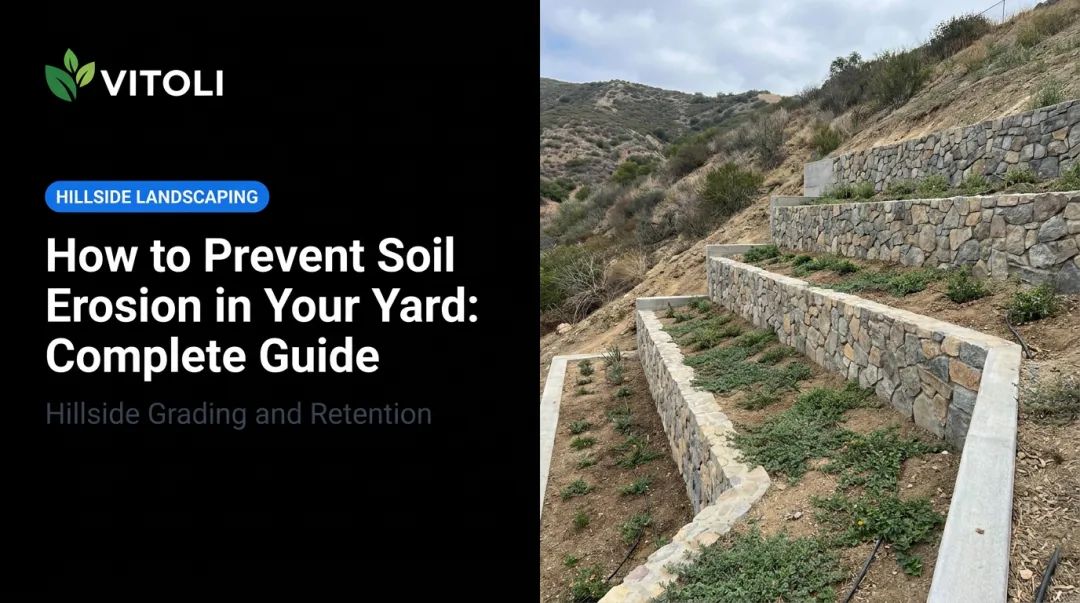
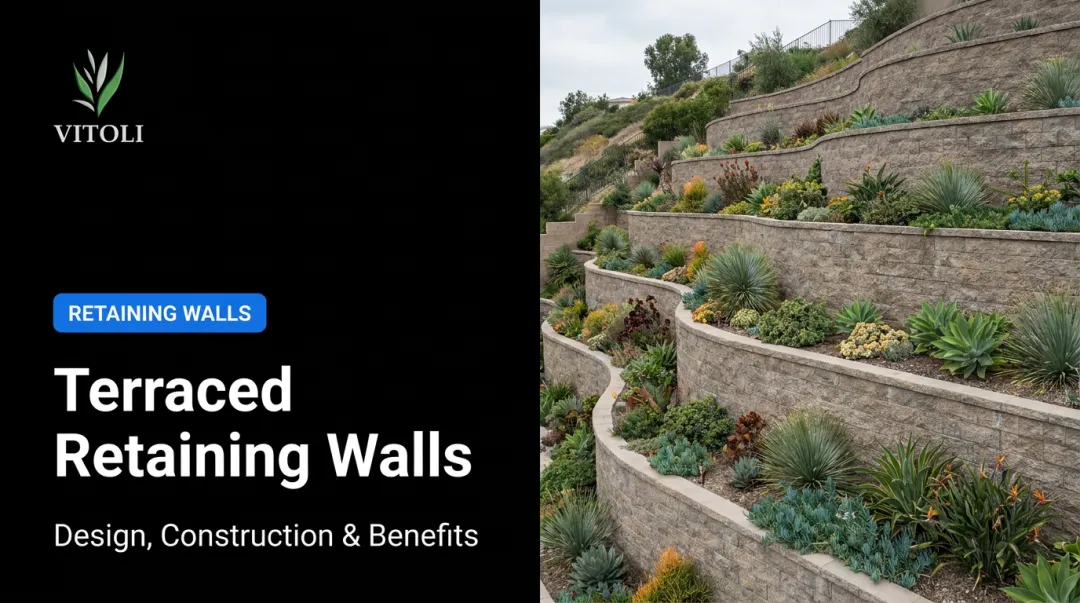
Retaining walls and terraces interrupt the length and steepness of a slope, breaking one long, steep grade into a series of shorter, flatter sections. This dramatically reduces runoff velocity and the energy available to dislodge and carry soil.
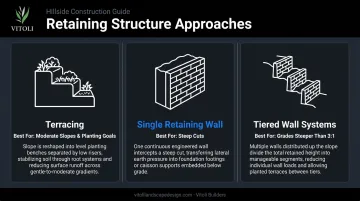
Two distinct approaches serve different conditions:
| Approach | Best For | How It Works |
|---|---|---|
| Terracing | Moderately steep slopes with planting goals | Creates level platforms cut into the hillside, often bordered by low walls |
| Single retaining wall | Steep cuts where soil mass needs to be held back | A structural barrier that resists lateral earth pressure |
| Tiered wall systems | Grades steeper than 3:1 | Multiple walls working together to manage large elevation changes |
Permits, Engineering, and Drainage
Under the 2022 California Building Code, retaining walls over 4 feet (measured from bottom of footing to top of wall) require a building permit. LA County and Ventura County follow the same general threshold, with additional requirements triggered by surcharge loads or special site conditions.
For walls on steep hillside grades, engineering is not optional. UC ANR Marin Master Gardeners guidance states that retaining walls over 4 feet or cut-and-fill work over 18 inches must be designed by a licensed engineer.
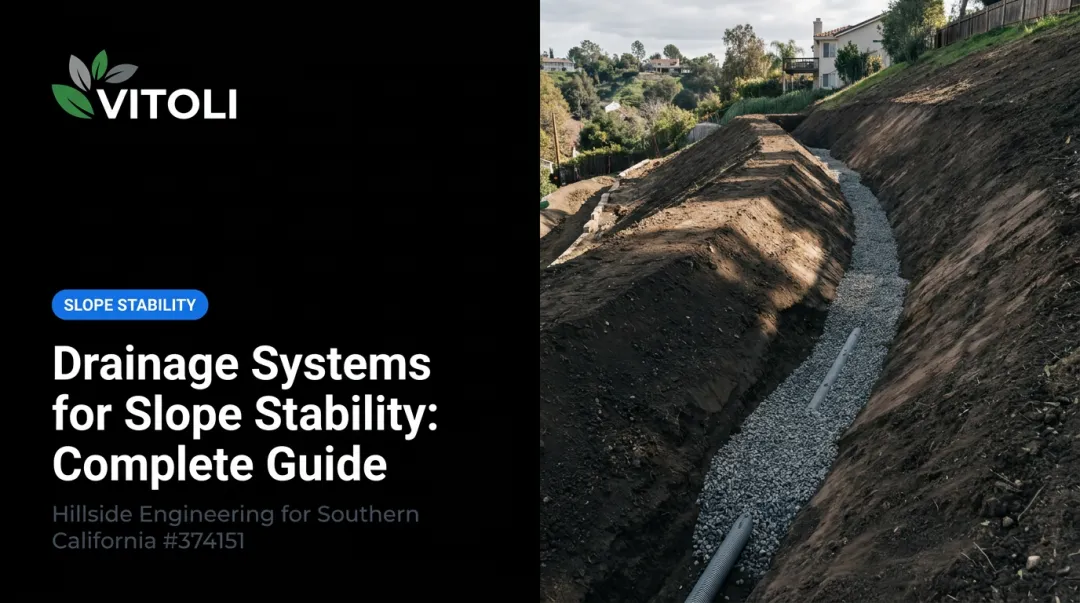
Drainage behind the wall is equally critical. Hydrostatic pressure — water accumulating in the soil behind a wall with no escape path — is one of the leading causes of retaining wall failure. The proper solution integrates three components:
- Gravel backfill to allow water to percolate rather than build up
- Perforated drain lines to actively redirect water away from the structure
- Weep systems built into the wall face to relieve residual pressure
Getting this drainage right is where many DIY and non-specialist builds fall short. A wall that looks solid at installation can crack, lean, or collapse years later if drainage wasn't designed in from the start — making it one of the most costly oversights in hillside construction.
For hillside homeowners in Los Angeles and Ventura Counties navigating complex grades, Vitoli Builders brings over 20 years of specialized experience in engineered retaining wall systems, tiered terracing, caisson-supported structures, and integrated drainage — all built to meet local code requirements on Southern California's demanding terrain.
Way 6: Manage Water Flow with Smart Drainage Systems
Protecting bare soil matters less if you're not also controlling where water flows. Concentrated runoff is the primary driver of rill and gully erosion — once water gains speed in a channel, it scours the streambed exponentially faster.
Subsurface and Surface Drainage Tools
French drains (perforated pipes set in gravel-filled trenches) intercept subsurface water moving through a slope and channel it away before it saturates the soil and triggers deeper erosion or landslides. USDA-NRCS residential drainage guidance recommends 4-inch perforated PVC or polyethylene pipe installed at a minimum 2% slope with cleanouts at bends.
Check dams offer a lower-cost option for narrow swales or channels. A series of stacked stones or coir fiber logs placed across a flow path slows water velocity, allows sediment to settle, and reduces scouring.
Other drainage tools to consider:
- Swales — shallow, vegetated channels that route runoff laterally across a slope rather than straight down
- Rain gardens — shallow depressions that capture roof and hardscape runoff, allowing it to infiltrate slowly
- Downspout extensions — redirect roof runoff away from hillside edges, where it would otherwise concentrate and carve channels
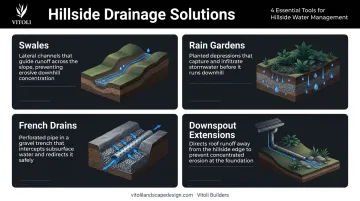
A downspout discharging at the top of a hillside adds a concentrated, recurring water source directly to your most vulnerable soil. USDA-NRCS notes that if the slope from a downspout to a rain garden exceeds 8%, a rock-lined channel or PVC pipe is needed to move water safely without causing erosion.
Way 7: Practice Contour Planting and Slope-Smart Design
Contour planting places plants, paths, or physical barriers in horizontal rows that follow the natural elevation lines of a slope — rather than running straight up and down. This creates a series of living barriers that slow the lateral movement of water across the hillside.
USDA-NRCS conservation standards confirm that increasing ground roughness and cover along the contour decreases overland flow velocity and increases water infiltration, giving rain more time to soak in rather than run off.
Dense, contoured planting rows act like living terraces, breaking the slope into smaller segments and slowing water at multiple points before it gains erosive speed. UC ANR Marin Master Gardeners also recommends staggered plant placement and slope-following pathways to manage drainage on steep hillsides.
Planting layout is only part of the picture. Site management decisions matter just as much:
- Minimize bare-soil disturbance — every exposed patch is a potential erosion point
- Time grading work before the rainy season: LA County requires erosion BMPs installed by October 15; Ventura County defines its wet season as October 1 through April 15
- Cover exposed soil immediately with mulch or erosion blankets after any construction or planting activity — even a week of unprotected ground before a rain event can cause serious erosion damage
Frequently Asked Questions
What causes soil erosion on hillside properties?
Rainfall impact, runoff velocity, wind, and exposed bare soil on steep grades all work together to dislodge and transport soil particles. Hillside properties are especially vulnerable: the slope angle funnels water into fast-moving flow paths that carry far more erosive energy than flat terrain.
What plants are best for preventing soil erosion on slopes in Southern California?
Deep-rooted native species adapted to the dry Southern California climate perform best. California buckwheat, native bunch grasses, coyote brush (Baccharis pilularis), and spreading Ceanothus varieties all tolerate drought well, require minimal upkeep, and develop strong root systems that hold slope soil in place.
How do retaining walls help prevent soil erosion?
Retaining walls reduce slope length and steepness while holding back soil mass on steep cuts. Proper drainage backfill — gravel and perforated drain pipes — is essential to prevent hydrostatic pressure from building up and destabilizing the hillside over time.
Can mulching alone stop soil erosion on a steep slope?
Mulch is effective as a temporary protective layer, but it needs to be combined with deep-rooted vegetation. On steeper grades, structural solutions like retaining walls or erosion control blankets are also required for long-term results — mulch alone will not hold.
When should I hire a professional for erosion control on my property?
Consult a licensed hillside contractor when slopes exceed a 3:1 grade or retaining walls over 4 feet are needed. Visible gullying, soil displacement, or slope instability also warrant professional involvement — these conditions require engineering assessments, permits, and proper construction.
Does soil erosion get worse during California's rainy season?
Yes. Dry summers leave soil bare and poorly bonded, making it highly vulnerable when intense winter rains arrive. Pre-season preparation is the best defense: establish vegetation, apply mulch, and install drainage before October to protect hillside properties ahead of the wet season.