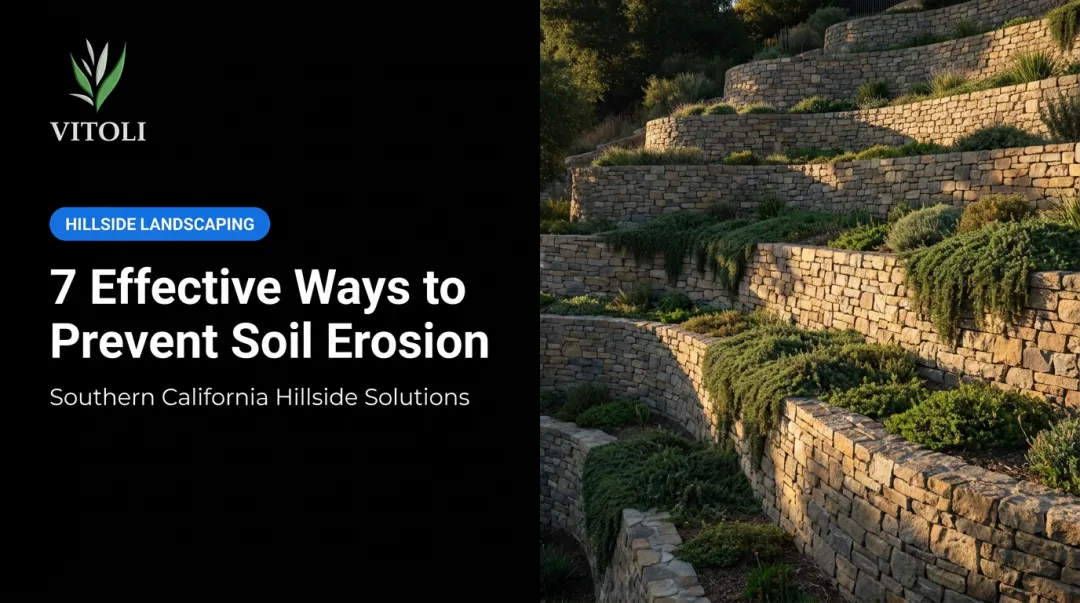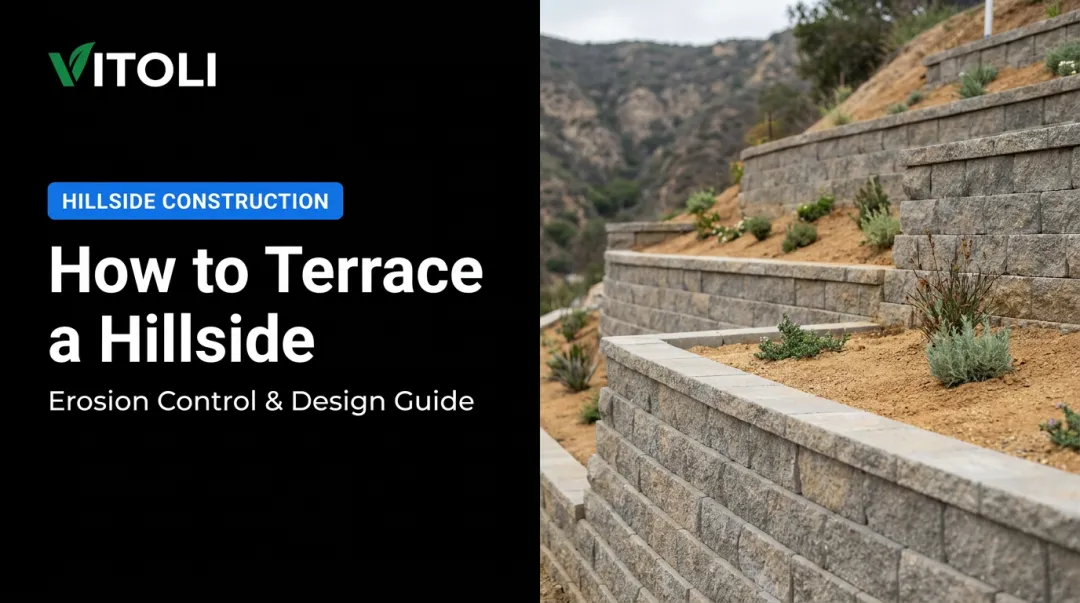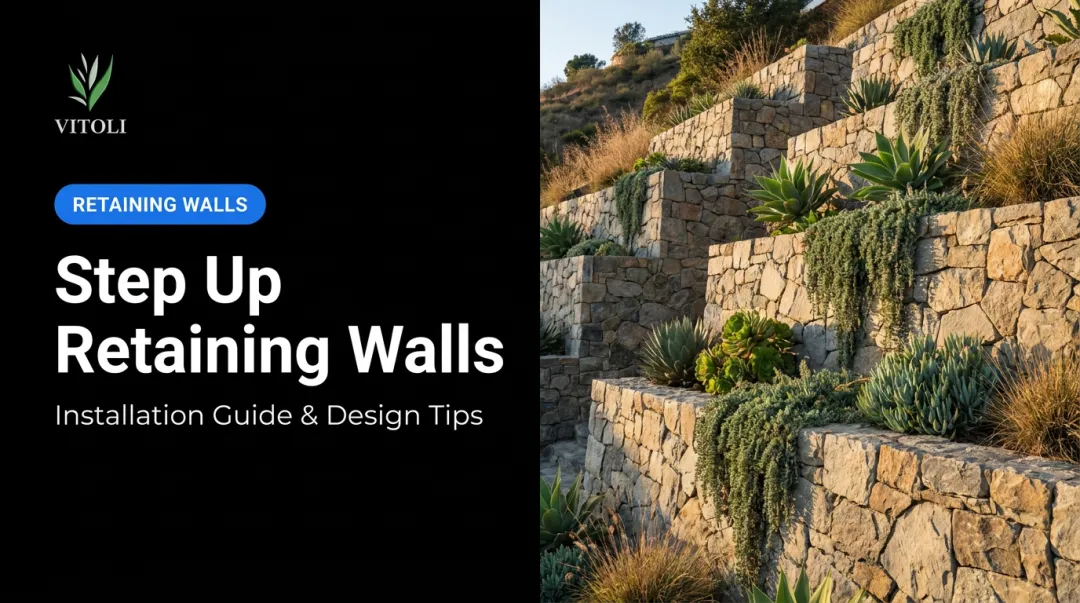
Terraced retaining walls are one of the most effective solutions. Instead of fighting the hillside with a single massive wall, terracing works with the grade, creating usable platforms while distributing soil loads across multiple shorter structures.
This guide covers what terraced retaining walls are, how they're designed and built, what they cost, and when the project clearly needs a specialist rather than a general landscaper.
Key Takeaways
- Terraced systems use multiple shorter walls to manage steep slopes more safely than one tall wall
- Space tiers at least twice the height of the lower wall — this is the baseline rule for structural stability
- Poor drainage is the leading cause of retaining wall failure; hydrostatic pressure will compromise even well-built walls
- Choose materials that balance structural performance with long-term appearance for your specific site
- Walls over 4 feet tall, multiple tiers, or surcharge loads require engineering review and permits in most California jurisdictions
What Is a Terraced Retaining Wall?
A terraced retaining wall system is a series of two or more shorter walls built at stepped intervals up a slope. Each wall holds back a portion of the grade. Between each pair of walls sits a flat, usable platform — the terrace itself.
The distinction matters: the retaining wall is the structural element holding soil in place. The terrace is the level ground created between two walls. Together, they form the system.
Terraced Walls vs. a Single Tall Wall
A single tall retaining wall on a steep hillside runs into a fundamental structural problem: lateral soil pressure doesn't scale linearly with height. Based on Rankine earth-pressure theory (a standard soil mechanics model), the active force acting on a wall is proportional to the square of its height.
That means a 12-foot wall faces roughly nine times the lateral force of a 4-foot wall — not three times. The result is deeper footings, heavier reinforcement, and a much more complex engineering scope.
Splitting that same 12-foot grade change into three 4-foot walls does several things at once:
- Reduces the lateral load on any single structure
- Eliminates the need for extreme footing depth on a single tall wall
- Creates planting, patio, or living zones between each tier
- Reduces the visual mass of the overall installation
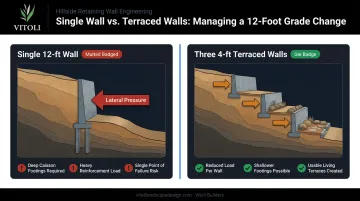
The structural and aesthetic advantages point in the same direction. That said, terracing introduces its own design requirements — spacing, drainage, and load distribution across tiers — each of which the following sections cover in detail.
Terraced Retaining Wall Design Principles
The biggest design mistake in terraced systems isn't wall height — it's wall placement. When two walls are built too close together, the soil load from the upper wall transfers pressure onto the lower wall. At that point, the two walls can no longer be treated as independent structures. They have to be analyzed as a combined system, which typically requires a licensed engineer and changes the entire design approach.
The Spacing Rule for Tier Independence
The widely referenced guideline from established retaining wall technical guides is that walls generally behave independently when the horizontal distance between them is at least twice the height of the lower wall. For example, if the lower wall is 4 feet tall, the upper wall should be set back at least 8 feet horizontally.
You may also see references to a "1:3 rule" in various landscaping contexts. That framing — 1 foot of setback for every 3 feet of wall height — is not drawn from California Building Code or verified engineering standards. Treat it as an informal rule of thumb, not a design standard, and confirm any spacing design with a structural engineer before breaking ground.
When walls are closer than the recommended spacing, the system must be designed as a single integrated structure. That's not automatically a problem, but it does mean the engineering workload increases significantly.
When Engineering and Permits Are Required
Under 2022 California Building Code Section 105.2, retaining walls over 4 feet (measured from the bottom of the footing to the top of the wall) generally require a permit — as do walls supporting a surcharge load regardless of height.
Local rules add further complexity:
| Jurisdiction | Permit Threshold | Notes |
|---|---|---|
| LA County (unincorporated) | Over 4 ft | Mirrors CBC; surcharge triggers permit at any height |
| City of Ventura | 3 ft or taller | Engineer required for walls over 5 ft or surcharge loads |
| LA County (engineered walls) | Walls over 12 ft or slopes steeper than 2:1 | Require referral to GMED |
Always verify with the specific local building department before starting. Hillside overlay zones in LA and Ventura Counties may impose additional height controls and design-review requirements beyond the base CBC thresholds.
Southern California Design Considerations
Three site-specific factors make hillside retaining wall design in SoCal more demanding than most of the country:
- Expansive clay soils — Clay minerals swell when wet and shrink when dry, creating cyclic pressure cycles against wall faces. Existing walls not designed with this in mind can fail gradually without visible warning signs.
- Seismic loading — LA County's retaining wall design manual requires dynamic seismic lateral earth pressure analysis for walls supporting more than 6 feet of backfill. This is not optional on hillside residential projects.
- Wet winter / dry summer cycle — Seasonal rainfall creates significant hydrostatic pressure buildups in winter, then shrinkage stress in dry months. Both phases stress wall and drainage systems.
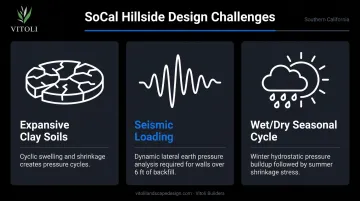
Each of these factors requires site-specific analysis before any wall design is finalized. Vitoli Builders works exclusively on LA and Ventura County hillside projects, where soil conditions, seismic exposure, and drainage patterns are evaluated on every site before design begins.
Materials and Construction
Terraced retaining wall construction covers two interdependent decisions: which materials to use for each tier and how drainage is engineered across the full system. Both choices determine whether the walls perform for decades or fail within years. Each tier must be completed and stabilized before the next begins, because skipping that sequence creates instability at every level above.
Material Options
Concrete block (segmental retaining wall units) is one of the most common choices for terraced systems. Modular units are consistent in dimension, cost-effective, and well-suited to both straight and curved alignments. They also accommodate geogrid reinforcement cleanly — often necessary for taller tiers. ASTM C1372 sets a minimum 3,000 psi compressive strength for SRW units, a baseline worth confirming on any engineered project.
Natural stone offers genuine aesthetic appeal and longevity, and it works particularly well on lower, garden-facing tiers where appearance carries more weight than raw structural performance. Dry-laid or mortar-set stone can be beautiful and durable within appropriate height ranges, but it's heavier, more labor-intensive, and not well-suited to the tallest tiers in a multi-wall system.
Poured concrete and concrete block with veneer is the strongest option for taller or load-bearing tiers. Poured concrete can be finished with stone or stucco veneer to balance structural performance with visual compatibility, a common approach in SoCal hillside construction where both engineering and aesthetics matter.
Vitoli Builders selects materials based on site-specific evaluation rather than a default preference, matching the structural demands of each tier with the right system.
Drainage: The Most Critical Element
According to the Federal Highway Administration, unimpeded water flow through or around a retaining wall is the cardinal rule for preventing hydrostatic pressure buildup. Without it, water accumulates behind the wall face and the structural consequences are predictable.
A properly drained terraced system includes:
- Compacted gravel backfill directly behind each wall face, allowing water to percolate rather than accumulate
- Perforated drain pipe (French drain) at the base of each tier, sloped to daylight at the wall face or connect to a storm drain
- Weep holes in the wall face to relieve any residual pressure buildup
In multi-tier systems, each tier needs its own independent drainage layer. Drainage from the upper tier must be captured and directed before it can saturate the soil behind the lower wall. A single shared drain path is not adequate — upper-tier runoff reaching the lower wall's backfill zone is a direct path to structural failure.
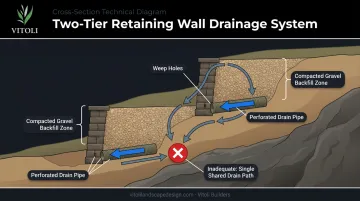
Vitoli's standard practice integrates gravel backfill, perforated drain lines, and weep systems into every wall, with drainage designed specifically for each site's soil type, slope, and seasonal water behavior.
Benefits of Terraced Retaining Walls for Hillside Properties
Erosion and Slope Stability
Unprotected hillside soil in Southern California is highly vulnerable during heavy rain events. Terracing slows runoff velocity across each level and keeps soil anchored, dramatically reducing erosion risk. The USDA NRCS Conservation Practice Standard for terracing (Code 600) recognizes terraces specifically as an erosion-control mechanism by intercepting runoff on sloping land.
Usable Outdoor Space
Every terrace between walls becomes a functional platform. Depending on width and layout, these zones work as:
- Patios and outdoor seating areas
- Outdoor kitchens or fire pit terraces
- Garden beds and planting zones
- Lawn areas or play spaces
- Pool decks integrated into the hillside
For hillside properties where the lot feels unusable, terracing can reclaim significant square footage — adding livable outdoor area without adding to the building footprint.
That functional gain also translates directly to curb appeal and market value.
Aesthetics and Property Value
Well-designed terraced walls add visual structure to a hillside lot and open up layered planting opportunities that flat lots simply can't offer. The 2023 NAR/NALP Remodeling Impact Report on outdoor features confirms that professionally executed outdoor improvements consistently increase perceived and appraised home value. The specific impact depends on design quality, permitting status, and site condition.
How Much Do Terraced Retaining Walls Cost?
National data from Angi (2026) puts typical retaining wall project costs at $3,193 to $9,182, with an average around $6,065. These are national figures. Southern California hillside projects typically run higher due to several compounding factors:
- Challenging site access and steep grading requirements
- Expansive soil conditions requiring additional footing depth
- Seismic design requirements on walls supporting significant backfill
- Engineering drawings, geotechnical reports, and permit fees
- Labor costs in the LA/Ventura market
The primary cost drivers for any terraced system:
- Total linear footage and number of tiers
- Wall height per tier and material selected
- Drainage system complexity
- Whether engineering stamps and permits are required
- Site accessibility for equipment
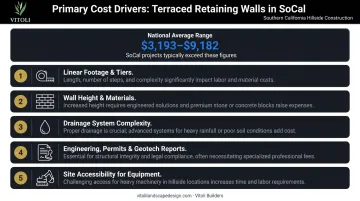
Cutting corners on footings, drainage, or tier spacing is a costly mistake. Wall movement, slope failure, or full collapse are real outcomes — and remediation routinely costs more than the original project. Skipping drainage on a multi-tier system, in particular, can turn a stable wall into a failure point within just a few rainy seasons.
When to Hire a Hillside Specialist
Some retaining wall projects are DIY-friendly. Terraced hillside systems in Southern California are rarely among them.
Call in a specialist when:
- Any wall exceeds 3–4 feet in height
- The project involves multiple tiers on a steep grade
- The site is close to a structure, pool, or property line
- Soil is clay-heavy or expansive
- Geogrid reinforcement is likely needed
- The property sits in a hillside overlay zone with permit requirements
When evaluating contractors, look specifically for:
- Demonstrated experience in hillside construction (not general landscaping)
- In-house or closely partnered engineering capability
- Familiarity with LA and Ventura County permitting processes
- A portfolio of completed terraced wall projects — ask to see comparable work
Vitoli Builders has spent over 20 years focused specifically on this type of work across Southern California, with more than 1,800 hillside projects completed. Their integrated design-build approach covers engineering, drainage design, permitting navigation, and construction under one team — so there's no handoff risk between separate engineers, drainage contractors, and builders. On hillside projects, that kind of fragmentation is where structural problems tend to originate.
Frequently Asked Questions
What is a terraced retaining wall?
A terraced retaining wall is a system of two or more shorter walls built at stepped intervals up a slope, with flat platforms (terraces) created between each wall. This approach manages steep grade changes more safely and attractively than relying on a single tall wall.
What is the difference between a terrace and a retaining wall?
A retaining wall is the structural element that holds soil in place. A terrace is the flat, usable area of land created between two retaining walls. The two elements work together as a system — neither is functional without the other in a terraced design.
What is the 1:3 rule for retaining walls?
The "1:3 rule" refers to 1 foot of horizontal setback for every 3 feet of wall height between tiers. It's an informal rule of thumb, not drawn from California Building Code or verified engineering standards. The more widely supported guideline is the 1:2 rule: spacing of at least twice the lower wall's height.
What is the cheapest option for a retaining wall?
Timber and basic concrete block are typically the most affordable materials upfront. For hillside applications, however, the cheapest initial option rarely holds up long-term once drainage, footing depth, and seismic requirements are factored in.
Do terraced retaining walls need drainage?
Each tier requires its own gravel backfill and perforated drain pipe. Hydrostatic pressure from water buildup behind the wall is one of the leading causes of retaining wall failure, and in Southern California's wet winters this risk is acute. One shared drain path across multiple tiers is not adequate.
Do I need a permit for a terraced retaining wall in California?
Under the 2022 California Building Code, permits are generally required for walls exceeding 4 feet (measured from the bottom of the footing). The City of Ventura applies a stricter 3-foot threshold. Hillside overlay zones in LA and Ventura Counties may impose additional requirements — always confirm with the local building department before starting construction.