Concrete caissons solve this problem by bypassing weak surface soils entirely and transferring structural loads directly to stable ground deep below the surface. Also called drilled piers or drilled shafts, they're the foundation method of choice for challenging hillside terrain across Los Angeles County and Ventura County.
This guide covers what concrete caissons are, why hillside properties depend on them, how they're installed, and what benefits they provide for long-term structural stability.
Key Takeaways
- Concrete caissons are reinforced concrete cylinders drilled deep into the ground to transfer loads to stable soil or bedrock
- They're essential on hillside sites where shallow foundations face sloped terrain, expansive soils, and seismic forces
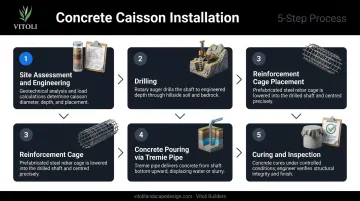
- Installation follows a five-step sequence: site assessment, drilling, rebar cage placement, concrete pouring, and curing
- Depth and diameter are always site-specific—determined by the geotechnical report, not a standard formula
- Caissons resist both vertical settlement and lateral forces, making them significantly more reliable than spread footings on sloped ground
What Are Concrete Caissons?
A concrete caisson is a deep foundation element: a cylindrical column of reinforced concrete drilled into the ground to bypass weak surface soils and carry structural loads down to stronger material below. In residential and hillside construction, the terms drilled pier, drilled shaft, and CIDH pile (cast-in-drilled-hole, per Caltrans) all refer to the same thing.
Instead of spreading a structure's weight across shallow soil—which may be expansive, poorly compacted, or otherwise unreliable—a caisson transfers that load vertically to a bearing layer capable of supporting it without movement or settlement.
The word "caisson" traces back through French to the Latin capsa, meaning a box or case. Early forms appeared in Roman and medieval bridge construction.
Modern drilled concrete caissons evolved across the 19th and 20th centuries. The FHWA's historical record traces U.S. development through James Eads' St. Louis bridge work in 1869, the Brooklyn Bridge in the 1870s, and A.H. Beck's drilled-shaft innovations beginning in 1932.
Drilled Caissons vs. Other Types
The term "caisson" appears in several engineering contexts, which leads homeowners to ask the wrong questions. Here's the distinction that matters:
| Type | How It Works | Used For |
|---|---|---|
| Drilled pier (drilled caisson) | Hole bored, filled with reinforced concrete | Residential, hillside, commercial |
| Open caisson | Bottomless cylinder sunk by internal excavation | Bridge piers, deep manholes |
| Pneumatic caisson | Pressurized chamber used below water table | Major infrastructure |
| Box caisson | Prefabricated, closed bottom | Marine and harbor construction |
For residential hillside work, drilled pier caissons are the relevant type—and the only one discussed in depth here. They require no dewatering, generate minimal vibration compared to driven piles, and can be precisely positioned even on steep or constrained lots.
Why Southern California Hillside Properties Require Concrete Caissons
Local Soil and Slope Hazards
Hillside lots in Los Angeles County and Ventura County present a specific combination of geotechnical challenges. LA County's Manual for Preparation of Geotechnical Reports requires expansive soil evaluation under ASTM D4829 and mandates mitigation when the Expansion Index exceeds 20. It also classifies undocumented fill as "Uncertified Fill—not suitable for support of structures."
Ventura County's requirements are equally clear: the county's Geotechnical Report Requirements acknowledge numerous faults, expansive soils, liquefaction zones, and landslide potential across the region. The consequences of ignoring these hazards are real—USGS documented that the 2005 La Conchita landslide in Ventura County destroyed or seriously damaged 36 houses and killed 10 people.
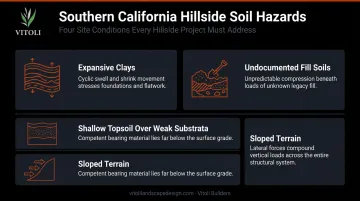
Common conditions that make shallow foundations inadequate on hillside sites:
- Expansive clays that swell when wet and shrink when dry, causing cyclic movement under footings
- Undocumented fill soils from prior grading that compress unpredictably under structural load
- Shallow topsoil over weak substrata, meaning competent bearing material may be many feet down
- Sloped terrain that adds lateral (sideways) forces to foundations—not just vertical ones
Those soil conditions don't exist in isolation — seismic risk compounds every one of them.
Seismic Considerations
CBC 2025 Section 1803.5.11 requires geotechnical investigations for structures in Seismic Design Categories C through F to evaluate slope instability, liquefaction, settlement, and surface displacement. The specific seismic design category for any given hillside site is determined through project-specific analysis—it isn't a blanket classification—but Southern California's fault environment means most hillside projects trigger these requirements.
Caissons anchored to firm bearing material perform better during seismic events than shallow foundations in loose surface soils. They act as embedded columns, resisting the lateral forces that ground shaking generates rather than simply riding along with unstable surface material.
That's precisely why caisson sizing and placement require site-specific expertise. Vitoli Builders has spent over 20 years specializing in hillside construction across Los Angeles County and Ventura County, completing over 1,800 hillside projects. Their in-house team dimensions and positions each caisson to match the site's specific soil profile and slope conditions — not a generic standard.
The Concrete Caisson Installation Process
Every caisson project follows the same essential sequence, though the specific engineering details vary by site.
Step 1: Site Assessment and Engineering
Before any drilling begins, a geotechnical investigation determines soil type, depth to stable bearing material, groundwater conditions, and seismic factors. LA County requires this for all hillside sites and areas of questionable soil stability, and CBC 2025 Section 1803.5.5 mandates geotechnical investigation for deep foundations specifically.
The caisson design — diameter, depth, reinforcement schedule — is engineered from these findings. Three key regulatory requirements apply at this stage:
- California Business and Professions Code Section 6735 requires engineering plans, calculations, and specifications signed and sealed by a licensed civil engineer
- LADBS typically requires a soils and/or geology report before issuing permits for hillside construction
- The structural engineer of record determines final caisson specifications based on the geotechnical findings
Step 2: Drilling
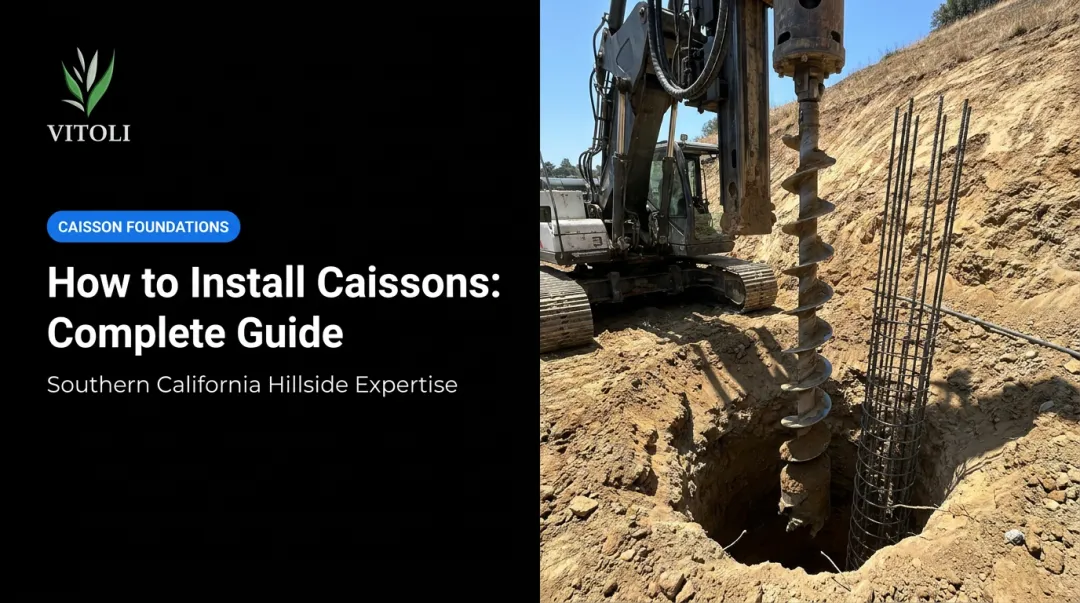
A rotary drill rig bores a cylindrical hole to the engineered depth. Depths vary considerably depending on where stable bearing material is located — depth is determined by the soils report. On hillside sites, equipment must be staged on sloped terrain, which demands specialized rigging and careful positioning to maintain safety and access.
Step 3: Reinforcement Cage Placement
A pre-assembled steel rebar cage is lowered into the drilled hole. This cage allows the caisson to resist both vertical compression loads and lateral (bending) forces from slope loading and seismic events. The cage's diameter and rebar sizing are specified by the structural engineer based on anticipated loads and site conditions.
Step 4: Concrete Pouring
High-strength concrete is placed using a tremie pipe — a watertight pipe that deposits concrete starting from the bottom of the shaft and works upward, preventing air voids and ensuring complete encasement of the rebar cage. Per FHWA's drilled shaft construction guidance, the tremie discharge point remains embedded in fresh concrete throughout wet placement.
Step 5: Curing and Inspection
Concrete requires adequate curing time before load is applied — FHWA references 28-day compressive strength as the standard benchmark. A licensed inspector verifies concrete placement, confirms depth, and signs off that the caisson meets all engineering and code requirements before construction proceeds.
Key Benefits of Concrete Caissons for Hillside Foundations
Load-Bearing Capacity and Settlement Resistance
Because caissons transfer loads to stable bearing material rather than relying on surface soils, they can support substantial structural loads with minimal movement. On hillside sites, differential settlement—where one part of a structure sinks more than another—is a persistent risk. Stable caissons directly counter that.
In practice, that means:
- Level floors and crack-free walls over the life of the structure
- Retaining systems that stay plumb as the hillside shifts with seasons
- Consistent load distribution even as surface soils erode or saturate
Lateral Force Resistance
Spread footings resist vertical loads. Caissons do that and more: they function as embedded columns that resist horizontal forces from both slope loading and seismic events. FHWA's guidance on laterally loaded deep foundations confirms that drilled shafts derive lateral resistance through soil-foundation interaction, with embedment depth and surrounding soil or rock providing the mechanism.
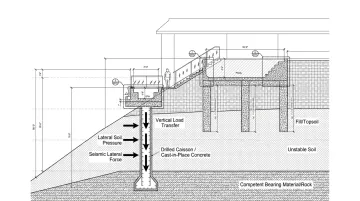
Gravity continuously applies lateral pressure to any foundation element on a slope, and seismic events layer dynamic horizontal forces on top of that. Caissons are engineered specifically to handle both.
Customizability and Long-Term Durability
No two caisson designs are identical. Diameter and depth are calibrated to each site's geotechnical conditions—no overbuilding on straightforward sites, no undersizing on complex ones. When properly designed, installed, and inspected, reinforced concrete caissons are among the most durable foundation elements available, with a service life that matches or outlasts the structure above.
That kind of site-specific precision requires both engineering knowledge and field experience. Working with a hillside specialist like Vitoli Builders, where in-house engineering expertise is paired with hands-on construction knowledge, ensures caissons are optimized for each site rather than templated from a generic design.
Frequently Asked Questions
What is a concrete caisson foundation?
A concrete caisson foundation is a deep foundation element formed by drilling a cylindrical hole, placing a steel reinforcement cage, and filling it with concrete. The resulting column transfers structural loads to stable soil or bedrock far below the surface, bypassing weak material near the top.
What is a concrete caisson foundation used for?
Caissons support structures on unstable, soft, or sloped terrain and resist lateral forces in seismically active regions. Common applications include hillside homes, retaining walls, terraced outdoor spaces, and sloped residential sites where shallow foundations can't reach competent bearing material.
How deep can concrete caisson foundations go?
Depth depends entirely on where stable bearing material is located. Residential caissons commonly range from 10 to 40 feet, though some sites require significantly more — depth is always determined by the project's geotechnical report.
Are concrete caissons required for all hillside homes?
Not necessarily. Whether caissons are required depends on the depth of stable soil, slope severity, seismic design category, and the type of structure. A geotechnical investigation and structural engineering review — both required by the CBC for most hillside projects — will confirm whether caissons are needed for your site.
How long does concrete caisson installation take?
Drilling and pouring typically takes one to several days, depending on the number of caissons, their depth, and site access. Concrete curing adds time before construction can continue, and complex sites with many caissons will extend the schedule further.