Introduction
Southern California hillside properties carry a specific set of risks that flat-terrain homeowners never have to consider. Heavy winter rains follow long dry seasons. Clay-rich soils swell, then shrink. And beneath all of it, seismic activity can shift ground that looked perfectly stable weeks before.
For homeowners in Calabasas, the San Fernando Valley, or anywhere across the Santa Monica Mountains, slope stabilization isn't optional landscaping — it's structural protection. The 1994 Northridge earthquake triggered more than 11,000 landslides across approximately 10,000 km², many of them in residential hillside areas. Many of those slides hit properties that showed no obvious warning signs beforehand.
What follows is what every Southern California hillside homeowner needs to know — before the next rain season, not after.
Key Takeaways:
- Slope failure warning signs — leaning walls, soil creep, slope cracks — require professional attention, not watchful waiting
- Effective stabilization combines structural support, drainage management, and vegetation or erosion barriers at the surface
- Drainage is the single most critical factor in retaining wall longevity
- California walls over approximately 4 feet of retained soil require permits and engineered drawings
- Tiered wall systems often outperform single tall walls on steep residential hillsides
Why Southern California Hillside Properties Face Unique Slope Risks
The Wet/Dry Cycle and Clay Soils
Most slope engineering guidance written for other regions doesn't account for Southern California's specific seasonal pattern. Long, dry summers cause clay-rich soils to shrink and crack. Then winter rains arrive and those same soils swell, closing surface cracks and reducing permeability — which means water accumulates rather than draining.
According to USGS research on Southern California landslide hazards, slopes in the region typically need about 10 inches of cumulative winter rainfall to reach near-saturation. After that threshold, as little as 0.2 to 0.25 inches in one hour can trigger abundant shallow landslides. Multi-storm wet seasons are the real danger, not just single extreme events.
Fine-grained sedimentary deposits throughout the region (identified by California Geological Survey Note 56) weather into clay-rich soils with low permeability and high water retention. In Ventura County soil associations, slopes with silty clay and clay loam at gradients up to 50% are well documented.
These soils amplify the wet/dry shrink-swell cycle, creating conditions where slopes that appear stable can deteriorate gradually and then fail suddenly. Rainfall triggers the event, but the underlying soil chemistry sets the stage.
Seismic Activity as a Slope Destabilizer
Seismic risk rarely appears in slope engineering guidance written for other states, but it's a primary design factor in Southern California. The Northridge earthquake didn't just shake structures — it compromised soil-to-bedrock bonds across thousands of hillside properties.
Most of those landslides were shallow disrupted falls and slides, 1 to 5 meters thick, in weakly cemented sediment. That's the same material underlying many residential hillside lots in LA and Ventura Counties.
CGS Seismic Hazard Zones designate areas at elevated risk for earthquake-induced landslides. Any hillside property in these zones should be assessed with both static and seismic load conditions in mind, not just rainfall patterns.
Understanding the Slip Plane
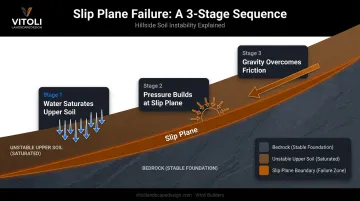
Think of a hillside slope as a layer cake. The bottom layers — bedrock or dense, competent soil — are stable. The upper layers are weaker. The boundary between them is the slip plane: the interface where gravity and water pressure do their work.
When water infiltrates the upper layers and can't escape, it builds pressure along that boundary. The upper material floats on the water-saturated interface and begins to move downslope. This is why retaining walls alone, without drainage, don't solve the underlying problem — they resist the symptom without eliminating the cause.
Three conditions drive slip plane failure:
- Water saturates the upper soil layer faster than it can drain
- Pressure builds at the boundary between weak and stable material
- Gravity pulls the upper layer downslope once friction is overcome
Warning Signs Your Slope Needs Professional Attention
Signs in an Existing Retaining Wall
These are not cosmetic issues. Each one signals structural overload:
- Tilting or leaning away from the slope — indicates the wall is rotating under lateral soil pressure
- Horizontal cracks near the top of the wall — a classic sign of overturning stress
- Bulging or bowing in the wall face — suggests the wall is yielding to pressure it can no longer resist
- Spalling concrete — surface deterioration that can accelerate structural deterioration underneath
- Gaps between the wall and adjacent structures — movement is already occurring
Slope-Level Warning Signs (No Wall Involved)
Slopes communicate distress in ways that don't require an existing wall to fail:
- Curved tree trunks or tilting fence posts — visible evidence of slow, gradual downhill soil movement (soil creep)
- Cracks running parallel to the slope crest — the surface is separating, which is a precursor to deeper movement
- Sunken or uneven ground near the hilltop — upper soil layers are beginning to detach
- Water seeping at the toe of the slope after rain — groundwater is moving through the slope and exiting at its base
Why Early Action Matters
When these warning signs appear, the window for lower-cost intervention is still open. The 2005 Bluebird Canyon landslide in Laguna Beach resulted in the evacuation of 350 homes and the destruction or damage of 15 residences — consequences that began with visible signs long before the failure.
Slopes rarely fail without warning. They show distress for months or years beforehand. A professional assessment at that stage is the lowest-cost intervention point — far less expensive than emergency stabilization or rebuilding after a collapse.
Slope Stabilization Methods Beyond Retaining Walls
Retaining walls are the most widely deployed structural solution, but they rarely work best in isolation. Effective slope stabilization usually combines methods matched to the specific failure depth, soil type, and slope angle.
Each method below addresses a different layer of the problem — from surface erosion to deep structural movement.
Vegetation-Based Stabilization
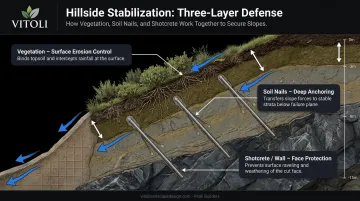
Deep-rooted native plants — grasses, native shrubs like coyote brush, groundcovers — bind surface soil layers, reduce erosion, and improve water absorption. LADWP supports native California plantings specifically for their erosion control and water retention benefits on hillside properties.
Best for: Lower-angle slopes, surface erosion control, aesthetic integration with landscaping Limitations: Doesn't address deep-seated movement or structural soil instability; roots don't reach the slip plane on steep slopes
Soil Nailing
Steel bars are drilled into the slope at angles and grouted in place, tying unstable upper soil into the more stable strata below. Per the FHWA Soil Nail Walls Reference Manual, soil nails are passive reinforcing elements that work by engaging the ground's own resistance once movement begins.
Best for: Cut slope reinforcement, situations where heavy equipment access is limited, combining with shotcrete facing Limitations: Requires professional design and installation; not a surface-only fix
Shotcrete
Sprayed concrete applied over soil nails or wire mesh creates a protective surface layer that resists erosion and weathering. It's a facing system, not a standalone solution. Shotcrete protects the reinforced soil behind it from surface deterioration and water infiltration.
One non-negotiable: shotcrete must be paired with a proper drainage strategy. Without drainage relief behind the surface, hydrostatic pressure builds and can cause the facing to separate from the slope.
On most hillside projects, these methods work together — vegetation manages surface runoff, soil nails anchor unstable strata, and shotcrete or a retaining wall holds the face.
Types of Retaining Walls and When to Use Each
Wall selection depends on retained soil height, slope angle, soil conditions, available space, and seismic load requirements. Under LA County Building Code Manual guidance, walls in Seismic Design Categories D through F supporting more than 6 feet of backfill must account for dynamic seismic lateral earth pressure — with safety factors of 1.5 for sliding and overturning and 1.1 when earthquake loads are included. That's a meaningful structural threshold, not a bureaucratic footnote.
Gravity Walls
Gravity walls — including dry-stack stone, concrete block, and gabion configurations — resist soil pressure through their own mass. No active reinforcement involved.
- Suited for walls under approximately 4 feet in garden terracing and low-load applications
- Gabion walls (wire mesh baskets filled with stone) are particularly useful where drainage is a concern — they're permeable by nature and flex slightly under seismic movement
- Must still satisfy California Building Code stability checks for sliding, overturning, bearing, and water uplift; no wall type is exempt from engineering review based on site conditions
Cantilevered Concrete Walls
The inverted-T reinforced concrete design is the standard engineered choice for mid-height residential retaining walls. The base slab extends under the retained soil, using the earth's own weight to help resist overturning — a counterintuitive but effective principle.
These walls require a reinforced concrete footing set at adequate depth, with full engineering calculations to back them up. In most Southern California jurisdictions, walls retaining more than 4 feet of soil require a building permit and engineered plans before breaking ground.
Anchored and Tieback Walls
When a wall must be taller, slender due to site constraints, or when passive resistance alone won't meet seismic requirements, anchors or helical tiebacks extend from the wall back into stable soil or bedrock behind it.
These systems are especially critical in seismically active regions. An unanchored wall — even a properly sized one — may not have adequate resistance to earthquake-induced lateral loads. For tall walls on steep slopes in LA and Ventura Counties, tieback anchoring is often the difference between a genuinely code-compliant design and one that looks compliant only on paper.
Tiered Retaining Wall Systems
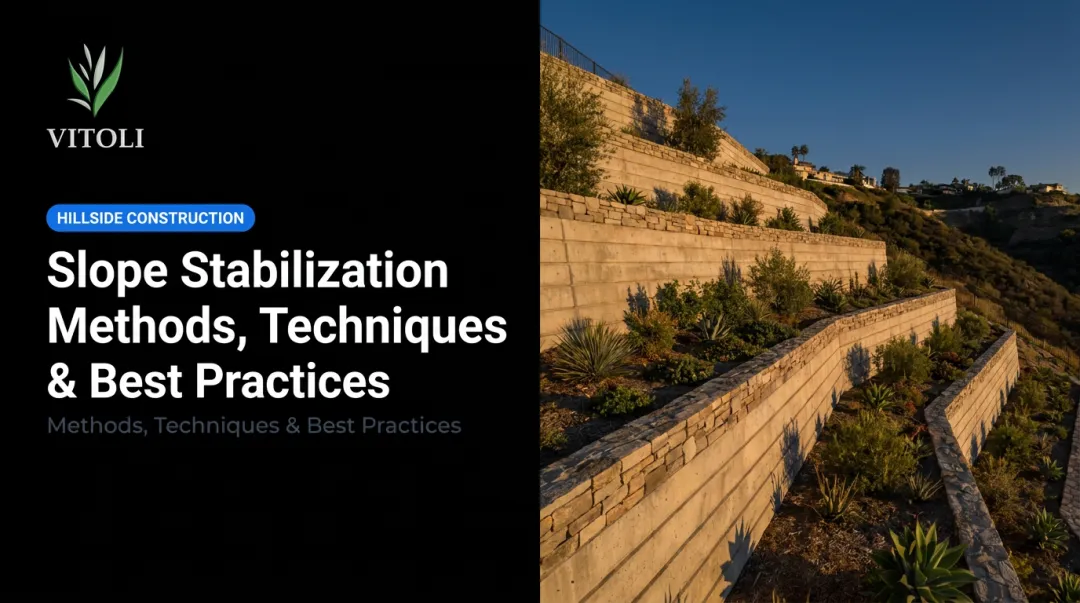
Rather than building one tall wall, tiered systems use multiple shorter walls at different elevations, separated by planting benches. This approach has several advantages over single-wall design:
- Distributes lateral load across multiple structures rather than concentrating it in one
- Reduces individual wall height, lowering structural demands on each section
- Creates natural drainage relief points between tiers, reducing hydrostatic pressure
- Allows for landscaping integration between levels, turning structural elements into usable outdoor space
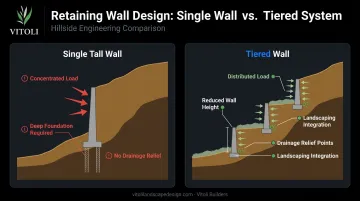
Vitoli Builders — who have completed over 1,800 hillside projects across Los Angeles and Ventura Counties — regularly deploy tiered wall configurations for precisely these reasons, particularly on slopes where a single tall wall would require deeper foundations and more intensive reinforcement.
The Critical Role of Drainage in Retaining Wall Performance
Why Water Is the Primary Threat
The US Army Corps of Engineers states that drainage systems are necessary to eliminate excess hydrostatic pressure on both the wall stem and the failure plane. That's a design requirement, not optional guidance.
When water cannot escape from behind a retaining wall, it adds directly to the lateral load the wall must resist. Saturated backfill is substantially heavier than dry backfill.
A wall designed to handle normal soil pressure may be overloaded beyond its design capacity once the retained soil reaches saturation — and that overload is invisible until cracks or movement appear.
The Three Core Drainage Components
Well-engineered retaining walls in Southern California incorporate all three:
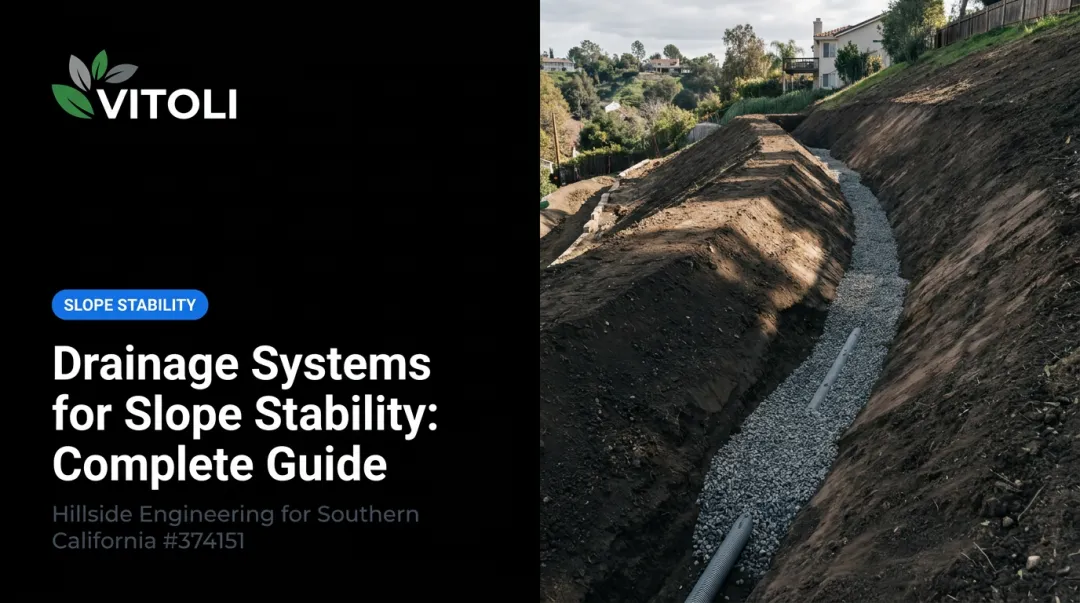
- Weep holes — openings at the base of the wall face that allow accumulated water to exit rather than build pressure
- Gravel or crushed stone backfill — permeable material directly behind the wall that allows water to move freely rather than accumulate
- Perforated drain pipes (French drains) — placed at the footing level to actively carry water away from the wall and slope
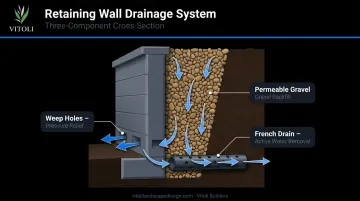
Vitoli Builders integrates all three as standard practice across their retaining wall projects, recognizing that drainage failure is one of the leading causes of wall failure across Southern California hillside properties.
Surface Drainage: The Upstream Defense
Drainage design doesn't start at the wall. California Residential Code requires lots to drain surface water away from foundation walls, with at least 6 inches of fall within the first 10 feet where practical. Applied to retaining wall design, this means:
- Grading the area behind the wall so water moves away from the slope, not toward it
- Installing swales or catch basins to intercept runoff before it saturates the retained soil
- Ensuring downspouts and irrigation systems don't discharge upslope of a retaining structure
Many wall failures that appear sudden actually reflect years of drainage neglect. Hydrostatic pressure builds gradually, causing slow wall rotation — that same tilting and bowing that shows up as early warning signs — until the accumulated load exceeds what the structure can bear.
Choosing the Right Approach for Your Southern California Property
What a Site Assessment Actually Covers
Before any wall type or stabilization method is recommended, a qualified hillside specialist evaluates:
- Slope height and angle
- Soil type, clay content, and expansiveness
- Proximity to structures or property lines
- Groundwater levels and drainage patterns
- Seismic zone designation (check CGS Seismic Hazard Zone maps)
- Applicable local grading ordinances in LA County or Ventura County
Assumptions about "good ground" without proper site investigation have caused real failures. Hillside properties in Southern California carry enough subsurface variability that even experienced contractors encounter unexpected conditions — the site assessment process exists to find those conditions before construction begins, not after.
Permitting Requirements in California
In most Southern California jurisdictions, retaining walls over approximately 4 feet of retained soil height require a building permit, engineered drawings, and inspections. LA County Public Works requires a separate retaining wall permit and fees.
Ventura County's Building and Safety division requires permit review for retaining walls, and a registered civil engineer must prepare grading plans when cut or fill exceeds 500 cubic yards or when drainage or geological issues are present.
Working with a licensed contractor who handles permitting directly — and carries a California Contractor License — is the most direct way to avoid non-compliance issues that can complicate property sales and insurance claims.
The Integrated Design-Build Advantage
When structural engineering, drainage design, and landscape planning are coordinated from the project's start — rather than added to each other after the fact — the result is a more durable system. Treating drainage as an afterthought, or bringing in a separate landscape contractor after walls are built, consistently produces avoidable redesign costs.
That coordination is what Vitoli Builders is structured to deliver. As a design-build hillside specialist, Vitoli's in-house team handles engineering, retaining walls, drainage integration, caissons, and landscape construction under one roof — so nothing gets handed off or lost between disciplines. For homeowners in LA and Ventura Counties navigating complex terrain, that matters in practice, not just in principle.
Questions to Ask Any Contractor
- Do they have documented experience specifically with hillside construction — not just general landscaping?
- Do they carry a valid California Contractor License (verifiable through CSLB)?
- Will they pull the required building and grading permits themselves?
- Do they have in-house engineering capability, or is design work outsourced to a separate firm?
- Can they show completed projects on hillside properties comparable to yours?
A contractor who hesitates on any of these — or can't answer concretely — is telling you something important about how your project will go.
Frequently Asked Questions
What is the purpose of retaining walls in slope stabilization?
Retaining walls intercept lateral soil pressure and hold soil at two different elevations, preventing upper layers from sliding downslope. They're the most widely used structural solution in hillside stabilization because they directly address the forces driving slope failure — gravity acting on unstable or water-saturated soil.
What is the most effective way to stabilize a slope?
The most effective approach combines structural support (retaining walls or soil nails), proper drainage to eliminate hydrostatic pressure, and surface protection through vegetation or shotcrete. The right combination depends on slope height, soil type, and failure depth: shallow erosion and deep structural instability each require different solutions.
What is the best retaining wall for a steep slope?
Steep slopes typically require engineered cantilevered concrete walls with helical tiebacks or anchored wall systems, as gravity walls lack structural capacity for high lateral loads. A tiered wall system with proper drainage between levels is often the most stable long-term solution on residential hillside properties.
What is the 1/3 rule for retaining walls?
The 1/3 rule states that a wall's embedment depth should equal approximately 1/3 of its total height for adequate stability. Engineered walls may vary from this ratio based on soil conditions, load requirements, and local code.
How do I know if my hillside property needs a retaining wall?
Look for: leaning or cracking in existing walls, tilted trees or fence posts indicating soil creep, cracks near the slope crest, sunken ground near the hilltop, or water seeping at the slope's base after rain. Any of these signs warrants a professional assessment before conditions worsen.
Does a retaining wall require a permit in California?
In most Southern California jurisdictions, retaining walls over approximately 4 feet of retained height require a building permit and engineered drawings. Grading permits may also apply. Requirements vary by city and county; verify with your local building department or work with a licensed contractor who manages permitting directly.