The right plants don't just add greenery. They anchor soil from multiple depths, intercept rainfall before it hits bare ground, slow runoff, and over time convert an unstable hillside into a functional, fire-wise landscape.
This guide covers the best erosion control plants for Southern California slopes, how to select them for your specific site conditions, and how a layered planting strategy produces far better long-term results than any single-species solution.
Key Takeaways
- Deep-rooted and spreading-root plants outperform shallow-rooted ornamentals on slopes
- SoCal-native species adapt better to compacted soils, drought, and fire cycles than non-native groundcovers
- Layering groundcovers, shrubs, and grasses at different root depths provides the strongest stabilization
- Biodegradable erosion-control fabric bridges the gap during the typical 2–3 year plant establishment period
- On steep or actively eroding slopes, vegetation works best alongside structural solutions
Why Erosion Is a Major Concern for Southern California Hillside Properties
SoCal slopes face a combination of stressors that few other regions match. Clay-heavy soils resist water infiltration, prolonged dry seasons strip slopes of active vegetation, and winter storms arrive in short, intense bursts — often with little warning.
A USFS study in the San Gabriel Mountains found that first-year post-fire erosion and sediment yield increased one to two orders of magnitude, then generally returned toward pre-fire levels within 2–3 years as vegetation recovered. Wildfire accelerates this cycle: burned slopes lose the vegetation that intercepted rainfall and bound soil together, leaving them fully exposed during that 2–3 year recovery window — exactly when the real damage happens.
Common erosion triggers on SoCal hillsides:
- Removal or die-back of existing vegetation (fire, drought, improper plant selection)
- Monoculture groundcovers like non-native ice plant or Cape ivy, which lack root depth and become fire hazards
- Poor drainage design that concentrates runoff in channels rather than dispersing it
- Grading activity that disturbs established root systems and leaves bare soil
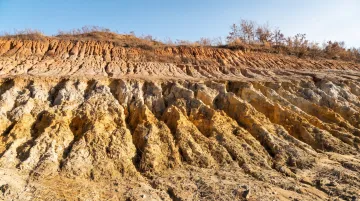
Replacing shallow-rooted or invasive monocultures with deep-rooted native plants is the most effective long-term fix — which is why plant selection matters as much as any engineered solution.
Best Erosion Control Plants for Slopes and Hillsides in Southern California
These plants were selected for root performance, drought tolerance, adaptability to Southern California's climate zones, and documented ability to stabilize slopes. Each entry includes the cultivars most recommended for hillside use.
California Buckwheat (Eriogonum fasciculatum)
California Buckwheat is one of the most widely used slope plants in the region — a low-growing native shrub that forms dense, dome-shaped mounds with deep lateral roots that bind soil across hot, dry exposures. The 'Dana Point' cultivar is explicitly recommended for erosion control on slopes, while 'Theodore Payne' has a sprawling habit with stems that root along the ground, extending coverage progressively across a hillside.
Creamy flower clusters fade to rust and remain attractive through fall, supporting native butterflies and pollinators through most of the warm season.
| Characteristic | Detail |
|---|---|
| Sun & Water | Full sun; very low water once established |
| Root & Spread | Deep lateral roots; 4–6 ft wide, under 3 ft tall |
| Best For | Hot, sunny slopes; fire-adjacent zones; low-maintenance coverage |
Coyote Brush (Baccharis pilularis 'Pigeon Point')
'Pigeon Point' coyote brush delivers year-round slope coverage with a reliably low, even habit — under 18 inches tall and spreading 6–8 feet wide. Theodore Payne Foundation rates it as great erosion control for slopes, and CNPS identifies it as an ideal slope holder with deep woody roots suited to steep, exposed hillsides.
It tolerates poor, compacted soils well and pairs effectively with showier natives as a backbone plant — providing consistent structural coverage while ornamental species fill in around it.
| Characteristic | Detail |
|---|---|
| Sun & Water | Full sun; low water once established |
| Root & Spread | Deep woody roots; 6–8 ft wide, under 18 in. tall |
| Best For | Steep, exposed hillsides; fire-risk zones; large-scale coverage |
Creeping Sage (Salvia sonomensis — 'Mrs. Beard' and 'Bee's Bliss')
Creeping Sage spreads faster than most SoCal slope plants — capable of covering 6 feet within the first year after planting. That speed makes it ideal for stabilizing bare or recently disturbed slopes while slower shrubs establish.
The two key cultivars differ in appearance:
- 'Mrs. Beard' — bright spring-green foliage, pale blue flowers, about 1 ft tall
- 'Bee's Bliss' — silver-gray foliage, purple-blue flowers, slightly larger at around 2 ft
Both attract hummingbirds and butterflies and perform well on south-facing exposures.
| Characteristic | Detail |
|---|---|
| Sun & Water | Full sun to partial shade; low to moderate water during establishment |
| Root & Spread | Spreading fibrous roots; up to 6 ft wide, 1–2 ft tall |
| Best For | Rapid stabilization of newly graded slopes; pollinator habitat |
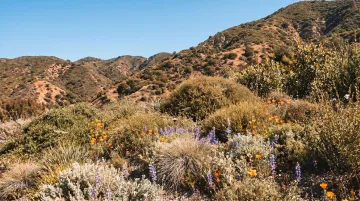
Manzanita (Arctostaphylos 'John Dourley')
Manzanita brings structural presence to a hillside planting — evergreen, deep-rooted, and built to last. 'John Dourley' is the most recommended groundcover manzanita for hillside use: low and mounding with gray-bronze foliage and pink urn-shaped flowers in late winter. CNPS describes it hugging slopes with deep roots, and Calscape identifies it as useful for banks and hillsides.
Mature plants anchor slopes for decades and produce seasonal berries that feed birds, ground squirrels, and mule deer — sustained wildlife value built into the slope itself.
| Characteristic | Detail |
|---|---|
| Sun & Water | Full sun to partial shade; very low water once established |
| Root & Spread | Deep branching woody roots; low and mounding (varies by site) |
| Best For | Long-term slope coverage; fire-adjacent hillsides; wildlife habitat |
Deer Grass (Muhlenbergia rigens) and Complementary Native Grasses
Deer Grass is the premier native ornamental grass for SoCal slope stabilization — a medium-sized bunchgrass with a dense fibrous root system that holds soil tightly across a range of gradients, including clay-heavy hillside conditions.
Theodore Payne's erosion control plant list identifies it as a deep-rooted bunchgrass suited for surface soil retention, growing to approximately 3 ft tall and 4 ft wide.
Complementary native grass options for SoCal slopes:
- Purple Three-Awn (Aristida purpurea) — suited to hot, dry, rocky exposures
- Wild Rye (Leymus 'Canyon Prince') — useful for larger-scale stabilization projects
Native grasses work best in combination with shrubs and groundcovers, adding textural variety and root-depth diversity to a mixed slope planting.
| Characteristic | Detail |
|---|---|
| Sun & Water | Full sun; low to moderate water; tolerates poor, dry soils |
| Root & Spread | Dense fibrous root network; clumps 2–4 ft wide, 2–3 ft tall |
| Best For | Mid-slope anchoring; combination plantings; high-wind exposures |
How to Plant for Maximum Slope Stability: The Layered Approach
A single species covering a hillside (whether ivy, ice plant, or a well-chosen native) will always underperform a mixed, layered planting. The reason is root depth diversity.
How the layers work together:
- Canopy layer (trees or large shrubs) — intercepts rainfall before it hits bare soil, reducing splash erosion at the surface
- Shrub layer (coyote brush, manzanita, buckwheat) — deep woody roots anchor mid-slope soil across multiple feet of depth
- Groundcover layer (creeping sage, deer grass) — seals the surface against runoff and binds topsoil with fibrous root networks
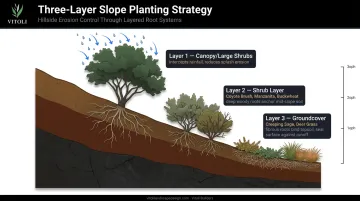
RCDSMM recommends a mosaic of plants that root at different depths to form a dense root web on steep hillsides — the same principle the Theodore Payne Foundation applies when recommending perennials, shrubs, and trees with different growth habits and rooting depths for erosion control.
Practical Planting Tips for SoCal Slopes
- Amend soil minimally. Most California natives prefer mulch over amended soil — adding too much compost can actually loosen slope stability on compacted hillsides.
- Plant on contour or in staggered rows to slow water movement across the slope rather than channeling it downhill.
- Water deeply but infrequently during the first season. This encourages roots to grow downward in search of moisture rather than staying near the surface.
- Use mulch between plants to suppress weeds, retain moisture, and protect bare soil while plants establish.
When to Use Erosion-Control Fabric
On bare, actively eroding slopes or immediately after grading, biodegradable jute or straw matting can stabilize soil during the plant establishment window. Theodore Payne recommends jute netting and wattles specifically because new plantings don't hold soil until roots become established — a process that takes 2–3 years.
Important: Avoid plastic-based erosion fabric. The California Coastal Commission recommends wildlife-friendly, plastic-free biodegradable netting (jute, coir, or natural fiber alternatives) because plastic netting does not decompose and creates long-term maintenance and wildlife hazards.
When Plants Aren't Enough
Fabric and planting solve most erosion problems, but some slopes need more than biology can deliver.
On very steep slopes or sites showing signs of active slippage, vegetation alone cannot provide adequate stabilization. Caltrans identifies slopes steeper than 2:1 (horizontal to vertical) as requiring a geotechnical review, a useful benchmark for residential hillside owners evaluating their options.
For these sites, engineered solutions (retaining walls, caissons, or terracing) need to be integrated with the planting plan, not treated as an alternative to it. Vitoli Builders works with Los Angeles and Ventura County hillside homeowners on exactly this combination, pairing structural stabilization with native planting so both systems reinforce each other.
How We Chose These Erosion Control Plants
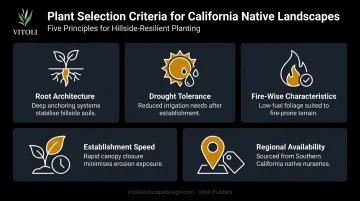
Plants on this list were evaluated on five criteria:
- Root architecture — depth, lateral spread, and anchoring capacity in compacted or graded soils
- Drought tolerance — low water requirements reduce irrigation-induced erosion during the dry season
- Fire-wise characteristics — CNPS identifies the hot-slope groundcover group (buckwheat, coyote brush, sage) as firewise
- Establishment speed — faster-establishing plants close the window of vulnerability sooner
- Regional availability — all listed species and cultivars are available through California native plant nurseries
What Homeowners Commonly Get Wrong
A few missteps show up repeatedly on SoCal hillside projects:
- Shallow, mat-forming roots won't anchor soil on a 30% slope — root depth matters more than how a plant looks in a pot.
- Cal-IPC lists Cape ivy, non-native ice plant, and English ivy as invasive California species — all three are still commonly planted on slopes despite documented fire hazards and competitive exclusion of natives.
- Sparse planting leaves bare soil exposed between plants, defeating the purpose of erosion control planting entirely.
Every plant in the list below passes all five criteria — aesthetics included.
Conclusion
Choosing erosion control plants for a Southern California hillside is as much a structural decision as a landscaping one. The right combination of deep-rooted natives — layered across groundcover, shrub, and grass strata — can transform an actively eroding slope into a stable, fire-resistant, and ecologically productive landscape over a 2–3 year establishment period.
Before selecting plants, evaluate your specific conditions: slope angle, sun exposure, soil type, and proximity to fire-risk zones. For recently graded, steep, or actively eroding slopes, professional consultation before planting will save both time and money.
When slope challenges extend beyond planting — into retaining walls, grading, drainage, and integrated hillside design — that's where a specialist makes a real difference. Vitoli Builders has completed more than 1,800 hillside projects across Los Angeles and Ventura County over 20 years, helping homeowners stabilize and transform difficult terrain. Reach out to schedule a consultation.
Frequently Asked Questions
What plants are used on slopes to prevent erosion?
Deep-rooted and spreading-root plants work best — including native groundcovers, fibrous-rooted grasses, and woody shrubs. For Southern California slopes, California Buckwheat, Coyote Brush ('Pigeon Point'), and Deer Grass are among the most documented and effective choices.
What is the best ground cover for a steep, dry hillside in Southern California?
California Buckwheat ('Dana Point'), Coyote Brush ('Pigeon Point'), and Creeping Sage ('Mrs. Beard' or 'Bee's Bliss') are the top options for hot, dry, steep SoCal exposures — all drought-tolerant, fire-wise, and documented for slope erosion control.
How long does it take for erosion control plants to establish on a slope?
Most native slope plants require 2–3 years to fully anchor into the slope. Biodegradable erosion-control fabric (jute netting or straw matting) can stabilize bare soil during this establishment window while roots develop.
Can plants alone stop erosion on a very steep hillside?
On very steep slopes — particularly those steeper than a 2:1 gradient — or sites showing active slippage, plants are most effective when combined with structural solutions like retaining walls or terracing. Vegetation alone is not sufficient for these conditions.
Are native plants better for erosion control than non-native species?
Yes, for SoCal slopes. Native plants develop deeper root systems, require far less irrigation (reducing irrigation-induced erosion), and carry fire-wise characteristics suited to the region's Mediterranean climate. Invasive groundcovers like English ivy and ice plant lack that root depth and create long-term fire and weed management problems.