That gap matters. A homeowner who budgets based on a generic $6,000 national average — when their actual Calabasas or Malibu hillside project runs $40,000 to $80,000 — is going to hit serious problems mid-project.
This guide breaks down retaining wall costs by material type, wall height, and project scale. It also explains the five factors that consistently move the final number up or down so you can budget accurately before getting your first contractor quote.
Key Takeaways
- Nationally, retaining walls cost $35–$65 per sq ft installed; LA hillside projects commonly run $49–$100+ per sq ft
- Walls over 4 feet (measured from footing base to top) require permits and engineered drawings in most California jurisdictions
- Labor represents 40–60% of total project cost — and hillside sites with access constraints push that share higher
- Drainage is not optional — inadequate drainage behind a wall is the most common cause of retaining wall failure
- Skipping engineering or drainage to save upfront nearly always costs more in repairs than the original savings
How Much Does a Retaining Wall Cost?
Retaining wall installation has no fixed price. Material, wall height, site conditions, drainage requirements, and local labor rates all factor in — and on Southern California hillsides, several of these variables compound simultaneously.
According to HomeAdvisor's 2026 data, the typical national range runs $3,193 to $9,194, with an average around $6,065. Local LA market data tells a different story: cost reports for Los Angeles show $49 to $54 per sq ft for standard installations, with hillside-specific work from local contractors ranging $25 to $100+ per sq ft depending on complexity.
The risk in misreading national estimates: homeowners underbudget mid-project, or choose a material that fails under hillside soil and drainage conditions, or skip engineering to save $3,000 and spend $30,000 fixing a failed wall.
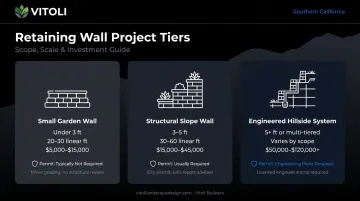
Typical Cost Ranges by Project Scale
| Project Type | Scope | Typical Installed Cost |
|---|---|---|
| Small garden wall | Under 3 ft, 20–30 linear ft | $5,000–$15,000 |
| Structural slope wall | 3–5 ft, 30–60 linear ft | $15,000–$45,000 |
| Engineered hillside system | 5+ ft or multi-tiered | $50,000–$120,000+ |
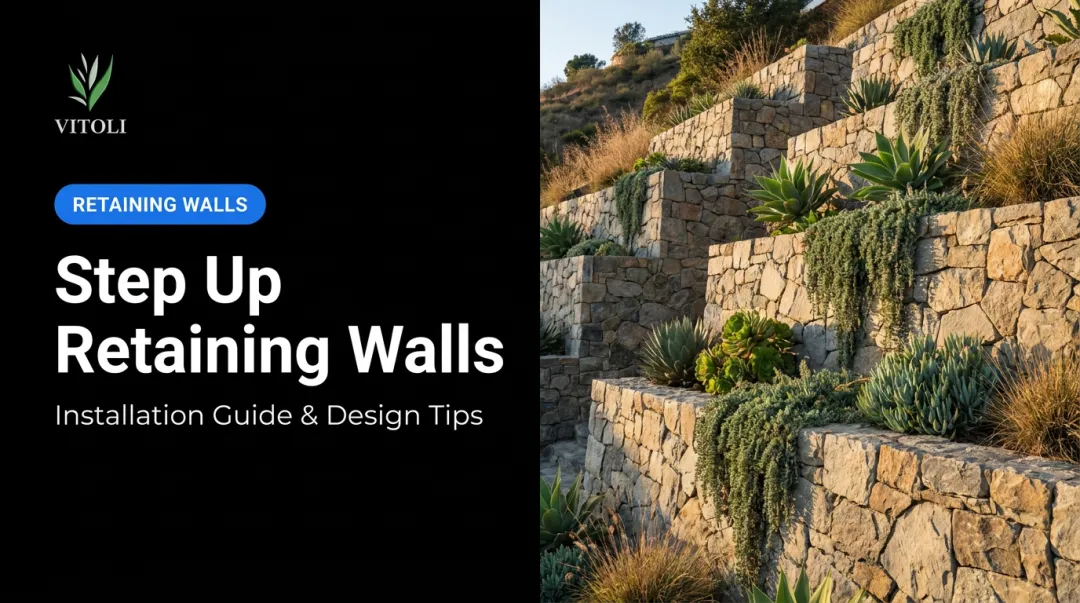
Each tier carries different permit and engineering obligations. Garden walls under 3 feet rarely require permits. Structural slope walls — the most common category for LA hillside properties — typically need permits, geogrid reinforcement, and drainage infrastructure. Engineered systems go further: stamped drawings, geotechnical reports, and major earthwork. Some complex multi-tiered hillside stabilization projects exceed $300,000.
These ranges generally include labor, base preparation, drainage aggregate, and perforated pipe. They typically exclude:
- Permit fees
- Structural engineering drawings
- Geotechnical reports
- Existing wall demolition
Retaining Wall Cost by Material
Material selection is the second-biggest cost driver after wall height. The right choice depends on the wall's structural demands, the property's aesthetic goals, and the site's specific soil and drainage conditions.
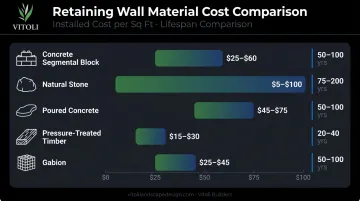
Here's how the five most common materials compare at a glance:
| Material | Installed Cost (per sq ft) | Best For | Approx. Lifespan |
|---|---|---|---|
| Concrete Segmental Block | $25–$60 | Hillside residential, seismic zones | 75–100 years |
| Natural Stone | $5–$100 | Luxury properties, aesthetic priority | 50–100+ years |
| Poured Concrete | $45–$75 | Tall walls, high lateral loads | 50–75 years |
| Pressure-Treated Timber | $15–$30 | Low walls, flat or dry sites | 15–20 years |
| Gabion (Wire Cage + Rock Fill) | $25–$45 | Naturalistic settings, drainage-sensitive sites | 40–60 years |
Concrete Segmental Block
Installed cost: $25–$60 per sq ft
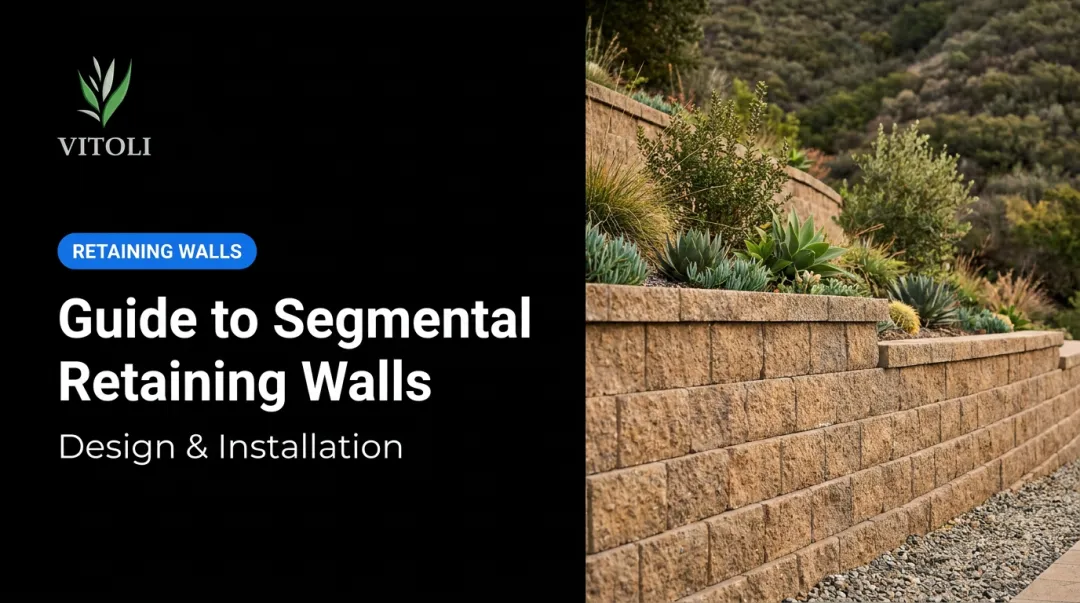
The most common choice for hillside residential walls in Southern California. Interlocking block systems offer design flexibility, handle seismic and expansive soil conditions well, and carry design lives of 75–100 years per NCMA guidelines. They're well-suited to LA and Ventura County hillside applications where structural performance and curb appeal both matter.
Natural Stone (Dry-Stacked or Wet-Laid)
Installed cost: $5–$100 per sq ft (wide range reflects stone type and placement complexity)
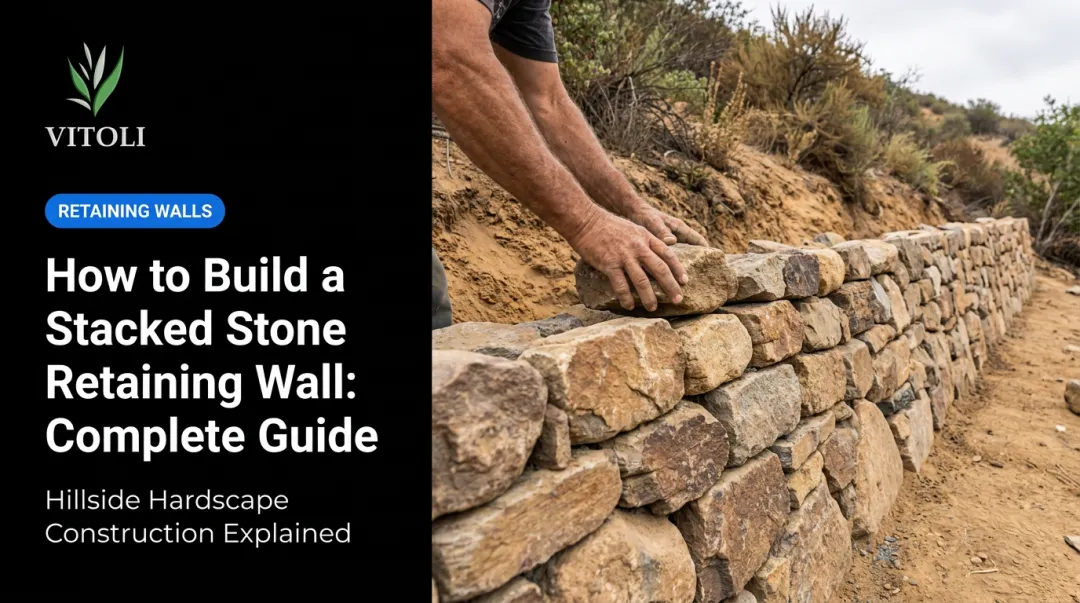
Natural stone produces a refined, enduring look that's particularly well-matched to luxury hillside properties across the region. The higher end of the range reflects the labor-intensive nature of working with irregular stone shapes — placement precision adds significant crew time compared to uniform block systems.
Poured Concrete
Installed cost: $45–$75 per sq ft
The most structurally robust option for tall walls holding significant soil loads. Requires skilled forming and finishing but produces a clean, modern look and handles high lateral pressures effectively. Best suited to walls where structural capacity matters more than a naturalistic appearance.
Pressure-Treated Timber
Installed cost: $15–$30 per sq ft
Timber carries the lowest upfront cost — but also the shortest lifespan. Rot, warping, and eventual structural degradation make it a poor choice where drainage is imperfect, which describes most Southern California hillsides. Not recommended for walls over 3 feet or on heavily irrigated properties.
Gabion (Wire Cage + Rock Fill)
Installed cost: $25–$45 per sq ft
Well-suited to informal hillside settings and naturalistic landscapes. A few practical advantages worth noting:
- Drains by design — water passes through the rock fill rather than building pressure behind the wall face
- Lower maintenance than mortared systems
- Cost-effective on sites where a naturalistic look fits the overall design
The industrial aesthetic won't suit every property, but on the right site it's a durable, low-fuss option.
Key Factors That Drive Retaining Wall Installation Cost
Beyond material and height, five factors consistently move the final number. On hillside properties, several of these hit simultaneously.
Wall Height and Engineering Requirements
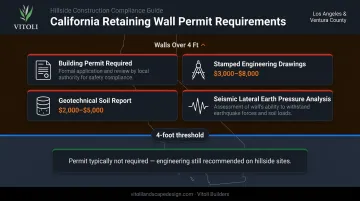
The 2022 California Building Code exempts retaining walls from permit requirements only when they are not over 4 feet, measured from the bottom of the footing to the top of the wall — unless supporting a surcharge or impounding hazardous liquids.
Once a wall crosses that threshold:
- Building permit required (fees vary by jurisdiction; Malibu's fee schedule shows $215–$1,075 for plan check depending on wall height and design complexity)
- Stamped engineering drawings required — California structural engineering firms cite $3,000+ for retaining wall calculations and drawings; LA hillside contractor sources put engineering at $3,000–$8,000
- Geotechnical soil reports may be required — typically $2,000–$5,000 for hillside sites
- Seismic lateral earth pressure analysis is required under the LA County Building Code for walls supporting more than 6 feet of backfill
Even for walls just under 4 feet on challenging hillside terrain, engaging a structural engineer is worth the cost. The permit threshold doesn't define the engineering threshold.
Site Access and Terrain Complexity
If equipment and materials can't reach the wall location directly — due to narrow gates, steep downslope positioning, or no direct equipment path — labor costs increase substantially. Most hillside properties in LA and Ventura County involve at least some access constraint.
Labor accounts for 40–60% of total retaining wall project cost on typical installations. Difficult-access sites push toward the higher end of that range, as hand-carrying materials and working in confined spaces adds crew hours directly to the final invoice.
Soil Conditions and Drainage Requirements
Expansive clay soils — common across Southern California hillsides — shrink and swell with moisture changes. When swelling is restrained by a rigid wall, research published in Soils and Foundations found that lateral earth pressure can reach 1.3 to 5.0 times overburden pressure. That's a fundamentally different structural loading environment than the well-draining sandy soils most national cost guides assume.
Practical cost impacts of clay-heavy soil:
- Deeper footings to reach stable bearing material
- More robust drainage systems — larger aggregate zones, additional drain pipe runs
- Possible soil stabilization or engineered fill requirements
- Engineering-specific footing designs rather than rule-of-thumb sizing
Wall Length and Project Scope
Longer walls cost less per linear foot because mobilization, equipment setup, and site preparation are spread over more footage. A contractor mobilizing for a 20-foot wall and an 80-foot wall carries similar setup costs — the difference comes out of the per-foot rate on the longer project.
Adding features like built-in steps, lighting, or seating caps increases total cost but raises the functional and aesthetic value of the finished project. When the wall is already being built, it's often the most cost-efficient time to add them.
Drainage Infrastructure
More retaining walls fail from poor drainage than from any other cause. Industry data consistently points to hydrostatic pressure buildup — not structural miscalculation — as the primary failure mode. A complete drainage system includes:
- Compacted gravel backfill — allows water to percolate rather than accumulate
- Perforated drain pipe — collects and redirects water away from the wall
- Filter fabric — prevents fine soil particles from clogging drainage aggregate
- Weep holes — provide pressure relief points through the wall face
- Controlled discharge point — directs water to an appropriate outlet away from the structure
Vitoli Builders integrates all of these components into hillside retaining wall projects as standard practice — designed around Southern California's wet season and expansive clay conditions. Installing a proper drainage system during initial construction typically costs a fraction of what wall failure and reconstruction runs after hydrostatic pressure does its damage.
What's Included in the Full Project Cost
The final project cost goes well beyond material and labor. Understanding what a contractor's quote includes — and what it doesn't — prevents expensive surprises.
One-time installation costs to account for:
- Excavation and grading — scope varies by soil volume and site access conditions
- Permit fees — Ventura County charges a $71 application fee, $57 issuance fee, 85% plan review fee, plus a 10% hillside surcharge on both plan review and permit fees; City of LA uses a valuation-based fee schedule calculated through LADBS
- Structural engineering drawings — typically $3,000–$8,000 for hillside sites in LA and Ventura County
- Geotechnical report — $2,000–$5,000 when soil conditions require it
- Waterproofing and drainage infrastructure
- Cap and finish work
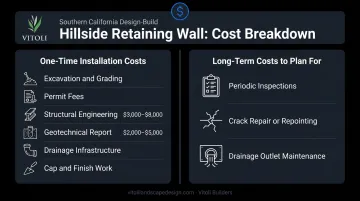
Long-term costs to plan for:
- Schedule periodic inspections after heavy rain seasons
- Budget for crack repair or repointing on mortared walls as they age
- Maintain drainage outlets and caps — especially on hillside sites where debris accumulation is common
Quality materials and proper drainage installation substantially reduce long-term costs. On hillside sites in LA and Ventura County, where soil movement and seasonal rain put extra stress on walls, getting the drainage right from the start is the single biggest factor in avoiding expensive repairs down the road.
Budget Mistakes That Cost Homeowners More
Three patterns consistently lead to expensive outcomes on hillside retaining wall projects.
Pricing materials only. Labor runs 40–60% or more of total project cost. Homeowners who estimate materials and double them for labor still miss hillside-specific costs — access limitations, earthwork, and drainage that add crew hours no material quote captures.
Cutting drainage or engineering to save money upfront. A wall without proper drainage will eventually fail as hydrostatic pressure builds through wet seasons. On a hillside, that failure can trigger slope movement affecting foundations or neighboring properties. A $5,000 shortcut can become a $50,000 problem.
DIY beyond a low garden border. DIY walls are reasonable only for low borders on flat ground with well-draining soil. Hillside walls need compaction equipment, drainage expertise, and engineering. Complex soil, restricted access, or any wall taller than 3 feet falls outside weekend-project territory.
Before committing to a scope or requesting quotes, it helps to understand what your specific site actually requires. Vitoli Builders offers free consultations for hillside homeowners in Los Angeles and Ventura County — so you know what you're getting into before any contractor shows up with a number.
Conclusion
Retaining wall installation cost varies significantly based on material choice, wall height, site terrain, drainage requirements, and local permitting. Hillside properties in Southern California typically involve more complexity than national averages convey — and the gap between a generic estimate and an accurate project budget can be substantial.
Walls that fail — leaning, cracking, or washing out — almost always trace back to shortcuts in drainage, engineering, or material selection. Proper upfront investment in these areas consistently costs less than remediation, which can run two to three times the original project price.
Per-square-foot estimates are a starting point, not a budget. Every hillside site has its own soil conditions, access constraints, drainage dynamics, and height requirements — all of which shape the real number.
A hillside specialist like Vitoli Builders can evaluate those site-specific factors and give you an accurate project scope before any money changes hands.
Frequently Asked Questions
How much is labor to install a retaining wall?
Labor accounts for 40–60% of total retaining wall installation cost. Hillside sites with difficult access, significant earthwork, or seismic reinforcement requirements push labor costs toward the higher end of that range — and sometimes beyond it on especially constrained properties.
Is it cheaper to build or buy a retaining wall?
Prefabricated or precast panel systems can reduce labor time but typically carry higher material costs. On hillside applications requiring engineering, the structural design requirements usually outweigh whatever labor savings prefabricated systems offer.
What is the 1/3 rule for retaining walls?
The 1/3 rule is an industry rule of thumb — not a California Building Code requirement — stating that roughly one-third of a wall's total height should be buried below grade (a 3-foot visible wall needs about 1 foot of footing). Taller walls and hillside sites require engineer-specified footing designs, not rules of thumb.
What is the cheapest retaining wall material?
Pressure-treated timber and vinyl are typically the lowest-cost materials per square foot. Both have significant limitations in lifespan and structural capacity. For hillside applications where durability matters, concrete segmental block offers the best balance of upfront cost and long-term performance.
Do I need a permit for a retaining wall in California?
In most California jurisdictions, walls over 4 feet measured from the bottom of the footing require a building permit and stamped engineering drawings. Hillside zones and HOA areas in LA and Ventura Counties often have stricter requirements, so verify with your local building department before starting any work.
How long does a retaining wall last?
Concrete block, stone, and poured concrete walls with adequate drainage last 50 years or more. Timber walls have the shortest lifespan at roughly 15–25 years. The single biggest factor in premature failure is inadequate drainage — not material choice.