Introduction
Southern California hillside homeowners face a specific and serious problem: slopes that look stable in summer can fail dramatically after the first heavy winter rain. Unstable soil, seasonal saturation, and seismic activity combine to threaten structures, landscaping, and property value in ways that flat-lot owners rarely encounter.
Land stabilization covers the methods and materials used to reinforce soil, control erosion, and prevent slope failure before damage occurs. USGS data puts annual landslide losses between $1.6 billion and $3.2 billion nationwide. Southern California has produced some of the worst residential examples — the 1995 La Conchita landslide in Ventura County alone destroyed or badly damaged 11 to 12 homes.
This guide covers the core stabilization methods and materials as they apply to hillside residential properties in Los Angeles and Ventura Counties — including how to spot warning signs, which approaches fit different slope conditions, and when a professional assessment becomes necessary.
Key Takeaways
- Stabilization combines soil treatment (compaction, chemical agents) and structural solutions like retaining walls and caissons — rarely one or the other alone.
- Wall cracks, slope slumping, and post-rain erosion are early warning signs that need action before failure occurs.
- In Southern California, seasonal rainfall, seismic activity, and wildfire history make hillside risk significantly higher than in flat-terrain regions.
- No single method fixes a hillside — most projects require layered approaches tailored to slope, soil, and drainage conditions.
- Structural hillside work in LA and Ventura Counties requires permits; starting without them creates costly delays.
What Is Land Stabilization and Why Does It Matter?
Land stabilization is the process of improving soil or terrain to increase load-bearing capacity, reduce erosion, prevent slope failure, and create a durable foundation for structures or landscaping. The term covers two distinct but related disciplines:
- Soil stabilization — treating soil properties through chemical agents, compaction, or material replacement
- Structural stabilization — physical systems like retaining walls, caissons, and drainage infrastructure
The Two Core Engineering Problems
Most hillside failures trace back to one of two root causes:
- Inadequate soil strength — the ground cannot bear the load placed on it, whether from structures, saturated soil weight, or seismic forces
- Excessive settlement or movement — soil shifts or compresses unevenly due to moisture changes, poor compaction, or slope geometry
Both problems intensify on hillside terrain. Gravity amplifies lateral pressure and water concentrates in low points. Graded lots compound this further — they frequently contain fill soils with unpredictable behavior under load.
Left unaddressed, either condition sets the stage for the failures described below.
What Happens Without Stabilization
Skipping stabilization carries real financial and structural consequences:
- Structural damage to foundations, retaining walls, and hardscape
- Landslides and slope failures that destroy usable land
- Accelerated erosion that undermines landscaping and drainage systems
- Emergency remediation costs that far exceed what proactive stabilization would have required
Southern California's 1979–80 winter storms caused approximately $1.1 billion in losses across six counties — and that was before the region's current density of hillside development.
Warning Signs Your Property Needs Land Stabilization
On Southern California hillside properties, the window between early warning signs and costly failure can close fast. Post-failure remediation is substantially more disruptive and expensive than preventive stabilization — yet most homeowners don't act until visible damage has already appeared.
Physical Warning Signs to Watch For
USGS and FEMA identify several observable indicators that a slope is becoming unstable:
- Cracks appearing in the yard, slope, or retaining walls
- Bulging or slumping ground on or below a slope
- New springs, seepage, or saturated soil in unexpected locations
- Doors and windows sticking (indicating foundation movement)
- Tilting or offset fences, posts, and utility lines
- Walls or walkways pulling away from adjacent structures
- Unusual water pooling near the base of a slope after rain
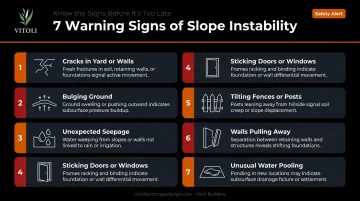
Seeing two or more of these signs together is a strong signal to get a professional site assessment — waiting typically means a more expensive fix.
Soil Conditions That Indicate Risk Before Damage Appears
Visible failure is often preceded by soil conditions that a trained evaluator can identify during inspection:
- Expansive clay soils that shrink and swell with moisture, causing uplift, cracking, and foundation movement — a documented issue in LA's fine-grained hillside soils
- Compacted fill on graded lots, which behaves differently from native soil once saturated and is common across LA County hillside developments
- Previously excavated or regraded ground that was built on without proper geotechnical preparation, which carries significantly higher failure risk
The LA County Residential Code Manual requires soil tests where expansive, compressible, or shifting soils are likely — reflecting how common these conditions are across the county's hillside neighborhoods.
Land Stabilization Methods Explained
No single method works for every site. The right approach depends on soil type, slope degree, load requirements, and site-specific conditions. Methods fall into two broad categories: chemical or soil treatment, and structural or mechanical stabilization. Most hillside projects combine several.
Mechanical Compaction and Regrading
Mechanical compaction uses equipment to densify loose or disturbed soil, increasing its bearing strength. Regrading reshapes slopes to reduce steep angles and improve surface drainage.
This is typically the starting point for most stabilization projects — particularly when soil is loose from prior grading but not chemically problematic. It addresses the most basic cause of instability: soil that hasn't been properly consolidated.
Chemical Soil Stabilization
Chemical stabilization introduces agents — most commonly lime or Portland cement — directly into existing soil to permanently alter its engineering properties.
- Lime raises soil pH and triggers pozzolanic reactions that create cementitious bonds in clay soils. It's appropriate for soils with at least 10% clay content and a plasticity index (PI) of 10 or greater, per FHWA screening criteria.
- Cement binds granular particles together and cures faster (within hours to three days), but is less effective in high-clay soils.
- Fly ash and Lime Kiln Dust (LKD) are supplementary co-products that can reduce cost for moderate-PI soils.
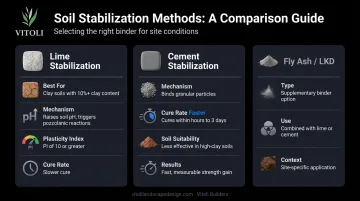
Validate dosage rates through laboratory mix design. A geotechnical report is essential before any chemical stabilization begins.
Structural Stabilization: Retaining Walls and Caissons
For hillside residential properties, structural methods are often the primary stabilization strategy.
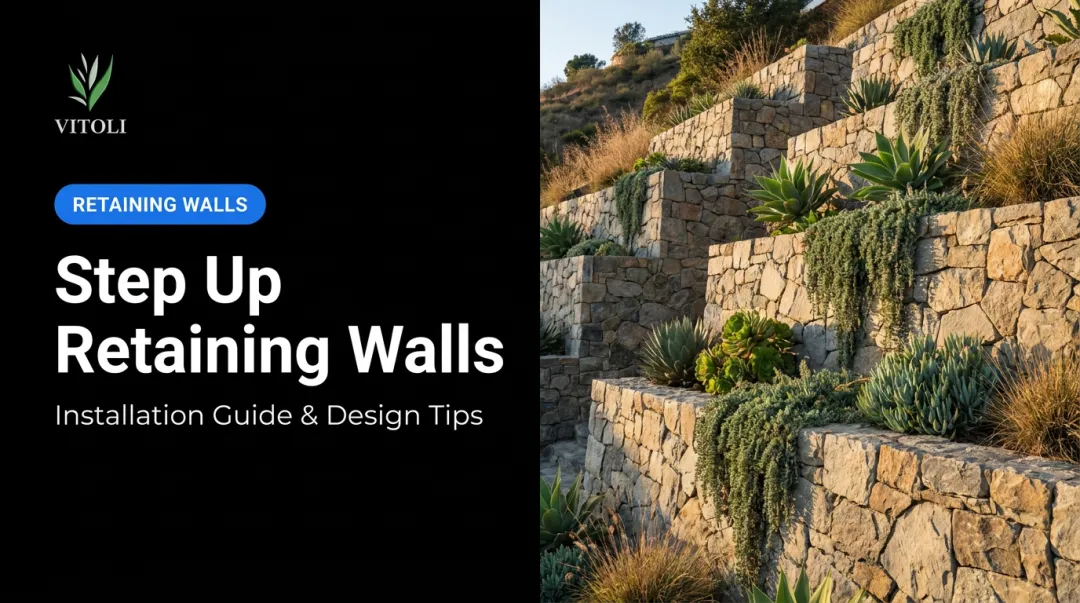
Retaining walls hold back soil masses, redistribute lateral earth pressure, and create level usable terraces on sloped land. Vitoli Builders installs several wall types: concrete, masonry block, natural stone, and poured-in-place systems. Every installation incorporates integrated drainage — gravel backfill, perforated drain lines, and weep systems — to relieve hydrostatic pressure.
Caissons are deep concrete piers drilled into stable soil or bedrock below unstable upper layers. They provide the foundational support that allows structures — retaining walls, elevated patios, pools — to be safely built on terrain that conventional spread footings cannot handle. Vitoli's caisson process covers:
- Drilling to depth specified by engineering analysis
- Reinforcement steel installation
- Concrete placement sized to site-specific diameter and load requirements
Erosion Control and Bioengineering
Erosion control methods address surface stability through vegetation and physical barriers:
- Hydroseeding and native slope plantings
- Erosion control blankets (ECBs) for temporary or permanent slope protection
- Live staking and coir logs for bioengineering applications
Research shows root reinforcement can produce an 11.2% increase in safety coefficient in studied slope models. The California Native Plant Society recommends deep-rooted native species — such as laurel sumac and woolly blue curls — specifically for hot, steep Southern California slopes.
Vegetation is a valuable complement to structural stabilization, not a substitute for it where active movement exists.
Geosynthetics: Geogrids and Geotextiles
Geogrids are rigid polymer grid materials placed within aggregate layers. They interlock with soil particles, increasing the strength and stiffness of the stabilized layer. Geotextiles are permeable fabrics that separate, filter, reinforce, and drain soil layers.
Both are used in slope reinforcement, retaining wall backfill, and drainage-sensitive applications. FHWA guidance supports a 75-year design life for permanent mechanically stabilized earth (MSE) walls. Specific geogrid products are rated at 75 to 100 years, depending on product specification and application.
Land Stabilization on Southern California Hillside Properties
Southern California presents a compounding set of stabilization challenges that most other regions don't face simultaneously.
The Regional Risk Stack
| Risk Factor | Key Data Point |
|---|---|
| Seasonal rainfall | Hillsides become susceptible after approximately 10 inches of cumulative seasonal rainfall |
| Post-fire debris flows | As little as 7mm of rain in 30 minutes can trigger debris flows after wildfire |
| Seismic landslides | The 1994 Northridge earthquake triggered more than 11,000 landslides across roughly 10,000 km² |
| Expansive soils | Clay-heavy soils shrink and swell seasonally, stressing foundations and hardscape |
Wildfire adds a particularly dangerous layer: fire removes stabilizing vegetation and creates hydrophobic soil layers that dramatically accelerate surface runoff and erosion. Post-fire hillsides can fail on rainfall amounts that would cause no problem on intact slopes.
What a Multi-Method Hillside Project Looks Like
A complex Southern California hillside project rarely relies on one approach. A representative Vitoli Builders project — starting with an eroded, poorly drained slope — typically involves:
- Site evaluation: soil composition, slope grade, drainage patterns, and load requirements
- Caisson installation where deep foundation support is needed
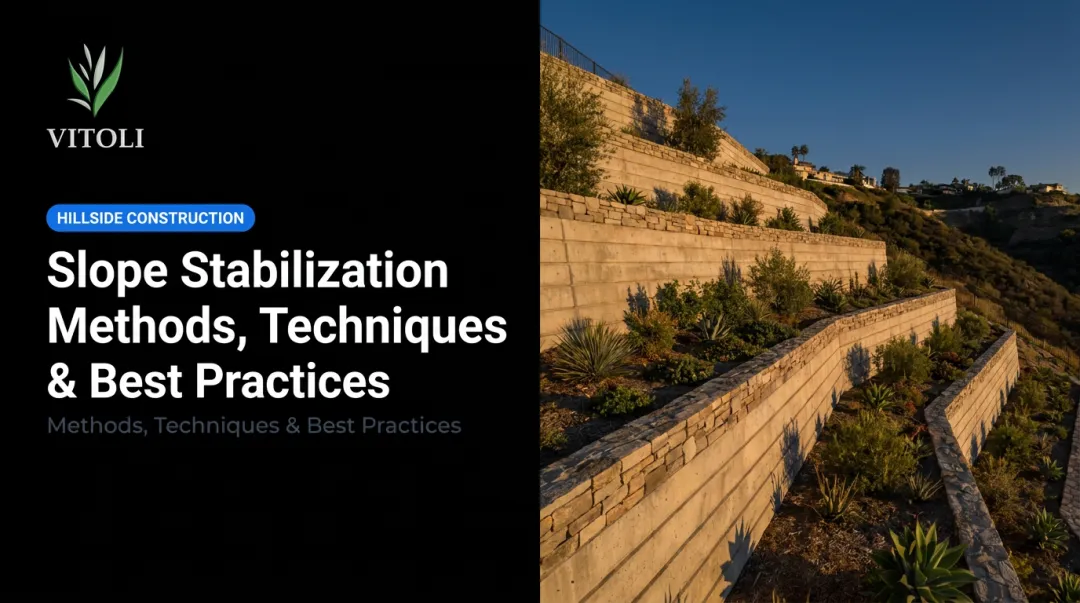
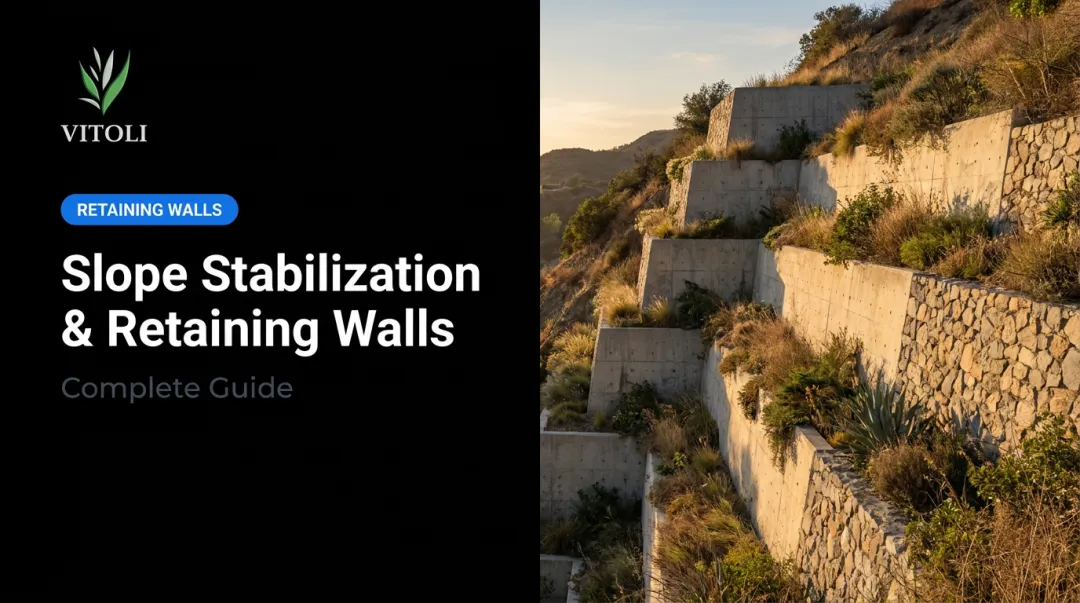
- Tiered retaining wall systems to manage lateral pressure and create usable levels
- Integrated drainage: gravel backfill, perforated drain lines, and weep systems built into the wall
- Regrading to redirect runoff and reduce erosion risk
- Landscaping integration: native plantings, stone steps, and hardscape terraces
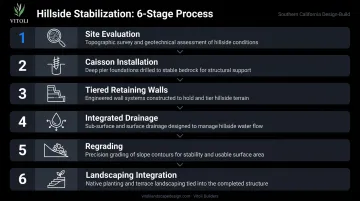
The steeper the grade and the more complex the soil, the more each element depends on the others being done right. Vitoli Builders has completed over 1,800 hillside projects across Los Angeles and Ventura Counties, with CEO Rob Litman bringing over 20 years of experience in exactly this kind of terrain.
California Permit Requirements
Most hillside stabilization work in this region requires permits. The specifics vary by jurisdiction:
Unincorporated LA County: Permits are required for retaining walls supporting level grade over 4 feet from the bottom of the foundation to the top of the wall, and for retaining walls of any height supporting a surcharge or slope. Geotechnical reports are required for walls supporting slopes steeper than 2:1 or backfill greater than 12 feet, per the LA County retaining wall design manual.
City of Los Angeles: LADBS requires grading permits for work in hillside grading areas, including removal, recompaction, and backfill. Soils and geological reports are required when stipulated.
Ventura County: Geotechnical soils reports are required for most site grading, retaining walls, and hillside construction under Ventura County Appendix J.
Vitoli Builders handles permit applications and geotechnical coordination directly, so homeowners don't have to manage that process themselves.
What Stabilization Unlocks Beyond Protection
Well-executed stabilization does more than prevent failure. It converts previously unusable slopes into functional outdoor space: terraced gardens, level patios, entertaining areas, and even pool-ready platforms. One Woodland Hills homeowner put it this way: "I don't think that I could have, in my head, imagined how much better it would look after Rob worked his magic."
Frequently Asked Questions
What does land stabilization mean?
Land stabilization is the process of improving soil or terrain strength, load-bearing capacity, and resistance to movement through physical, chemical, structural, or vegetative means. The goal is to prevent erosion, slope failure, or foundation settlement before damage occurs.
What are some examples of stabilization?
Common examples include a retaining wall holding back a cut hillside, lime mixed into clay soil before construction, geogrid-reinforced aggregate under a foundation slab, and deep-rooted native plantings securing an eroding slope. Most hillside projects combine several of these methods.
How long does soil stabilization last?
Chemical treatments like lime and cement last decades when protected from water intrusion, while engineered geogrid systems are typically rated for 75–100 years. Retaining walls and caissons are permanent structural solutions. Vegetation-based stabilization matures over several years and needs periodic maintenance.
What are the warning signs that a hillside property needs stabilization?
Watch for cracks in retaining walls or foundations, soil erosion or slumping after rain, tilting fences or retaining structures, doors and windows that stick unexpectedly, and unusual water pooling at the base of a slope. Any of these warrants a professional site assessment.
Do land stabilization projects in California require permits?
Generally, yes. Retaining walls over 4 feet, caisson work, and significant grading in LA County and Ventura County typically require permits and a geotechnical report. Requirements vary by jurisdiction, so a licensed local contractor can manage this process for you.