Introduction
On a sloped backyard, water doesn't spread evenly — it accelerates. Instead of distributing broadly and soaking in gradually, runoff accelerates downhill, concentrating at the base of slopes, pooling against foundations, and carving erosion channels through topsoil.
This is a recurring challenge across Southern California hillside communities, where steep grades and slow-draining clay-heavy soils create conditions where rainfall exceeds the ground's infiltration capacity — NRCS data shows clay soils absorb just 0.04 to 0.2 inches per hour, compared to over 0.8 inches per hour for sandy soils. When rain hits faster than the ground can accept it, everything flows downhill.
This guide covers:
- How to identify what type of drainage problem you actually have
- The best fixes for sloped terrain — swales, French drains, retaining walls, and more
- A step-by-step installation approach
- When to DIY versus when to call a professional
Key Takeaways
- Sloped yards concentrate and accelerate runoff — the fix must intercept water before it reaches problem areas
- Mild slopes need only regrading or swales; steep terrain requires French drains, retaining walls, or engineered systems
- Diagnose the specific symptom first — choosing a solution without it leads to wasted cost and repeat failures
- DIY works for gentle slopes; foundation risk or steep grades above 20% require a licensed hillside contractor
- Regular maintenance — clearing drains, inspecting walls, preserving ground cover — stops most problems from returning
Why Sloped Backyards Have Unique Drainage Challenges
On a flat yard, rainwater spreads out and percolates relatively evenly. On a slope, it does neither. Gravity pulls water into concentrated channels, increasing both speed and volume as it moves downhill — eroding soil, undercutting structures, and depositing everything at the base of the slope.
The USDA's Revised Universal Soil Loss Equation (RUSLE) calculates erosion using slope length and steepness as direct multipliers — longer, steeper slopes produce proportionally more soil loss per rain event. Pacific Coast erosivity is also highest in late fall and early winter, meaning Southern California hillside properties absorb the full impact of seasonal storms before most vegetation has time to establish.
Soil composition makes both infiltration and erosion worse. Southern California's clay-heavy soils create three compounding issues:
- Slow infiltration — at 0.04–0.2 in/hr, clay-heavy soil can't accept water fast enough during moderate rain, forcing most of it to run off rather than absorb
- High runoff potential — NRCS Hydrologic Soil Group D soils (more than 40% clay) have very slow water transmission and high runoff potential when saturated
- Erosion vulnerability — fast-moving sheet flow strips exposed topsoil readily, especially on bare or sparsely vegetated slopes
Left unaddressed, these conditions lead to eroded slope faces, retaining wall failure from hydrostatic pressure buildup, foundation undermining, dead landscaping, and costly structural repairs. On Los Angeles County hillsides, where clay soils and steep grades combine with late-season storm surges, drainage problems rarely stay manageable on their own — they escalate.
How to Identify Your Sloped Yard's Drainage Problem
Before choosing any fix, observe the yard during or immediately after a rainstorm. Walk the property and note where water enters, where it travels, where erosion channels are forming, and where it backs up against structures or pools.
Skipping this step turns diagnosis into guesswork. The wrong solution on a slope wastes money and often makes the problem worse.
Identifying Problem Type by Symptom
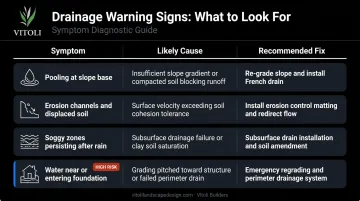
| Symptom | Likely Cause | Starting Point |
|---|---|---|
| Pooling at slope base or near foundation | Water runs faster than soil can absorb; grading or permeability issue | Regrading, swale, or French drain intercept |
| Erosion channels, exposed roots, displaced soil | High-velocity sheet flow stripping topsoil | Retaining walls, ground cover, or gravel beds |
| Soggy zones that stay wet for days after rain | Poor subsoil drainage or subsurface low point | French drain, dry well, or catch basin |
| Water near or entering the foundation | Surface water not redirected away from structure | Immediate professional assessment |
The IRC requires surface lots to fall at least 6 inches within the first 10 feet from foundation walls, and Orange County's site grading policy cites the same standard under the 2022 California Residential Code. If your yard slopes toward the house rather than away from it, that's a code-level problem, not a cosmetic one.
Best Drainage Fixes for a Sloped Backyard
No single solution works for every slope. Effective drainage on sloped terrain almost always combines more than one method. The right combination depends on slope severity, soil type, proximity to structures, and whether the primary problem is surface runoff, subsurface saturation, or both.
Regrading and Slope Correction
Regrading reshapes existing soil so water flows away from the home. Code standard: at least 6 inches of fall over the first 10 feet from the foundation (equivalent to 5% slope, or 0.6 inches per foot). Swales within 10 feet of a foundation require a minimum 2% slope toward a drainage outlet.
Use compacted soil when building a grade. Loose topsoil or mulch washes away in the first heavy rain.
French Drains
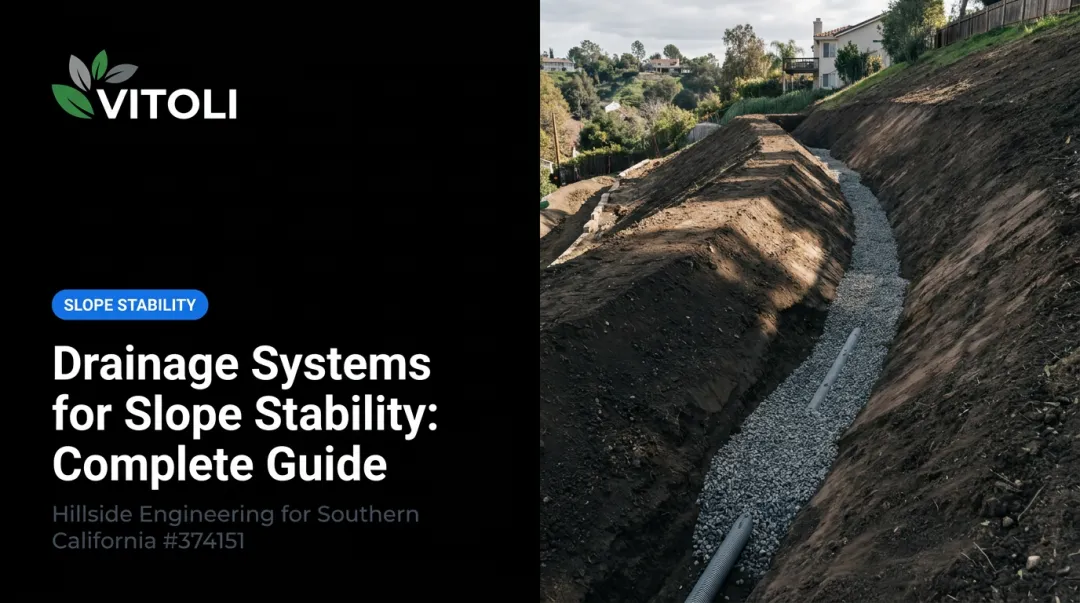
A French drain intercepts water mid-slope before it reaches problem areas. The trench is cut perpendicular to water flow, lined with filter fabric, filled with gravel, and fitted with perforated pipe that channels water to a designated outlet: a dry well, drain emitter, or property edge.
Key specs per BASC stormwater guidance: French drains should be 18 inches or more below ground with a positive slope toward the outlet. They're most effective for recurring wet zones, soggy mid-slope areas, and subsurface saturation.
Installed costs run $10–$100 per linear foot, averaging around $45/lf.
Swales
Swales are shallow, graded channels (grass-lined or rock-lined) that run along or perpendicular to the slope contour, slowing and redirecting sheet flow. They're low-cost, can double as a landscape feature, and work well on mild to moderate slopes.
UC ANR recommends swale channels at least 6 inches deep, capable of handling brief high-flow events. Expect to pay $5–$15 per linear foot.
Retaining Walls with Drainage Backfill
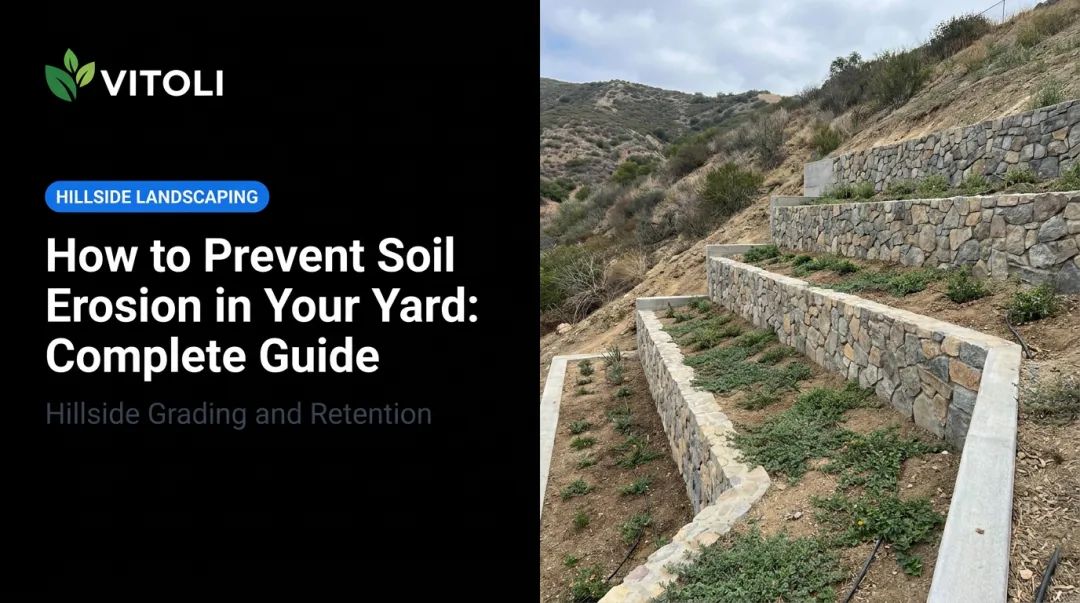
On steep slopes, retaining walls do two jobs: they physically hold soil in place to prevent erosion and create level terraces, and when built correctly, they manage water behind them.
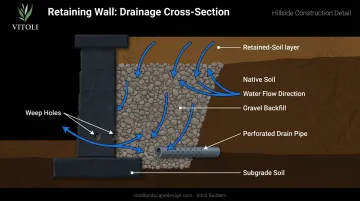
Every properly built retaining wall must include:
- Gravel backfill to allow water to percolate rather than accumulate
- Perforated drain lines to collect and redirect that water
- Weep holes or weep systems to relieve hydrostatic pressure at the wall face
A wall built without these provisions traps water behind it. Hydrostatic pressure is one of the leading causes of retaining wall failure: bulging, cracking, and outright collapse.
That failure risk also carries permitting implications. In California, retaining walls over 4 feet from bottom of footing to top of wall typically require a permit. Walls on hillside properties supporting surcharge loads are permit-sensitive regardless of height.
Budget $35–$65 per square foot installed; typical projects run $3,193–$9,182.
Dry Creek Beds
Dry creek beds are surface channels lined with rocks of varying sizes, designed to guide stormwater to a safe outlet. They handle high-flow events well, prevent bare soil erosion, and can be visually attractive. Line the base with landscape fabric before placing rock to prevent soil migration into the drainage layer.
Catch Basins
Catch basins collect concentrated water at slope bases or downspout termination points and route it through buried PVC pipe to an outlet. Installing underground downspout drainage costs $150–$350 per downspout and is often one of the highest-impact, lowest-cost fixes when roof runoff is accelerating the problem.
Catch basin installation runs $200–$2,000 each depending on size and depth.
Step-by-Step: How to Fix Drainage in a Sloped Backyard
Step 1: Map and Stake the Water Flow Path
Walk the yard during or right after a rainstorm. Mark with flags or spray paint where water enters, how it travels, and where it exits or pools. Photograph erosion channels and areas where soil has moved. This map drives every installation decision that follows.
Step 2: Excavate and Grade the Site
Based on your chosen solution:
- French drain: Dig a trench at the intercept point, angled toward the outlet
- Swale: Shape a shallow channel with consistent slope — minimum 2%
- Retaining wall: Excavate footing area and prepare subgrade
Tamp soil between layers and verify slope direction with a level. Getting this step right determines whether the system works long-term.
Step 3: Install the Drainage System
Install components in order:
- Lay perforated pipe wrapped in filter fabric before adding gravel and backfilling French drains
- Set catch basins at low points and connect to outlet pipe before filling in around them
- Build retaining walls with gravel backfill layers, keeping weep holes unobstructed
- Line dry creek beds with landscape fabric before placing rock
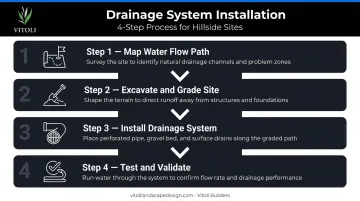
Step 4: Test and Validate
Run a hose from the uphill entry point and confirm the system performs as designed. Then check again after the first real rainstorm:
- Water follows the intended path to the designated outlet
- No new pooling zones have formed elsewhere in the yard
- No erosion channels have opened along the drain line
- Pipe inlets and catch basins remain clear and unobstructed
Common follow-up fixes include re-grading short runs, clearing blocked inlets, or adding a secondary catch basin at a new low point.
DIY vs. Hiring a Professional for Sloped Yard Drainage
What Homeowners Can Tackle
These fixes are DIY-accessible with basic tools and a motivated approach:
- Downspout extensions and redirected pipe
- Minor regrading on gentle slopes
- Basic swale shaping
- Dry creek beds
- Adding gravel beds to erosion-prone areas
When to Call a Professional
Some situations simply require licensed expertise:
- Slopes above 20% — LA County grading guidance identifies this threshold for drainage-control requirements
- Foundation water intrusion — any sign of water entering the home warrants immediate professional assessment
- Active erosion or slope movement — exposed soil, displaced root systems, or visible slope shifting
- Retaining walls — especially over 4 feet or on hillsides with surcharge loads (permit-required)
- Engineered drainage systems requiring soil mechanics analysis and hydrostatic pressure calculations
When the complexity of your site exceeds what any shovel-and-YouTube approach can solve, Vitoli Builders handles the full scope: retaining walls, precision grading, drainage system integration, and erosion control for hillside properties across Los Angeles County and Ventura County. With over 20 years of hillside construction experience, their process starts with a site evaluation covering soil composition, slope grade, and drainage pattern mapping before any work is scoped.
Project Manager Oz Tzalalihin coordinates directly between clients and crews throughout each project, identifying cost-reduction opportunities early — before they become expensive field corrections.
How to Prevent Sloped Yard Drainage Problems from Returning
Good drainage systems don't maintain themselves — especially on slopes where forces are greater and soil movement is ongoing.
Seasonal maintenance checklist:
- Clear all drain openings, swale channels, and downspout outlets before and after rainy season
- Inspect retaining walls for hydrostatic pressure signs: bulging, cracking, or soil seeping around weep holes
- Regrade any areas where soil has settled or eroded
- Keep ground cover and gravel beds intact — bare soil creates new erosion channels fast
Deep-rooted native plants and ground covers anchor soil, slow surface runoff, and improve subsoil permeability over time. The California Native Plant Society recommends slope plants that control erosion and tolerate drought. In Southern California specifically, fire-resistance matters too — fire season can strip ground cover entirely and leave slopes fully exposed to the first winter rains.

That fire risk has real data behind it. USDA Forest Service research found post-fire erosion remained elevated two years after high-severity burning, and soil compaction nearly doubled erosion rates in affected areas. If your hillside has lost ground cover to fire, reestablishing vegetation before winter rains isn't a landscaping preference — it's a structural necessity.
Frequently Asked Questions
How do I know if my sloped backyard has a serious drainage problem?
Key warning signs: persistent pooling at the slope base after rain, visible erosion channels or displaced soil on the slope face, and ground that stays soggy for days. Any water near or entering the foundation warrants immediate professional assessment — that situation moves from drainage inconvenience to structural risk quickly.
What is the best drainage solution for a steep backyard slope?
Steep slopes typically need a combination: retaining walls to terrace the grade and control soil movement, French drains to intercept subsurface water, and gravel backfill or swales to manage surface runoff. On grades above 20% (where LA County drainage-control requirements apply), professional engineering is usually required.
Can I fix sloped yard drainage myself, or do I need a professional?
Mild slope issues like downspout extensions, gentle regrading, basic swales, or dry creek beds are DIY-accessible. Any project involving steep grades, retaining walls over 4 feet, foundation risk, or engineered drainage systems should be handled by a licensed contractor with hillside construction experience.
How much does it cost to fix drainage in a sloped backyard?
Typical ranges: French drains run $10–$100/linear foot; swales run $5–$15/linear foot; catch basins cost $200–$2,000 each; retaining walls average $35–$65/sq ft. Total project costs scale with slope severity and complexity, with Southern California hillside jobs typically landing at the higher end.
Do retaining walls help with drainage in a sloped backyard?
Yes — when built correctly. Properly constructed walls with gravel backfill, perforated drain lines, and weep holes create level terraces that slow runoff and allow subsurface water to pass through safely. Walls built without these drainage provisions trap hydrostatic pressure and eventually fail.
How do French drains work on a slope?
A French drain is a trench cut perpendicular to water flow, lined with gravel and perforated pipe to intercept runoff before it reaches problem areas. Water is channeled downhill to a designated outlet — a dry well, drain emitter, or the property edge — following the trench's consistent grade.