Understanding why erosion occurs is the first step toward stopping it. This guide covers the main causes, the warning signs you shouldn't ignore, and the layered prevention strategies that actually work — from ground cover and mulch to engineered retaining walls and drainage redesign. Whether you're dealing with a mild slope or a steep hillside grade, the right combination of solutions can protect your yard before the damage becomes expensive.
Key Takeaways
- Bare soil, steep unmanaged grades, poor drainage, and shallow-rooted cover are the four main erosion drivers.
- Plots with over 45% ground cover produce up to 16x less sediment than bare soil, per NRCS research.
- Plant deep-rooted natives before Southern California's rainy season (November–March) for maximum root establishment.
- Retaining walls require drainage fabric, gravel backfill, and weep holes to prevent hydrostatic pressure buildup and structural failure.
- Foundation repair averages $5,176 nationally; acting early costs far less.
Common Causes of Soil Erosion in Your Yard
Soil erosion is the displacement of topsoil by water, wind, or gravity. It rarely has a single cause — it accelerates when multiple risk factors combine. On Southern California hillsides, that combination is common.
Bare and Exposed Soil
Unprotected soil is the fastest-eroding condition. When rain hits bare dirt, it dislodges particles directly and carries them downhill with each drop. There's no root structure to hold the surface together, no organic layer to absorb impact.
Common scenarios:
- Post-construction grading that leaves raw earth exposed
- Dead grass patches from drought, foot traffic, or seasonal die-back
- Garden beds left unplanted or unmulched over winter
Steep Slopes Without Stabilization
Gravity does the rest on a steep grade. The steeper the slope, the faster runoff moves, and faster water carries more soil. NRCS hillslope research reports that erosion potential increases by a factor of 10 as slope gradient rises from 0% to 10%, while the University of Minnesota Extension classifies slopes over 10% as high erosion-potential areas.
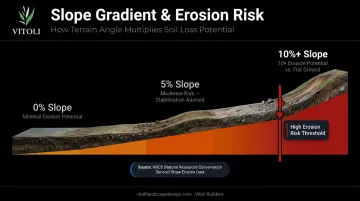
Most Southern California hillside yards fall well above that threshold, which means seeding alone isn't a solution. Slopes without terrace breaks, cleared hillsides, and grades that have never had proper vegetation are particularly vulnerable.
Poor Drainage and Misdirected Water
When water has no controlled path off your property, it carves its own. Downspouts discharging directly into lawn areas, improperly sloped patios, and blocked gutters all concentrate flow and accelerate erosion in localized spots.
Real-world examples:
- Downspout outflow washing out planting beds over a single storm season
- Paved driveways funneling runoff directly toward unprotected slopes
- Hardscape areas without drainage channels directing water to the same low point repeatedly
Shallow-Rooted or Insufficient Ground Cover
Lawn grass has shallow roots. During heavy rain or extended saturation, topsoil has little holding it in place. Over-irrigation makes this worse: saturated soil loses its structural bond with roots, making even vegetated areas vulnerable during Southern California's wet season.
What Happens When Soil Erosion Goes Unchecked
Unchecked erosion follows a predictable path: bare patches deepen into rills, rills become gullies, and altered grading redirects water straight toward your foundation. Left alone long enough, the result is foundation cracks, sinking retaining walls, and unlevel hardscapes — problems that are far more expensive to fix than to prevent.
According to HomeAdvisor's 2026 data, foundation repair averages $5,176, with most homeowners spending between $2,225 and $8,135. Retaining wall repairs add another layer: Angi's 2026 cost data lists typical retaining wall repair at $450–$950, but bowing wall repairs can run $65–$85 per square foot, and major failures can reach $14,500.
The damage doesn't stop at your property line. Sediment washing from hillside yards enters California's regulated stormwater systems under Clean Water Act Section 402(p). LA County's LID standards require covered development projects to manage stormwater quality — and homeowners whose runoff repeatedly enters storm drains may face scrutiny under local illicit discharge definitions. For hillside properties in LA and Ventura counties, where slopes are steeper and soils looser, that risk is higher than most homeowners realize.
Warning Signs You're Already Losing Soil
Catch these early and the fix is manageable:
Visible signs:
- Exposed plant or tree roots at the soil surface
- Bare patches that expand after each rainfall
- Small channels or rills forming across slopes
- Mulch or topsoil washing onto driveways, walkways, or the street
Structural signs:
- Pavers, patios, or walkways that are sinking or becoming uneven
- Retaining walls showing cracks, bowing, or visible lean
- Standing water pooling near the home's foundation after rain
How to Prevent Soil Erosion in Your Yard
On a hillside property, no single measure is enough. Prevention works in layers — plant cover, surface protection, structural hardscape, and drainage control each address different mechanisms. Together, they create a yard that holds through both heavy rain and dry spells.
Plant Deep-Rooted Vegetation and Ground Cover
The root system is your first line of defense. Deep, dense roots bind soil the way rebar holds concrete — shallow lawn grasses don't come close.
Recommended plants for Southern California slopes:
- Native bunch grasses — California bunchgrasses can develop roots 10–20 feet deep, providing extensive fibrous soil-binding systems
- Ceanothus — a reliable, drought-tolerant slope holder recommended by CNPS for sunny hillsides
- California fescue — suited to shaded or semi-shaded slope conditions
- Creeping rosemary — drought-tolerant and fast-spreading; not native but effective on dry slopes
- Creeping sage, Bee's Bliss sage, buckwheat, and manzanita — all listed by CNPS as strong slope holders
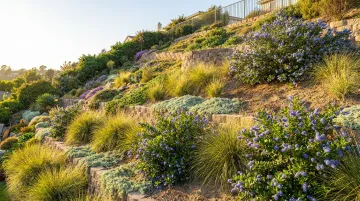
For bare areas that need fast coverage, use spreading groundcovers or temporary erosion-control seed mixes while slower-growing plants establish. The timing matters: both CNPS and UC ANR recommend planting California natives in late fall specifically because warm soil and winter rains help root systems establish before the following dry summer.
Apply Mulch and Organic Surface Cover
Mulch does two things: it absorbs raindrop impact so soil particles aren't dislodged on contact, and it slows surface runoff velocity so water has time to soak in.
UC Master Gardener guidance recommends 2–4 inches in general landscape areas and 4–6 inches on slopes. Shredded bark or wood chips work well. Avoid piling mulch against plant stems or structures.
For newly seeded or freshly graded slopes, biodegradable erosion control blankets (coir or jute mats) are a practical addition. They hold seed and topsoil in place until vegetation is established — UC Marin Master Gardeners recommend temporary measures like these for the first couple of years after new hillside planting.
Install Retaining Walls or Terraces on Slopes
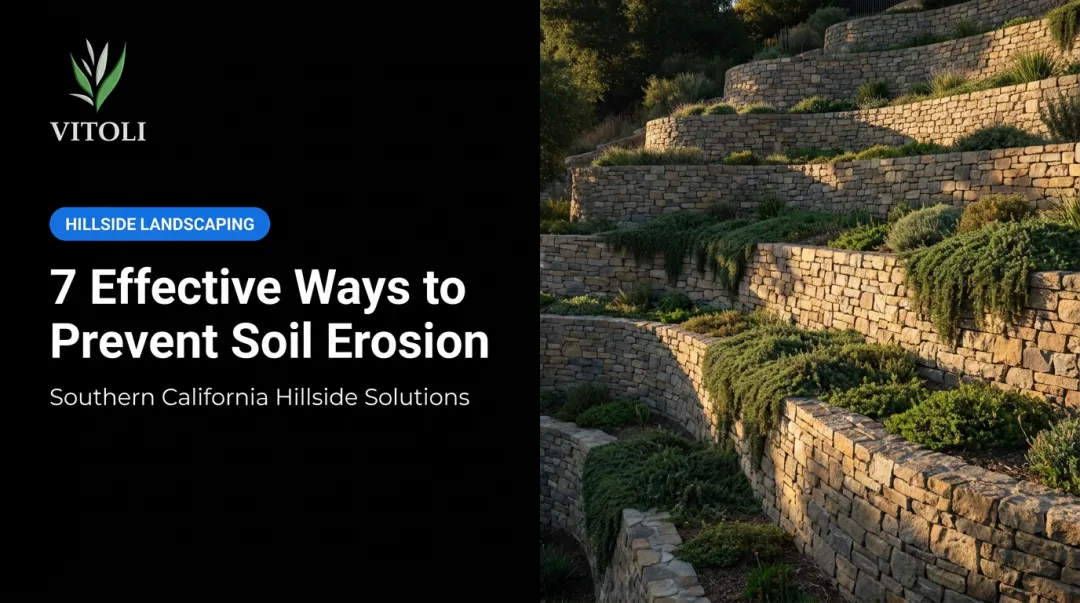
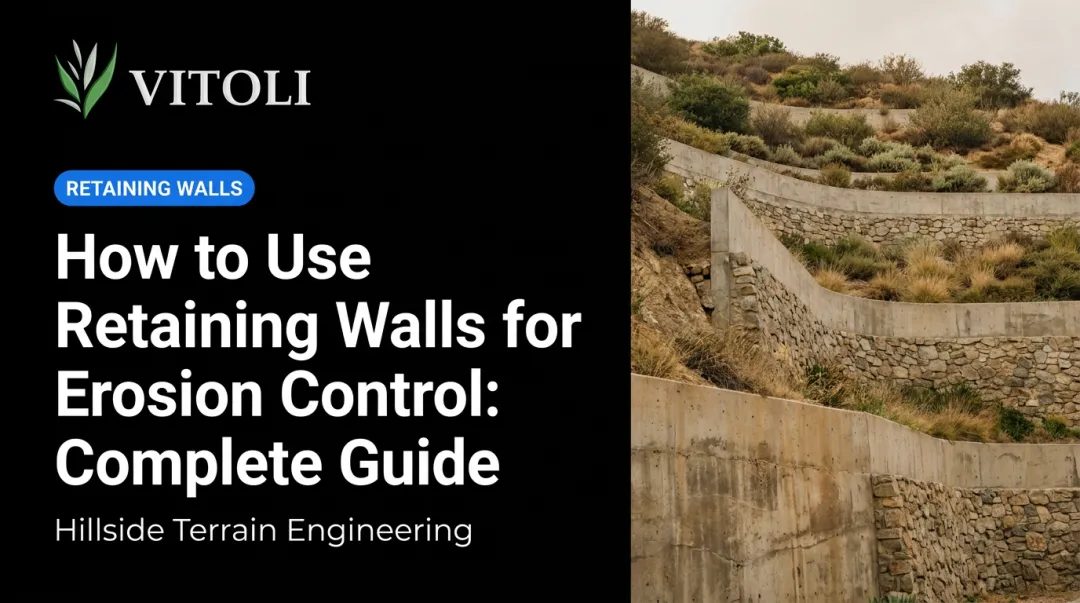
Retaining walls and terraces break a long, steep grade into shorter, manageable levels. Each tier slows water velocity, catches runoff, and gives soil and plants time to absorb moisture before water moves further downhill.
Critical construction requirements:
- Gravel backfill behind the wall to allow water to percolate rather than accumulate
- Perforated drain lines to actively redirect water away from the structure
- Weep holes or weep systems to relieve hydrostatic pressure
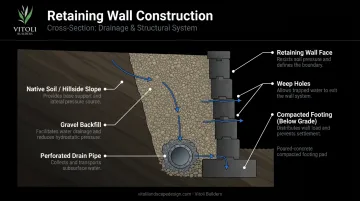
Without proper drainage, water pressure builds behind the wall until it fails. LA County's retaining wall design requirements mandate stability against overturning, sliding, excessive foundation pressure, and water uplift — and require drainage by subdrains, weep holes, or approved methods.
Permit thresholds to know:
- LA County requires permits for retaining walls over 4 feet (measured from bottom of footing to top of wall) supporting level grade — and for walls of any height supporting a surcharge or slope
- The City of Ventura uses the same 4-foot threshold; walls supporting a surcharge at any height also require permits
For complex hillside properties in LA or Ventura County, Vitoli Builders builds retaining wall systems with gravel backfill, perforated drain lines, and weep systems as standard. All designs meet local building codes. Homeowners can choose from concrete, masonry block, natural stone, or poured-in-place systems for both structural performance and visual fit.
Improve Yard Drainage to Redirect Water Safely
A retaining wall stabilizes the slope — but if water has nowhere to go, it will find the weakest point. Redirecting drainage away from structures and saturated soil is just as important as what you plant or build.
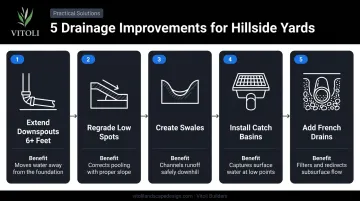
Practical drainage improvements:
- Extend downspouts at least 6 feet from the foundation, directing discharge toward absorbent surfaces — not steep slopes
- Regrade low spots so surface flow moves away from the home rather than pooling near the foundation
- Create gentle swales to guide water to a safe outlet at the property edge
- Install catch basins in chronic ponding areas to collect and convey surface water underground
- Use French drains to intercept subsurface water before it saturates soil near structures
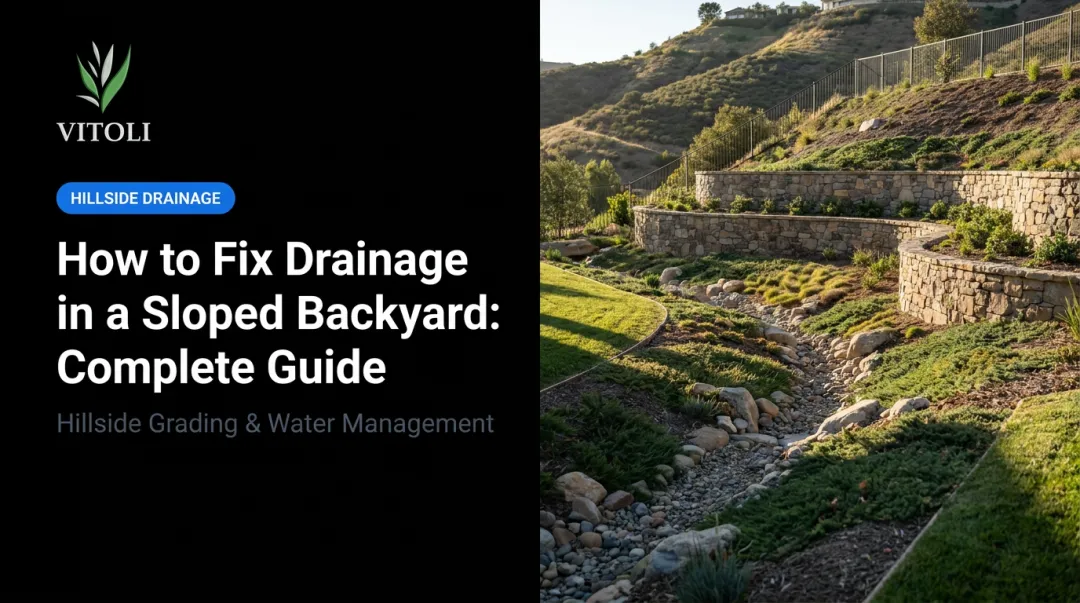
Dry creek beds work particularly well on hillside properties. They manage runoff effectively and look intentional — a drainage solution that fits a terraced hillside landscape rather than disrupting it.
Tips for Long-Term Erosion Prevention and Control
Erosion control requires ongoing attention — here's what to stay on top of:
- Inspect after heavy rain events — walk the yard and check for new bare spots, rill formation, mulch displacement, or changes in drainage patterns. Small problems caught early are inexpensive to fix.
- Replace mulch annually before rainy season — reseed bare patches promptly. Never leave soil exposed during or after landscaping or construction work.
- Keep drainage systems clear — clean gutters and inspect catch basin grates and French drain inlets at least twice per year. A blocked drain can redirect water into unprotected areas in a single storm.
- Know when to escalate — gullies forming, retaining walls shifting, or moisture showing up near the foundation are signs the problem has exceeded DIY capacity. A licensed hillside contractor like Vitoli Builders can assess what's happening beneath the surface and recommend the right structural solution.
Conclusion
Soil erosion has identifiable causes and manageable solutions — the key is acting before damage compounds. Each layer of the problem has a corresponding fix:
- Ground cover builds root-level stability in the soil
- Mulch and erosion blankets protect exposed surface areas
- Retaining walls and terraces manage steep grades
- Drainage improvements redirect water before it concentrates and cuts
For hillside homeowners in LA or Ventura County, the window before each rainy season is the time to assess and act. For complex slopes, existing damage, or projects requiring engineered walls and drainage permits, Vitoli Builders handles all of these layers under one contractor — with over 20 years of hillside construction experience across Southern California (CA License #1043914).
Frequently Asked Questions
What is the cheapest way to prevent soil erosion?
Cover bare soil with mulch, extend downspouts away from the foundation, and reseed bare patches before rain arrives. These steps cost a fraction of what erosion damage repairs run — and they target the conditions that let erosion take hold in the first place.
What plants are best for preventing soil erosion on a slope?
Deep-rooted natives are the strongest choice for Southern California slopes: ceanothus, California bunch grasses, California fescue, and creeping sage. Root depth matters more than surface coverage. Shallow-rooted plants can't anchor soil during heavy rain; natives with extensive root systems can.
How do retaining walls help prevent soil erosion?
Retaining walls break steep grades into level tiers, slow runoff velocity at each level, and physically anchor soil in place. Proper drainage behind the wall is essential: gravel backfill, drain lines, and weep holes all prevent hydrostatic pressure from building up and causing the wall to fail.
How do I know if my yard has a soil erosion problem?
Look for exposed roots or tree bases, bare patches that grow after each rainfall, small channels forming on slopes, and mulch or topsoil washing onto hardscapes. Sinking pavers, uneven walkways, and standing water near the foundation are structural signs that erosion is already affecting the property.
Can soil erosion damage my home's foundation?
Yes — unchecked erosion shifts soil away from the foundation, alters drainage patterns toward the home, and can cause settling, moisture intrusion, and cracking. On hillside lots, slope instability makes this risk especially serious.
When should I call a professional for soil erosion problems?
Contact a professional when gullies are forming, retaining walls are cracking or shifting, drainage is affecting the foundation, or the slope requires permitted retaining walls under local code. These scenarios require engineered solutions, not surface treatments.