Introduction
For hillside homeowners in Los Angeles County and Ventura County, poor drainage isn't just an inconvenience — it's often the hidden trigger behind slope erosion, soil movement, and outright slope failure. After heavy rain events, water doesn't just run off the surface. It infiltrates, accumulates, and steadily breaks down the soil structure holding your hillside in place.
The problem compounds quickly. Southern California's wet/dry seasonal cycle means slopes absorb little during dry months, then face intense infiltration pressure the moment rains arrive. By the time visible damage appears — cracked ground, slumping soil, a retaining wall that's started to lean — the groundwater conditions causing that damage have often been building for weeks.
Understanding that sequence — how water moves, where it collects, and what it does to soil over time — is what makes the difference between a drainage fix that lasts and one that just delays the next failure. This guide walks through each piece of that picture.
Key Takeaways
- Water-saturated soil loses shear strength — the leading cause of slope failure on residential hillside properties
- Three main drainage categories exist: surface, subsurface, and horizontal drain systems, each suited to different conditions
- Ground cracking, standing water, and sticking doors are warning signs of active drainage problems that need professional attention
- The correct drainage approach depends on slope angle, soil type, groundwater depth, and proximity to structures
- Drainage systems need seasonal inspections, particularly before and after Southern California's rainy season, to stay effective
Why Water Is the Primary Cause of Slope Failure
The Mechanics of Saturation
When rain falls on a hillside, some water runs off the surface. The rest infiltrates. As it moves downward through soil, it raises the groundwater table and increases what engineers call pore-water pressure (the pressure of water held within the voids between soil particles).
This matters because pore-water pressure directly undermines a slope's ability to hold itself together. As Caltrans confirms, increased pore-water pressure reduces effective stress and shear strength in soil. The USGS describes groundwater as the most important single contributor to landslide initiation — a rising water table reduces the resisting forces that keep slope material in place, while a falling water table restores them.
When shear strength drops far enough, the slope's "factor of safety" falls below acceptable thresholds, and soil mass begins moving downhill under gravity.
Why Cumulative Rainfall Is More Dangerous Than a Single Storm
A single heavy storm rarely fails a slope on its own. Sequential storms do.
USGS research on Southern California identifies two key thresholds hillside properties face:
- ~10 inches of cumulative winter rainfall brings soil near full saturation
- 0.2 to 0.25 inches in a single hour can then trigger abundant shallow failures
- Weeks or months of infiltration precede many deep-seated slides (10–15+ feet below surface)
The 2005 Bluebird Canyon landslide — which damaged or destroyed 15 homes — was attributed primarily to heavy rainfall accumulation across January and February, not one isolated event. The storm that triggers failure is often not the storm that caused it.
The Role of Clay Soils and Seasonal Cracking
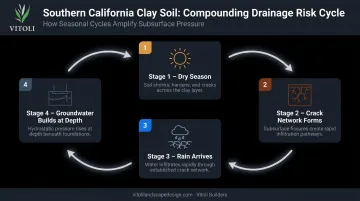
Southern California's clay-heavy soils add another layer of risk. Repeated wet/dry cycles cause clay to shrink and crack during dry months, then expand when wet.
A peer-reviewed study in Scientific Reports found that wetting-drying cycles in expansive soil slopes generate fissure networks that act as preferred channels for rapid water infiltration, accelerating groundwater buildup far faster than intact soil would allow.
This creates a compounding cycle many hillside properties face: drought creates cracks, rains exploit those cracks, and groundwater builds at depth faster than it can drain.
Types of Drainage Systems for Slope Stability
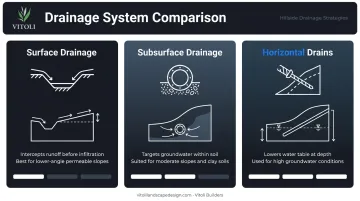
No single drainage system solves every hillside water problem. The three main categories each address different parts of the problem.
Surface Drainage Systems
Surface drainage intercepts water before it infiltrates the slope. Common components include:
- Swales and V-ditches — channeled depressions that redirect runoff away from slope crests and toes
- Catch basins — collection points at low spots that capture and divert concentrated flow
- Bench drains — Los Angeles County defines these as gunite or concrete V-ditches along residential hillsides, typically 3–5 feet wide and 12 inches deep, designed to drain slope faces and protect against erosion
Surface drainage works well on lower-angle slopes with permeable soils where overland flow is the main concern. Its key limitation: it does nothing to address groundwater that has already infiltrated the slope. For clay-heavy or steep terrain, surface drainage alone is rarely sufficient.
Subsurface Drainage Systems
Subsurface systems target water within the soil, intercepting groundwater before it can build pressure along a potential slip surface.
Common subsurface solutions include:
- French drains and perforated pipe trenches — installed below grade and backfilled with gravel or aggregate; Caltrans specifies 6-inch or 8-inch perforated pipes in filter-fabric-lined trenches to collect lateral groundwater and channel it away
- Drainage blankets — layers of aggregate or geocomposite material placed behind retaining walls and along cut slopes to collect infiltration and prevent hydrostatic pressure from building against the structure
FHWA guidance on mechanically stabilized earth walls strongly recommends base drains and back drains behind reinforced soil masses. At Vitoli Builders, gravel backfill, perforated drain lines, and weep systems are standard components of every retaining wall project — not optional additions — because improper water management is one of the leading causes of wall failure.
Horizontal Drain Systems
Horizontal drains are perforated pipes drilled at a slight upward angle directly into the slope face. Unlike surface or shallow subsurface systems, they're designed to intercept groundwater from within the slope mass and drain it by gravity — particularly effective when the water table needs to be lowered at depth.
Several practical factors govern their effectiveness:
- Placement elevation relative to the water-bearing zone — drains placed above the groundwater source provide little benefit
- Soil permeability — USGS data shows that in clay soils, only 50% of water table improvement may occur in the first year, with full changes taking up to 5 years
- Maintenance — USGS also notes that uncleaned horizontal drain holes may be only 25% effective, and Caltrans confirms these systems tend to clog over time and require periodic refurbishing
Horizontal drains perform best in moderate-to-high permeability soils during sustained high-intensity rainfall events, and work most reliably as part of a broader drainage strategy rather than a standalone fix.
Warning Signs Your Hillside Has a Drainage Problem
Catching drainage problems early is far cheaper than addressing slope failure after it happens. Watch for these indicators:
Visible ground changes:
- Horizontal or curved tension cracks near the crest of the slope
- Soil slumping or bulging at the toe (bottom) of the slope
- Persistent standing water or boggy ground that remains after rain
Structural signals near the property:
- Doors and windows that stick, shift, or no longer close properly
- New cracks in walls, ceilings, or foundation elements
- Retaining walls that tilt, crack, or show displacement
- Fencing, hardscape, or utility poles that lean or shift
USGS lists all of these as recognized signs of landslide development. Several, including sticking doors, foundation cracks, and ground deformation, are commonly attributed to water-driven soil movement beneath the surface.
Structural signals point to the problem indirectly. These drainage-specific signs point to it directly:
Drainage-specific indicators:
- Water seeping from unexpected locations on the slope face
- Erosion channels forming after rain events
- Sediment deposits accumulating at the slope base
- Drain outlets that are clogged, collapsed, or not discharging during storms
LA County and Ventura County both identify poorly maintained hillside drainage devices as a direct source of flooding and erosion problems. A clogged drain isn't just non-functional; it can actively redirect water in ways that worsen slope conditions.
How to Choose the Right Slope Drainage System
Start With a Site Assessment
The correct drainage solution depends on five site-specific factors:
| Factor | Why It Matters |
|---|---|
| Slope angle and height | Steeper slopes generate more runoff velocity and hydrostatic pressure |
| Soil type and permeability | Clay soils drain slowly and hold pore pressure longer |
| Groundwater depth | Determines whether subsurface or horizontal drains are needed |
| Rainfall exposure | Cumulative seasonal loading affects saturation risk |
| Proximity to structures | Walls, foundations, and utilities constrain drainage routing |
Caltrans is clear: drainage pipes installed into a slope with very little groundwater accomplish nothing. The drainage system must match the actual water condition — which requires field investigation, ideally during the rainy season when groundwater discharge can be measured accurately.
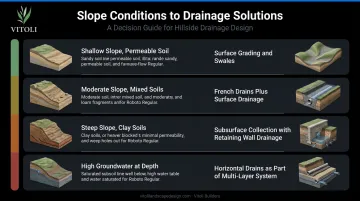
Match the System to the Slope Condition
- Shallow slopes, permeable soils: Surface grading and swales may be sufficient
- Moderate slopes, mixed soils: French drains or perforated pipe trenches combined with surface drainage
- Steep slopes, clay soils: Subsurface collection systems combined with retaining wall drainage (gravel backfill, weep systems, perforated lines)
- High groundwater at depth: Horizontal drains as part of a multi-layer approach
Why Integrated Systems Outperform Single Solutions
No single system handles every condition a hillside throws at it. On most residential properties, drainage works best in combination — USGS identifies adequate drainage as the most critical element of slope stabilization, and Caltrans describes integrated approaches (surface ditches, horizontal drains, and underdrains together) as the standard for effective groundwater control.
Properties with multiple slope levels, existing retaining structures, or prior movement history need a professional evaluation before any system is specified. Vitoli Builders builds drainage design into the initial site evaluation — alongside slope grade assessment, soil composition analysis, and drainage pattern mapping — so it's integrated into the construction specifications from day one, not retrofitted afterward.
Drainage System Maintenance for Long-Term Slope Stability
Seasonal Inspection Priorities
Inspect your drainage systems at minimum twice per year — once before the rainy season begins and once after significant storm events. Check for:
- Clogged outlet pipes or catch basin inlets
- Sediment buildup in swales and channels
- Cracked or displaced drain components
- Surface grading that has shifted to direct water toward the slope instead of away from it
LA County places this responsibility on homeowners: maintaining hillside slope and bench drains, keeping them clear of debris and overgrowth, is a documented homeowner obligation to prevent undermining, structural failure, and erosion.
The Outlet Blockage Problem
Outlet blockage is the most common — and most consequential — maintenance failure. When drain pipe outlets clog with debris or root intrusion, water backs up into the slope rather than discharging. This can create higher internal pressure than if no drain existed at all.
To prevent this:
- Clear outlet openings of debris after every significant storm
- Flush perforated pipes annually to remove sediment accumulation
- Inspect filter fabric (geotextile) for blinding — fine particles clogging the fabric reduce flow through the system
Vegetation and Drainage Compatibility
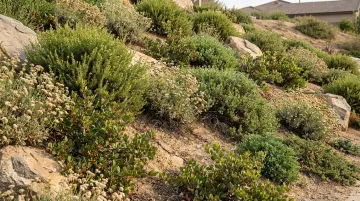
Plant selection affects drainage function. For Southern California slopes, CNPS recommends low, wide-spreading natives that stabilize soil without aggressive root systems that can block drainage paths:
- Coyote brush — drought-tolerant, spreads low and wide
- Buckwheat — shallow-rooted, fire-compatible, native to Southern California
- Manzanita — dense surface coverage without deep lateral root spread
UC ANR Master Gardeners confirm that a mix of species outperforms any single plant for hillside erosion control. On steep slopes, plugs or 4-inch pots establish more reliably than large specimens. When roots stay shallow and spread wide, they hold the surface without infiltrating perforated drain pipes below.
Frequently Asked Questions
What is a slope drainage system?
A slope drainage system is an engineered network of channels, pipes, or drains that collects and redirects water away from a slope to prevent excess groundwater buildup — the primary driver of reduced soil shear strength and slope movement.
Are horizontal drains effective for slope stability?
Horizontal drains work well when a slope has an elevated groundwater table and moderate-to-high soil permeability, but performance depends on correct placement, drain length, and ongoing maintenance. In clay soils, full water table response can take up to five years.
What are the warning signs of a drainage problem on a hillside property?
Key indicators include visible slope cracking or slumping, water seeping from the slope face between rain events, erosion channels forming after storms, clogged or non-functioning drain outlets, and shifting retaining walls or new foundation cracks.
How does drainage prevent landslides on hillside properties?
Drainage reduces pore-water pressure in the soil, preserving the shear strength that keeps slope material in place. Keeping groundwater below the critical threshold maintains a safe factor of safety against movement.
How often should hillside drainage systems be inspected?
At least twice a year — once before the rainy season and once after significant storms. Any warning signs (clogged outlets, new cracking, seeping water) should prompt an immediate professional evaluation rather than waiting for the next scheduled check.