Introduction
After a rain storm, you walk your yard and find water pooling against the foundation, soggy patches that stay wet for days, and soil washing down the slope in thin brown rivers. Most homeowners blame the storm. The real culprit, in most cases, is improper grading.
Grading controls where water goes. When it's wrong, even a moderate rain event creates problems that compound over time — weakened soil and foundation stress, with hillside properties facing the added risk of accelerating erosion.
This guide covers the slope standards professionals use, how to measure and verify your yard's grade, and which drainage solutions fit different site conditions — including when a hillside property needs engineering beyond the standard rules.
Key Takeaways
- 2% is the minimum slope standard for most surfaces and drainage pipes — roughly ¼ inch of drop per foot of run
- Hillside slopes should not exceed a 3:1 ratio (3 feet horizontal per 1 foot vertical) without added stabilization
- Drainage options — French drains, swales, and catch basins — are matched to your soil type and slope
- Standing water (48+ hours), foundation seepage, and erosion channels all signal a grading problem
- Slopes steeper than 3:1 typically require retaining walls, geotextiles, or engineered foundations
What Is Landscape Grading and Why Does It Matter?
Landscape grading is the deliberate shaping of soil to control water movement. The goal isn't a flat yard — it's intentional slopes that guide runoff away from structures and toward safe discharge points.
Poor grading creates compounding damage:
- Waterlogged soil weakens root systems and destabilizes planted slopes
- Excess moisture around foundations causes cracking and settling over time
- Uncontrolled runoff accelerates erosion, especially on hillside lots where velocity builds quickly
Why Timing Matters
Grading is best addressed before planting, hardscape installation, or structural work begins. Once a yard is finished, corrective drainage work means digging up patios, removing plantings, and excavating near structures, all of which add real cost and disruption.
IRC R401.3 makes this a code issue, not just a design preference: residential lots must divert surface drainage to an approved storm sewer or collection point that doesn't create a hazard. Get it wrong early, and you're solving a structural and legal problem — not just a landscaping one.
Slope Standards You Need to Know
The 2% Baseline
2% slope means 2 inches of drop for every 100 inches of horizontal run — or approximately ¼ inch per foot. Under the 2021 IRC, impervious surfaces within 10 feet of a building foundation must slope at least 2% away from the structure.
Why 2%? It's fast enough to keep sediment suspended in drainage pipes (preventing clogging) but gradual enough to remain stable and usable as a near-level surface.
On smooth, finished surfaces with precise installation, 1% can technically work. On irregular materials — flagstone, gravel, turf — it isn't reliable. Water finds low spots and pools. For drainage pipes, 1% also risks sediment buildup over time. Treat 2% as your minimum.
That 2% baseline applies to general surfaces. Near the foundation itself, the standard gets steeper.
Foundation Zone: The 6-Inch Rule
The 2021 IRC also requires at least 6 inches of drop within the first 10 feet from the foundation wall. That calculates to roughly 5% — steeper than the 2% impervious surface minimum. Where barriers like fences or retaining walls prevent that fall, swales or drains must carry water away instead.
Hillside Slopes: The 3:1 Threshold
For exposed soil slopes, a 3:1 ratio (3 feet horizontal for every 1 foot of vertical rise, equal to roughly 33%) is the common rule-of-thumb threshold for natural stability. LA County's Grading Guidelines reference this ratio in the context of grading exemptions.
The 2022 California Building Code Appendix J generally limits constructed cut and fill slopes to 2:1 unless a geotechnical report justifies steeper angles. Anything steeper than these thresholds should be treated as engineered work.
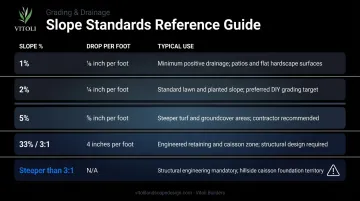
Quick Reference: Slope Standards by Use
| Slope | Drop Per Foot | Typical Use |
|---|---|---|
| 1% | ⅛ inch | Marginal — smooth finished surfaces only |
| 2% | ¼ inch | Patios, lawns, drainage pipes, impervious surfaces |
| 5% | ⅝ inch | Foundation-adjacent grade (IRC minimum in some conditions) |
| Up to 33% (3:1) | 4 inches per foot | Stable soil slope threshold |
| Steeper than 3:1 | — | Engineered solutions required |
How to Calculate and Check Your Yard's Slope
The Formula
Slope % = (Rise ÷ Run) × 100
For a 2% target, the shortcut is: drop (feet) = run (feet) × 0.02
A 20-foot patio at 2% needs a total drop of 0.4 feet — about 5 inches from high side to low side. Those 5 inches are easy to confirm with a tape measure before any paving goes down.
Field Methods
String-and-line-level method (good for homeowners):
- Drive two stakes at the high and low ends of the area you're checking
- Tie a string between them and attach a line level
- Adjust until the string reads level (true horizontal)
- Measure the gap between the string and the ground at the lower stake — that's your actual rise over that run distance
Laser level (standard for professional installations): Ensures consistent grade across large areas — terraced patios, retaining wall bases, and tiered drainage channels where small errors compound across multiple levels. On hillside projects, contractors use this to verify grade before concrete, pavers, or drainage pipe goes in.
Direction Matters as Much as Percentage
A slope that reads 2% but drains toward the house is worse than no slope at all. Water must drain:
- Away from the foundation — minimum 10 feet of positive slope
- Away from garage openings, retaining walls, and low-lying structures
- Toward a designated discharge point — street gutter, dry well, or a planting area designed to absorb runoff
For pipes and swales: maintain at least 1–2% slope toward the outlet to keep water and sediment moving.
On hillside properties, getting direction wrong is where drainage failures typically start — water pools against a wall, saturates the soil, and puts pressure on foundations. Confirming both percentage and direction before construction begins is the difference between a drainage system that works and one that causes problems for years.
Drainage Solutions That Work With Your Slope
Surface Drainage: Swales and Berms
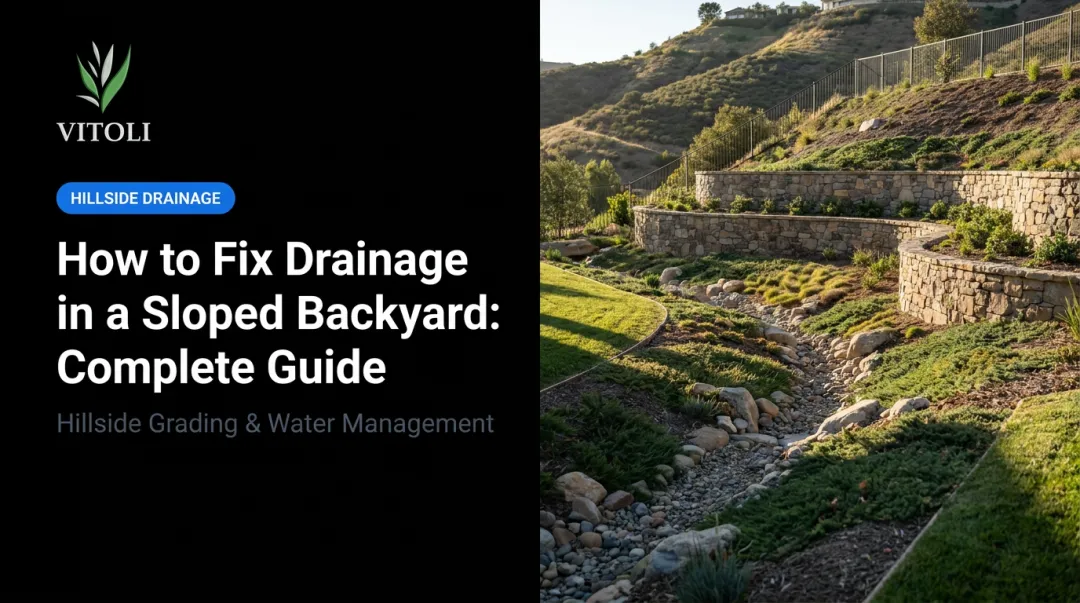
On gently sloped residential lots, swales and berms are usually the first solution worth trying. Swales are shallow graded channels that collect and redirect sheet flow; berms are raised soil mounds that redirect water around a feature. Both work with your existing grade — no underground infrastructure required.
A well-placed swale can solve pooling problems that look complicated but are actually just a matter of directing flow to the right place.
Subsurface Drainage Systems
When surface drainage alone isn't enough:
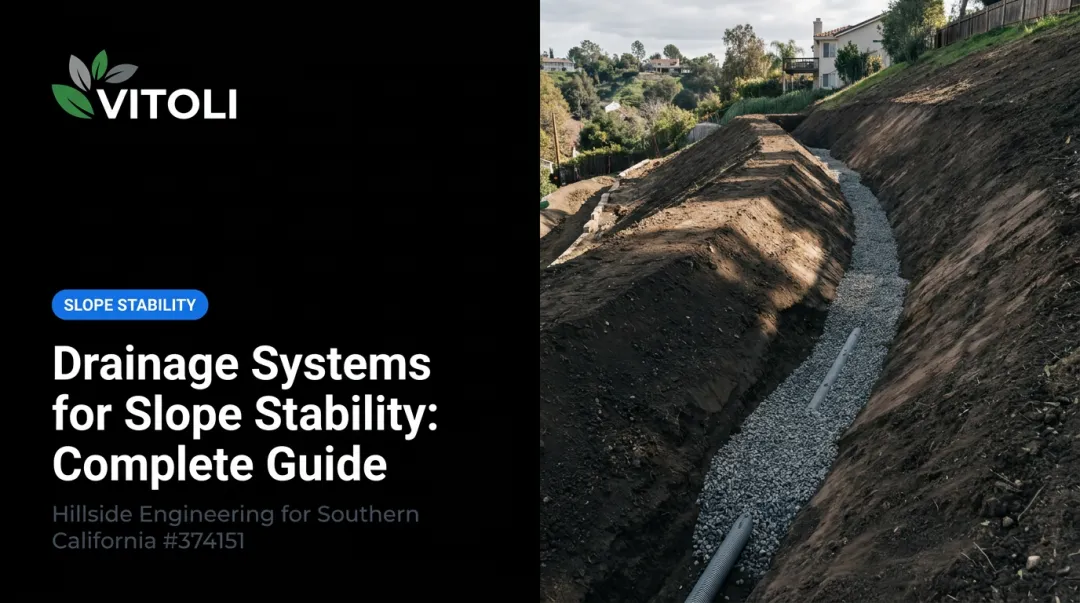
- French drains: A perforated pipe set in a gravel-filled trench, used to intercept and redirect subsurface water. The drain pipe must slope 1–2% toward its outlet to function correctly.
- Catch basins: Collect surface water at low points and channel it underground to an outlet. Effective at area drains, driveway aprons, and patio low corners.
- Downspout extensions: Carry roof runoff away from the foundation. UMN Extension recommends keeping infiltration features at least 10 feet from structures — a useful benchmark for any outlet placement.
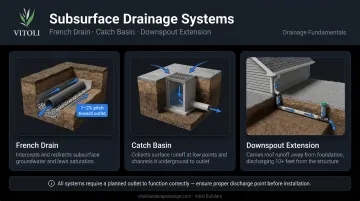
All subsurface systems need planned outlets. Collected water must discharge somewhere safe, at a distance from structures.
Soil Type Considerations
NRCS research on soil infiltration confirms what many Southern California homeowners discover the hard way: clay-heavy soils drain slowly because water moves through small pores rather than large ones. Sandy or loamy soils drain faster and may need only surface grading.
For clay-heavy lots:
- Subsurface drainage is often necessary, not optional
- Adding organic matter improves soil aggregation and infiltration — but it doesn't replace properly graded drainage paths
- Gravel backfill behind retaining walls prevents hydrostatic pressure buildup — critical on hillside lots where clay soils trap moisture against wall faces
Signs Your Grading or Drainage Needs Attention
Most grading problems make themselves visible within 48 hours of a storm. Here's what to look for:
After rain:
- Standing water or puddles that take more than 48 hours to drain
- Water consistently pooling against a foundation, fence, or retaining wall
- Visible erosion channels or exposed roots on slopes
Structural warning signs:
- Hairline cracks forming in a foundation or concrete flatwork
- Basement moisture or seepage that correlates with rainfall
- Retaining walls showing bowing, tilting, or bulging
Wall movement — bowing, tilting, or bulging — signals hydrostatic pressure buildup behind the structure. Under the California Building Code, that's a structural engineering issue, not a landscaping nuisance.
The Southern California Seasonal Pattern
Southern California's wet season creates a specific drainage trap. After months of dry summer conditions, soil becomes hydrophobic, meaning water-repellent rather than absorbent. UC ANR research describes this as a natural occurrence caused by waxy residues from decomposing organic matter.
The result: even a short, moderate storm produces significant runoff because dry soil initially sheds water rather than absorbing it. If drainage problems only show up during the first heavy rain of the season, don't treat it as a fluke. That's a grading issue revealing itself under exactly the conditions it was always going to fail in.
Hillside Properties: When Standard Grading Isn't Enough
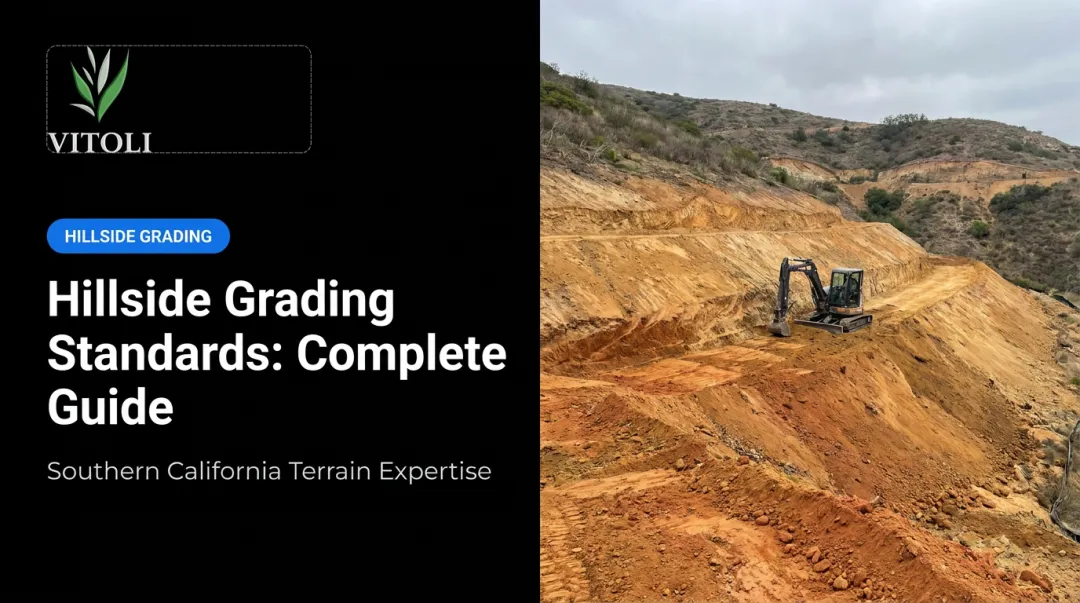
Standard grading rules apply well to flat or gently sloped residential lots. Hillside properties where natural grades routinely exceed 15–30% face a different set of challenges: concentrated runoff velocity, limited space for gradual slope transitions, and soil instability that simple regrading can't fix.
Engineered Solutions for Steep Slopes
When slopes exceed the 3:1 threshold, these solutions replace rule-of-thumb grading:
- Retaining walls (segmental block, poured concrete, or stone) to create level terraces and hold soil against lateral pressure
- Geotextile fabric and riprap for erosion control on exposed cuts — supported by NRCS guidance on soil bioengineering and slope protection
- Caisson foundations drilled into stable soil or bedrock, used to anchor retaining structures where standard footings won't hold
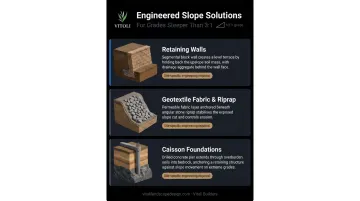
Each of these requires site-specific engineering. LA County's Hillside Management ordinance regulates grading intensity and landform preservation in designated hillside areas. In Ventura County, engineered grading (with professional plans and a hydrology report) is required above 500 cubic yards of moved soil.
One Contractor for the Whole Project
Vitoli Builders works specifically on this type of complex hillside terrain across Los Angeles County and Ventura County. Their process starts with a four-part site evaluation covering soil composition, slope grade, drainage patterns, and structural load requirements before any design decisions are made.
With over 20 years of hillside construction experience, they handle everything from initial slope assessment through retaining wall construction and finished landscape grading as a single integrated project.
That integrated approach matters on hillside properties. A drainage solution that ignores the wall — or a wall design that ignores the drainage — tends to fail within a few seasons.
Frequently Asked Questions
How do you calculate 2% slope for drainage?
Multiply the run distance by 0.02 to get the required drop. A 20-foot patio at 2% needs a 5-inch total drop from high side to low side. The ¼ inch per foot shortcut (equal to about 2.08%) is accurate enough for most field calculations.
Is 1% slope enough for drainage?
On smooth, perfectly finished surfaces, 1% can technically function. On irregular materials like flagstone, gravel, or turf, it's unreliable; water finds low spots and pools. For drainage pipes, 1% risks sediment buildup over time. The 2% standard is universally safer.
Does a retaining wall need drainage behind it?
Yes. Without gravel backfill and a drainage pipe or weep holes, water pressure builds behind the wall. California Building Code Chapter 18 requires retaining walls to account for lateral soil and hydrostatic loads — drainage features are a standard engineering requirement, not an afterthought.
What is the minimum slope for yard drainage away from a foundation?
The 2021 IRC requires at least 6 inches of drop within the first 10 feet from a foundation wall. For impervious surfaces within 10 feet, the minimum is 2%. Some local codes require more; steeper grades are preferable in high-rainfall areas.
What causes poor drainage in a yard?
The most common causes: flat or negatively sloped grade, compacted or clay-heavy soil that resists percolation, clogged or absent subsurface drainage, and hardscape that interrupts natural water flow paths.
Can I grade my own yard, or do I need a professional?
Small surface fixes like filling a minor low spot may seem simple, but it's worth having a professional assess the underlying cause first. Anything involving slopes near a foundation, retaining walls, subsurface drainage systems, or hillside terrain requires a licensed contractor to avoid costly mistakes and ensure local code compliance.