Many homeowners in Los Angeles County and Ventura County discover this too late. They hire a contractor, get a pool, and within a few years notice cracks in the shell, a tilting water line, or a wall face starting to push outward. These aren't cosmetic problems. They're symptoms of structural failures that cost far more to repair than to prevent.
This guide is for hillside property owners who want to understand what proper retaining wall design actually involves before speaking with a contractor — specifically the engineering principles, code requirements, wall type selection, and drainage design that determine whether a hillside pool remains safe and watertight for decades.
Key Takeaways
- A hillside pool retaining wall must be engineered for soil pressure, hydrostatic forces, and slope movement — the structural demands go far beyond basic soil retention
- Southern California's expansive clay soils and seismic activity make a geotechnical assessment mandatory before any design begins
- Under the 2025 CBC, pool walls within 7 feet of a descending slope top must independently support the full hydrostatic load — soil counts for nothing in that zone
- Wall type selection should follow slope severity and load demands — not aesthetics or budget alone
- Drainage is a structural component: walls without it will fail regardless of how well everything else is built
Why Hillside Pool Construction Demands Precision-Engineered Retaining Walls
The Problem with Clay Soils on a Slope
Southern California hillside soils — particularly the clay-heavy fills common across LA and Ventura County — don't stay put. Through repeated wet-dry cycles, clay expands during winter rains and contracts in dry summer months. This cycling causes the upper layers of slope soil to migrate gradually downhill, a process known as slope creep.
According to USGS landslide research, creep movement is classified as less than 1 foot per decade — slow enough to be invisible year-to-year, yet fast enough to transfer enormous cumulative force onto any structure within the creep zone over a decade or two.
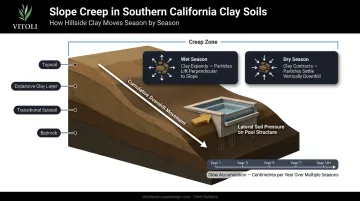
For a pool on a hillside, that force doesn't just push on the retaining wall. It acts on the pool shell itself.
Differential Settlement: Why Pool Shells Crack
A pool shell is a thin-walled concrete structure. If one section of its foundation sits in the slope creep zone while another rests on stable bedrock or compacted fill, the two sections move at different rates. The result is differential settlement: uneven stress across the pool floor and walls that leads to cracking, water infiltration, and accelerating structural damage.
This failure mode is far more common on hillside sites than on level ground, precisely because the soil conditions beneath different parts of the pool vary so dramatically.
What the Current Building Code Requires
The 2025 California Building Code (effective January 1, 2026, based on the 2024 IBC) addresses hillside pool construction in Section 1808.7:
- Section 1808.7.4: Any pool wall within 7 horizontal feet of the top of a descending slope must be capable of supporting the full pool water load without any soil support — a freestanding wall standard. Pool setbacks from slopes must equal one-half the building footing setback required by the slope-clearance provisions.
- Section 1808.7.5: Alternate setbacks may be approved by the building official, who can require a geotechnical investigation as a condition of approval.
Experienced engineers working on Southern California hillside sites typically extend the freestanding wall zone beyond the code minimum, and recommend foundation setbacks well beyond what the formula alone produces — because code minimums reflect the lowest acceptable threshold, not what experienced engineers actually build to on Southern California hillsides.
Retaining Wall Types for Hillside Pool Projects
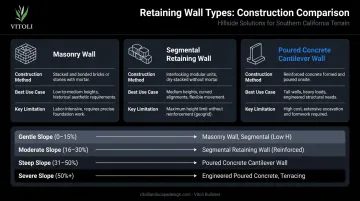
Choosing the wrong wall type for a hillside pool site doesn't just create aesthetic problems. It creates structural ones. Here's how the three main systems compare:
Masonry Walls (Poured Concrete or Concrete Block)
Construction: Concrete footer with continuous rebar, block or poured concrete stem, vertical rebar tying into the footing. Typically faced with stone or tile for finish.
Best for: Tall, high-load applications where soil pressure and surcharge loads are significant.
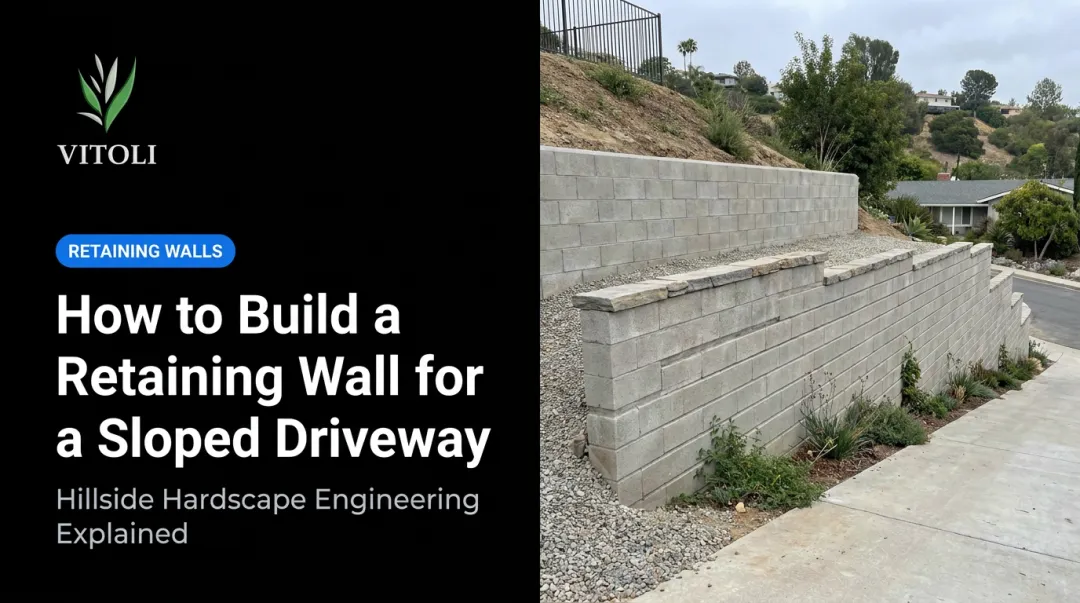
Key limitation: Any wall over 4 feet from bottom of footing to top of wall requires a permit under IBC 2024 Section 105.2 (unless it supports a surcharge or impounds liquids, in which case the permit threshold is lower). LA County enforces the same 4-foot threshold for separate retaining wall permits.
Segmental Retaining Walls (Interlocking Dry-Stack Block)
Construction: Pre-cast concrete blocks stacked without mortar, relying on block weight, backward batter, and sometimes geogrid reinforcement for stability.
Best for: Lower to mid-height walls on moderate slopes where aesthetics matter and load demands are manageable.
Key limitation: Not suited for the most aggressive hillside scenarios — steep grades, high surcharge from pool water and deck loading, or sites with documented expansive soils.
Poured Concrete Cantilever or Gravity Walls
Construction: Reinforced concrete poured in place, designed as a cantilever or gravity structure with a continuous footing and rebar cage.
Best for: Steep slopes, high surcharge loads, and sites where failure carries serious consequences — settlement, wall movement, or soil loss behind the pool shell. Structural engineering references consider reinforced concrete cantilever walls economical up to approximately 25 feet.
Key limitation: Most expensive option, requiring detailed engineering drawings and thorough permit documentation.
Matching Wall Type to Site Conditions
| Slope Condition | Typical Wall Approach |
|---|---|
| Under 2 ft grade change | Grading may suffice; minor block wall |
| Moderate slope, mid-height wall needed | Segmental or masonry wall |
| Steep slope, pool near descending grade | Poured concrete or engineered masonry |
| Complex hillside, unstable soil | Wall integrated with caisson foundation system |
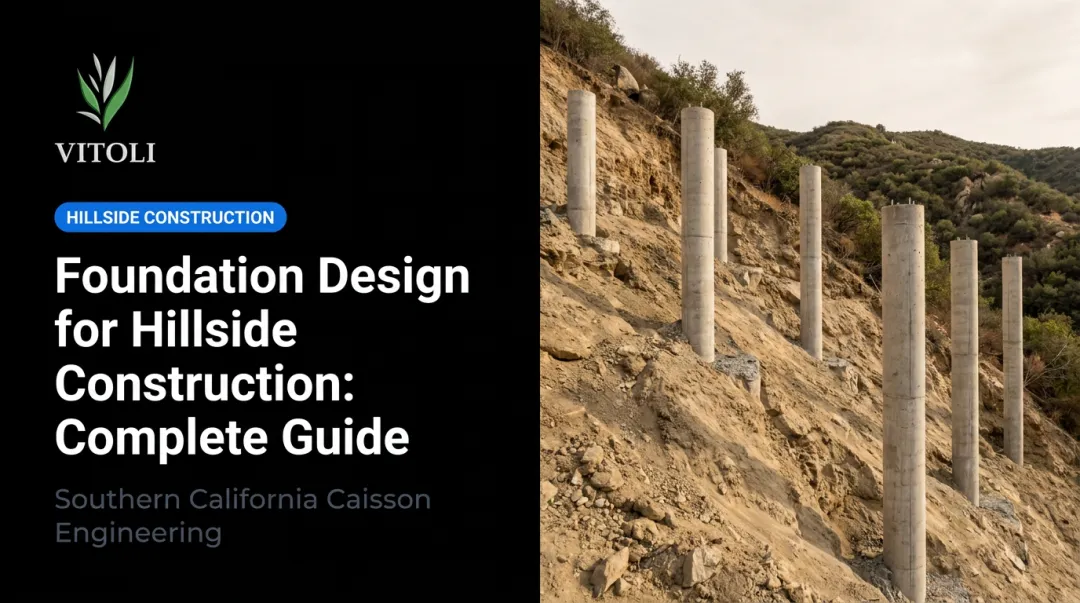
In Southern California hillside contexts — particularly sites in the Santa Monica Mountains, Calabasas, Hidden Hills, or Malibu — the most demanding sites rarely call for a wall alone. Combination solutions pairing a retaining wall with a caisson foundation system are the norm, not the exception. Vitoli Builders approaches these two systems as complementary elements of a single structural strategy, a perspective shaped by over 1,800 hillside projects completed across LA and Ventura Counties.
The Retaining Wall Design and Build Process
Designing a hillside pool retaining wall follows a defined sequence. Rushing any phase doesn't save time. It creates problems that surface two or three years after construction.
Site and Geotechnical Assessment
A geotechnical engineer evaluates:
- Soil type, expansiveness, and moisture behavior
- Slope angle, stability, and depth to firm bearing material
- Proximity of the proposed pool to the top of any descending slope
- Drainage patterns and seasonal groundwater behavior
This report drives every structural decision that follows — pool placement, foundation setback, wall type, footing depth, and drainage design. Treating the geotech report as optional is one of the most common and costly mistakes on hillside pool projects.
Once the report is complete, the structural engineer uses it to:
- Confirm pool placement and required setback from the slope
- Determine whether freestanding wall construction is required
- Specify wall type, dimensions, and footing depth
- Design the drainage system behind the wall
Drainage Engineering
USGS and NCMA research both identify hydrostatic pressure as a leading cause of retaining wall failure. A proper drainage system behind a hillside pool retaining wall includes:
- Gravel backfill layer against the back of the wall face (minimum 3 feet wide per NCMA best practices)
- Perforated drain pipe (minimum 4-inch diameter) at the wall base, with outlets spaced no more than 50 feet apart
- Weep holes through the wall face to prevent pressure buildup
- Sloped patio surface that directs rainwater and splash away from the wall and pool deck
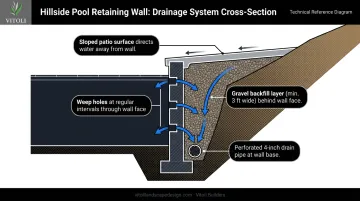
Drainage isn't a finishing detail — it's a structural component. Without an adequate drainage system, hydrostatic pressure accumulates behind the wall face until it exceeds what the structure can hold.
Permitting and Engineering Sign-Off
For hillside pool retaining walls in Southern California:
- Walls over 4 feet from bottom of footing to top of wall require a permit and, in most cases, stamped structural engineering drawings
- Walls supporting surcharge loads (such as pool water, decking, or soil above) face stricter requirements regardless of height
- LA County hillside development standards apply to sites on slopes steeper than 1V:3H (33.3%), with additional sensitive hillside design guidelines for slopes of 25% or greater
- The City of Los Angeles maintains specific hillside construction requirements through LADBS that exceed standard IBC minimums in several respects
Navigating these requirements takes time. Some Southern California jurisdictions require multiple plan-check review cycles before issuing a grading or building permit. Vitoli Builders' in-house design and engineering team handles documentation coordination directly, which reduces the back-and-forth that causes most permitting delays.
Critical Design Decisions: Height, Setback, and the 1-3 Rule
Wall Height Thresholds
Wall height drives cost, permitting, and safety requirements simultaneously. Key thresholds to understand:
- Under 18–24 inches: Can double as a seating wall; no handrail required
- 24–32 inches: Open, cost-effective; still below most handrail triggers
- Over 30 inches: IBC guard requirements apply where the wall creates a drop adjacent to a walking surface
- Over 4 feet (footing to top): Permit required in most Southern California jurisdictions; engineered drawings typically required
The most practical early cost-management decision on a hillside pool project is pool placement — setting it at a position that minimizes required wall heights rather than designing tall walls around a preferred location.
The 1:3 Rule — and Its Limits
The 1:3 rule is often cited as a general guideline: a retaining wall's footing depth should be at least one-third its exposed wall height, providing a basic check against overturning and sliding.
No NCMA, CMHA, or California code source codifies the 1:3 ratio as a fixed engineering requirement. Actual retaining wall design relies on bearing capacity calculations, overturning and sliding factors of safety (typically minimum 1.5), global stability checks, and site-specific soil data. The ratio is a starting point, not a substitute for engineering.
For hillside pool walls in Southern California, the 1:3 rule is a quick sanity check, not a substitute for engineering.
Foundation Setback Strategies
On constrained hillside lots, increasing pool depth can effectively increase horizontal setback from the slope face without widening the project footprint. Each additional foot of pool depth adds horizontal setback equal to the slope ratio. On a 2:1 slope, one extra foot of depth adds half a foot of horizontal clearance — a useful technique when lot geometry limits options.
Common Retaining Wall Problems on Sloped Pool Sites
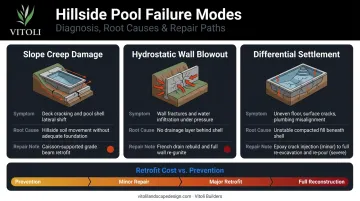
Slope Creep Damage After Construction
What you see: Pool walls crack or rotate out of level; the pool appears slightly tilted years after a seemingly correct installation.
Likely cause: Pool placed too close to a descending slope without freestanding wall construction, allowing creep-zone soil movement to transfer load to the pool shell as soil support erodes.
Fix: Underpinning the pool structure, installing a structural barrier (such as a caisson-supported grade beam), and addressing drainage. Retrofit solutions in the Los Angeles area typically run two to three times the cost of engineering this correctly from the start.
Retaining Wall Blowout from Hydrostatic Pressure
What you see: Wall face cracks, bulges, or partially collapses — typically following heavy rain.
Root cause: No drainage system installed behind the wall. Water accumulates, builds hydrostatic pressure, and overcomes the wall's resistance.
Fix: Rebuilding the wall — often partially, sometimes fully — and installing a proper French drain with gravel backfill behind it.
Differential Settlement and Pool Cracking
What you see: Visible cracks in the pool shell, uneven waterline at the tile, pool floor no longer level.
Likely cause: Part of the pool foundation sits within the slope creep zone on unstable fill; that section settles while the rest of the pool remains stable.
Fix: Repair options range in severity depending on how much movement has occurred:
- Epoxy crack injection for minor surface cracking
- Structural underpinning where foundation support has partially failed
- Full re-excavation and foundation reinforcement in serious cases — costly and highly disruptive
Frequently Asked Questions
Can a retaining wall support a pool on a slope?
Yes — a properly engineered retaining wall can stabilize soil, manage hydrostatic pressure, and create a level platform for pool construction on a slope. The critical word is "engineered": the wall must be designed by a structural engineer based on actual slope geometry, soil conditions, and pool load, not built to a generic standard.
What is the best retaining wall for a steep slope?
For steep slopes carrying significant pool loads, poured concrete cantilever walls or heavily reinforced masonry walls with proper footings and drainage are typically most reliable. On complex Southern California hillside sites, a caisson-supported system alongside the retaining wall is often required to reach stable bearing material.
What is the 1:3 rule for retaining walls?
The 1:3 rule is a general guideline — footing depth should be at least one-third the exposed wall height — used as a basic check against overturning. Treat it as a starting point only. Hillside pool walls require site-specific calculations that go well beyond this ratio.
How much does a pool retaining wall cost on a hillside?
National retaining wall installation ranges from $3,000–$8,500 per HomeAdvisor's cost guide, a figure that rarely reflects hillside pool complexity. Southern California hillside projects consistently land at the higher end due to permit fees, engineering requirements, soil conditions, and the depth of foundation work involved.
Do I need a structural engineer for a pool retaining wall?
In most Southern California jurisdictions, yes — any retaining wall over 4 feet tall, or any wall near a slope that supports surcharge loads, requires stamped engineering drawings and a permit. For shorter walls near a descending slope, a geotechnical engineer's site assessment is strongly recommended regardless.
What drainage system does a pool retaining wall need?
At minimum, a hillside pool retaining wall needs gravel backfill, a perforated drain pipe (4-inch minimum) at the wall base with outlets every 50 feet or less, weep holes through the wall face, and a patio surface graded away from the wall. Skip any of these, and hydrostatic pressure will compromise the structure over time.