Introduction
Building on a hillside in Southern California is nothing like building on flat ground. The foundation is where that gap becomes real — and where the cost of getting it wrong shows up first.
Hillside foundation design is the engineering process of selecting, designing, and installing a structural support system specifically engineered to anchor a home into sloped terrain rather than level ground. Get it right, and the structure performs safely for decades. Get it wrong, and the consequences range from cracked walls and sticking doors to catastrophic slope failure.
This guide is written for hillside property owners across Los Angeles County and Ventura County — particularly in areas like Calabasas, Malibu, and the Hollywood Hills. On this terrain, steep slopes, expansive soils, and seismic exposure all converge. Foundation engineering isn't just one consideration among many; it determines whether everything built above it holds.
Here's what this guide covers:
- What makes hillside foundation design fundamentally different from standard construction
- How the process works, from geotechnical investigation through construction
- Which foundation systems are used and why
- The most common — and costly — mistakes homeowners and builders make on sloped terrain
Key Takeaways
- Hillside foundations must handle vertical loads, lateral earth pressure, and seismic forces — flat-lot systems are not built for this
- California law requires a geotechnical investigation before hillside foundation design can begin
- Drilled caissons with grade beams are the standard foundation system for Southern California hillside builds
- Cutting corners on soil investigation is the single most dangerous shortcut in hillside construction
- Diagonal cracks or leaning retaining walls are warning signs that require immediate professional inspection
What Is Hillside Foundation Design?
Hillside foundation design is the engineering of a structural base for a home built on sloped, unstable, or steep terrain, where the ground varies in load-bearing capacity and is subject to ongoing movement.
The goal is specific: transfer the structure's weight safely into stable soil or bedrock while resisting the lateral, downhill, and seismic forces that are unique to hillside sites.
How It Differs from Flat-Lot Foundation Design
Flat-lot foundations primarily manage vertical loads on relatively uniform soil. The engineering challenge, while real, is comparatively straightforward.
Hillside foundations face a different problem altogether:
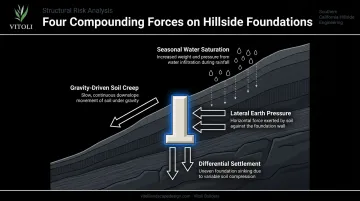
- Gravity-driven soil creep pushes material downslope continuously
- Differential settlement occurs when uneven soil compression causes parts of the foundation to move at different rates
- Lateral earth pressure pushes sideways against foundation walls and caissons
- Drainage and water saturation destabilize slopes seasonally, particularly during Southern California's wet winters
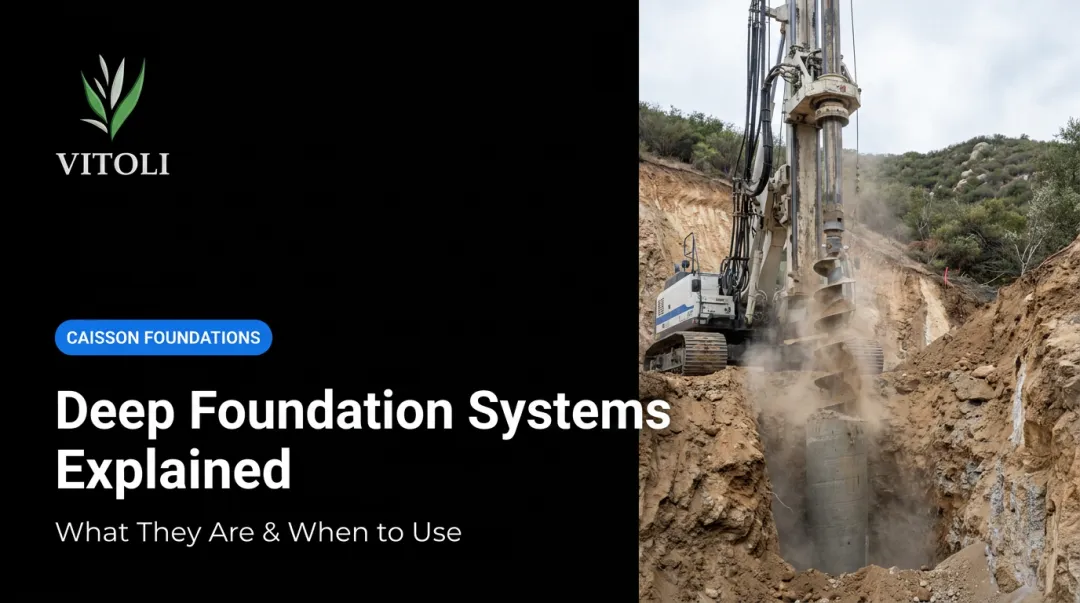
These forces don't operate independently — they compound each other. Addressing that combination means going deeper, literally: hillside sites typically require deep foundation systems like caissons or driven piles that bypass unstable surface soils entirely and anchor into bedrock or competent earth below.
Why Hillside Foundation Design Requires Specialized Engineering
Slopes introduce forces that standard foundation systems were never designed to resist. USGS defines a landslide as the downslope movement of soil, rock, and organic materials under the effects of gravity — and that same gravitational pull acts on every hillside site continuously, with or without a building on it.
Soil Conditions Across LA and Ventura County Hillsides
Southern California hillside terrain presents a range of soil and geologic materials, each behaving differently under load, water exposure, and seismic activity:
| Soil/Material | Behavior on Slopes |
|---|---|
| Colluvial soil mantle | 1–4 ft thick in the Santa Monica Mountains; prone to shallow soil slips during heavy rainfall |
| Ravine fill | 2–10 ft thick in drainage courses; creates debris-flow risk paths |
| Weathered granitic and slaty basement rock | Soil-slip scars form in colluvium overlying this material |
| Weak or fractured bedrock | Tectonically fractured rock is a primary driver of Southern California landslides |
| Liquefiable water-saturated soils | Regulated through California Seismic Hazard Zones covering liquefaction-prone areas |
Source: USGS Professional Paper 851 — Soil Slips, Debris Flows, and Rainstorms in the Santa Monica Mountains
The Lateral Force Problem
Soil pushes sideways against foundation walls and caissons on any hillside. During earthquakes, that pressure doesn't just increase — it cycles — amplifying and releasing force against the structure in repeated waves.
CBC Section 1803.5.12 requires evaluation of dynamic seismic lateral earth pressures on foundation walls and retaining walls supporting more than 6 feet of backfill in Seismic Design Categories D through F — which covers most of Los Angeles County and Ventura County.
Differential Settlement
On slopes, soil composition changes across short distances. One section of a foundation may bear on competent material while an adjacent section sits on looser fill or weathered rock. The result is uneven compression over time — parts of the structure sink or shift at different rates.
The visible symptoms — diagonal cracks above door frames, sloping floors, doors and windows that suddenly stick — aren't cosmetic. They indicate the foundation is moving.
Regulatory Requirements
These failure modes — slope instability, liquefaction, differential settlement, and fault displacement — are precisely what California building code requires engineers to address before a hillside permit is issued. CBC Section 1803.5.11 mandates geotechnical investigations for Seismic Design Category C through F structures to evaluate each of these risks.
For City of Los Angeles projects specifically:
- CBC Section 1808.7 applies to foundations on or adjacent to slopes steeper than 1V:3H (33.3%), triggering slope-specific setback and foundation requirements
- LAMC Section 91.5.301.1.5 applies these seismic provisions to new buildings and additions on slopes steeper than 33.3%
- LADBS requires permits for all grading and earthwork in the Hillside Grading Area, and a soils/geology report is generally required before permit issuance
How Hillside Foundation Design Works
Hillside foundation design is a sequential, engineering-driven process that begins well before any excavation. It moves from site investigation through geotechnical analysis, structural design, and controlled construction — each stage building on verified data from the one before it.
Step 1: Geotechnical Site Investigation
Before any foundation system can be designed, a licensed geotechnical engineer must investigate the site. This typically involves drilling test borings or digging test pits to determine:
- Soil type and layering
- Depth to stable soil or bedrock
- Groundwater levels
- Slope stability factors (factor of safety)
- Liquefaction and landslide potential
This is not optional in Southern California. It's a regulatory requirement for hillside sites and forms the entire basis for all structural design that follows. Los Angeles County GMED requires exploration to extend 10 feet below the foundation bottom, or 20 feet in liquefaction areas.
Step 2: Structural Design and System Selection
With geotechnical findings in hand, the structural engineer selects the appropriate foundation system, specifies depth requirements, reinforcement details, and connection points.
No two hillside foundation designs are identical — the system must match that site's specific soil profile, slope angle, seismic zone, and load requirements. There is no template.
This is also where design and construction expertise need to work in close coordination. When separate parties handle these phases, miscommunications arise: a caisson layout drawn without field experience, or drainage plans misread by a crew that wasn't present during site assessment. Vitoli Builders' in-house team handles both sides, so the engineers who spec the foundation are the same people overseeing its execution.
Step 3: Controlled Construction and Inspection
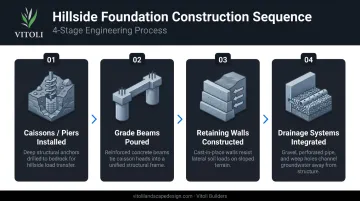
Hillside foundation construction follows a staged sequence:
- Caissons or piers installed first — deep elements must be set before above-ground structures are built
- Grade beams poured — connecting caissons horizontally to form a rigid structural assembly
- Retaining walls constructed — engineered to manage slope and lateral earth pressure
- Drainage systems integrated — gravel backfill, perforated drain lines, and weep systems installed concurrent with or immediately following wall construction
Each stage requires inspection sign-off from the local building department before the next stage begins. Site access logistics — limited space, equipment staging on steep terrain, haul routes for excavated material — must be planned before work starts.
Foundation Systems Used in Hillside Construction
Most hillside projects require deep foundation systems. The upper soil layers on slopes are typically too unstable to carry structural loads, so foundations must reach past that material into stable ground below.
Caissons and Grade Beams
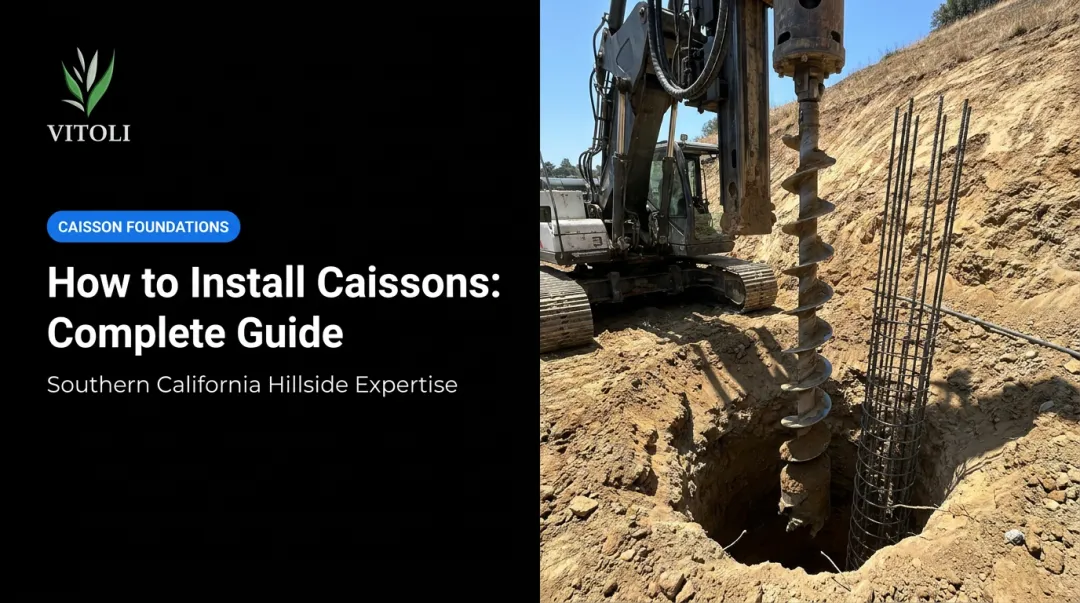
Drilled concrete caissons are the most common foundation element in Southern California hillside construction — large-diameter shafts bored into stable soil or bedrock and filled with reinforced concrete to transfer structural loads past the unstable upper layers.
Two components work together in this system:
- Caissons transfer vertical load deep into stable material; depth is set by the geotechnical report based on where sound bearing is encountered
- Grade beams connect caissons horizontally, distributing load and forming a rigid structural cage that resists both uplift and lateral sliding
LADBS explicitly lists "Caisson, Piles, Grade Beams" and "Step'g/Retain'g Foundation, Hillside Special" as structural observation items — reflecting how standard this system is for hillside work in Los Angeles.
Micropiles
Micropiles are small-diameter, drilled and grouted piles that reach significant depth with minimal ground disturbance — useful on hillside lots where standard drilling equipment cannot be safely positioned or access is tightly constrained.
Important note for Los Angeles County projects: LA County GMED states that helical piles are not permitted for geologic hazard mitigation or to support new foundations. If a project is subject to LA County GMED jurisdiction, confirm system eligibility with your geotechnical engineer before specifying alternatives to drilled caissons.
Retaining Walls as Structural Components
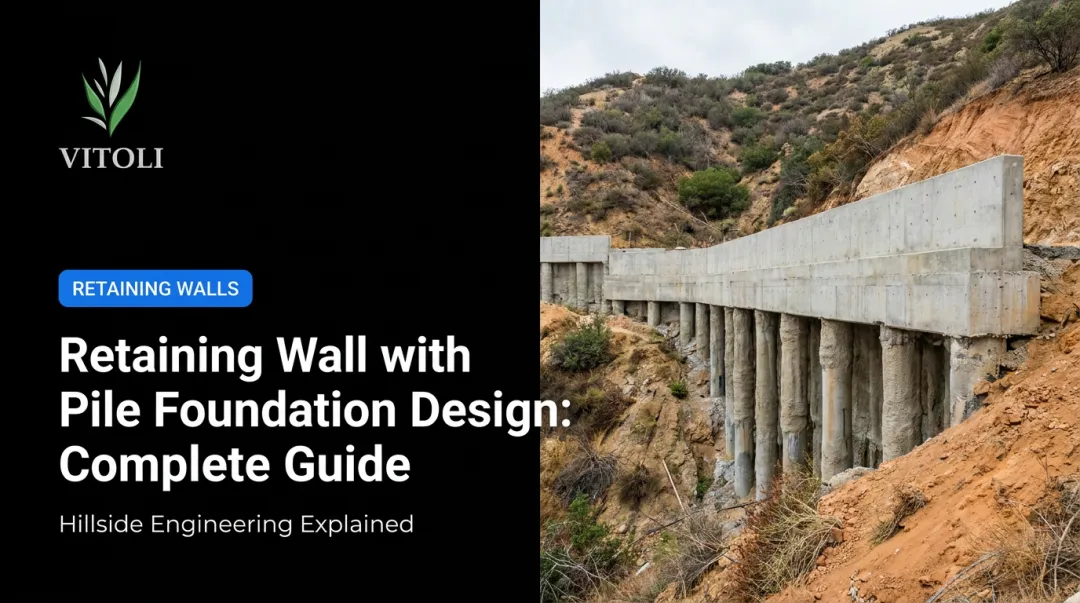
Retaining walls on hillside properties are not landscaping features — they are structural elements that hold back lateral earth pressure and protect the foundation from soil movement.
For them to work, they must be:
- Engineered and reinforced specifically for the soil conditions and wall height at that location
- Tied into the foundation system so the wall and structure act as a unified assembly
- Equipped with drainage — gravel backfill, perforated drain lines, and weep systems to prevent hydrostatic pressure buildup
Improper water management behind retaining walls is one of the leading causes of wall failure on hillside properties. Drainage is not an add-on — it's a structural requirement.
Common Mistakes in Hillside Foundation Planning
Treating Hillside Foundations Like Flat-Lot Foundations
The most dangerous misconception: that digging footings deeper on a slope is equivalent to hillside foundation engineering. Depth alone does not solve lateral force, drainage, or differential settlement problems. Hillside foundations require a different structural logic from the ground up.
Skipping or Rushing the Geotechnical Investigation
Every Vitoli Builders project begins with a comprehensive site evaluation because designing a foundation without that data means engineering based on assumptions rather than reality. Every Vitoli Builders project begins with a comprehensive site evaluation covering soil composition, slope grade, drainage patterns, and load requirements — because designing a foundation without that data means engineering on assumptions rather than reality.
That evaluation drives every structural decision that follows. Skipping it to save time or money produces a design that holds up until the first significant rain event or earthquake. The remediation costs that follow consistently far exceed the original savings.
A proper geotechnical investigation typically covers:
- Soil composition and bearing capacity
- Slope grade and geometry
- Subsurface drainage patterns
- Seismic and load requirements
Building on an Unstable Slope Without First Stabilizing It
On severely compromised hillside sites where the slope itself is geotechnically unsound, no foundation system will perform adequately without first addressing the underlying instability. Remediation comes before foundation design — not alongside it.
Depending on site conditions, that work can include:
- Slope regrading to reduce the failure plane
- Soil nails or ground anchors to stabilize loose material
- Drainage correction to eliminate hydrostatic pressure buildup
The La Conchita landslide of January 2005 in Ventura County destroyed or seriously damaged 36 houses and killed 10 people — the direct result of unmitigated slope instability in Southern California.
If the slope's stability factor of safety doesn't meet the required minimums (LA County GMED requires 1.50 for gross static stability), foundation design becomes secondary to slope remediation.
Frequently Asked Questions
What is a hillside foundation?
A hillside foundation is a structural support system engineered for sloped terrain. It uses deep elements (caissons, grade beams, or piers) to anchor a structure into stable soil or bedrock below the unstable upper slope layers, while resisting the lateral and seismic forces that flat-lot foundations are not designed to handle.
What type of foundation works on hillsides?
Drilled caissons connected by reinforced grade beams are the most common and reliable system for Southern California hillsides. Micropiles are effective alternatives on sites with limited access. The right system depends entirely on the specific soil profile, slope angle, and load requirements of the individual site — there is no universal answer.
Can you build a house on a hillside?
Yes. Houses are regularly and successfully built on hillside lots throughout Southern California. Doing so requires specialized foundation engineering, a geotechnical investigation, appropriate permitting, and a construction team experienced in the unique demands of sloped terrain.
Do I need a geotechnical report before building on a hillside?
In California, a geotechnical report is required by the CBC and LADBS for hillside sites meeting certain slope and seismic thresholds. It is also the primary document on which all structural design decisions are based. Building without one is both a code violation and a serious structural risk.
How deep do caissons need to go for hillside construction?
Caisson depth is site-specific — it depends on how far below the surface stable soil or bedrock lies, accounting for slope stability, seismic loads, groundwater, and liquefaction potential. The geotechnical report specifies the required bearing depth for each caisson location on your project.
What are the warning signs of a failing hillside foundation?
Watch for: diagonal cracks above door frames, sticking doors or windows, floors that slope noticeably, stair-step cracks in exposed foundation walls, soil pulling away from the foundation perimeter, or leaning retaining walls. Any of these on a hillside property warrants an immediate professional structural inspection — not a wait-and-see approach.