Introduction
A standard retaining wall footing works well — until it doesn't. On steep hillsides, soft soils, or sites with heavy lateral loads, shallow spread footings can't always provide the bearing capacity, sliding resistance, or overturning resistance a wall demands. That's when a pile foundation enters the picture.
A retaining wall with pile foundation is a system where deep foundation elements (drilled concrete piers, steel H-piles, or helical piles) transfer the wall's loads down to stable soil or bedrock far below the surface, bypassing whatever weak or unstable material sits near the top.
According to USGS UCERF3 research, there's a 60% probability of a magnitude 6.7 or greater earthquake striking the Los Angeles region within 30 years. For Southern California hillside properties, that seismic reality — combined with expansive clays, fill soils, and tight building envelopes — makes pile-supported retaining walls a standard engineering response, not an exception.
This guide covers:
- When pile foundations are necessary (and when they're not)
- How these systems are designed and engineered
- What stability checks engineers perform before approval
- What hillside property owners in Los Angeles County and Ventura County should expect from the process
Key Takeaways
- A pile foundation is required when surface soils can't provide adequate bearing, sliding, or overturning resistance for the wall
- Design covers earth pressure calculations, pile capacity checks, pile cap design, and global stability analysis
- Pile type — drilled caissons, steel H-piles, or helical piles — depends on soil conditions, site access, and local regulations
- In Southern California, seismic loading and county geotechnical reporting requirements add significant design complexity
- Coordinating structural engineering, geotechnical engineering, and an experienced hillside contractor is essential for a compliant build
What Is a Retaining Wall with Pile Foundation?
A conventional cantilever retaining wall relies on a spread footing — a wide, shallow concrete base that transfers loads through bearing pressure on near-surface soil. A pile-supported retaining wall replaces that footing with deep foundation elements that reach competent material well below the unstable surface layer.
The wall stem itself still resists lateral earth pressure the same way. What changes is how those forces get transferred into the ground.
The Pile Cap Connection
Between the wall stem and the piles sits the pile cap (sometimes called a grade beam). This structural element distributes the wall's resultant forces — overturning moment, vertical load, and horizontal sliding force — to the individual piles below. Engineers check it for:
- Bending in both directions (parallel and perpendicular to the wall)
- One-way shear across the cap
- Punching shear around each pile
Per IBC Chapter 18 requirements, pile caps must embed vertical foundation elements at least 3 inches and extend at least 4 inches beyond the outermost elements.
How This Differs from Embedded Walls
A common source of confusion: pile-supported retaining walls are not the same as soldier pile walls or sheet pile walls. USACE defines sheet pile walls as rows of interlocking segments driven into the ground that derive stability from soil embedment and passive resistance.
A pile-supported retaining wall is fundamentally different: it has a conventional above-grade wall structure, and the piles function strictly as a foundation system beneath it. The wall and the foundation are separate elements — in a sheet pile system, they're one and the same.
When Does a Retaining Wall Need a Pile Foundation?
No code establishes a single height threshold that automatically triggers a pile foundation requirement. The decision is site-specific, driven by soil conditions and engineering judgment. Even so, several site conditions consistently push a project toward deep foundations — and knowing them helps you ask the right questions before construction begins.
Poor Near-Surface Soil Bearing Capacity
When a geotechnical report identifies soft, expansive, or liquefiable soils near the surface, a spread footing can't safely transfer wall loads without excessive settlement or bearing failure. Piles bypass the weak layer entirely, reaching stable material below.
The California Geological Survey's Seismic Hazard Zones identify specific areas prone to liquefaction and earthquake-induced landslides throughout Southern California. If your property falls within one of these zones, most jurisdictions require a site-specific geotechnical investigation before issuing a permit.
Steep Terrain and Space Constraints
On hillside properties, there often isn't room to extend a footing far enough to prevent sliding and overturning — especially when property lines, utilities, or existing structures limit the available footprint. Piles solve this by providing high capacity within a compact plan area.
Tall Walls with High Lateral Demand
The California Building Code requires dynamic seismic lateral earth pressure calculations for retaining walls in Seismic Design Categories D through F that retain more than 6 feet of backfill. Los Angeles County adds that walls over 8 feet require a site-specific geotechnical report before permits are approved.
At these heights, combined static earth pressure and seismic loading routinely exceeds what friction and passive pressure alone can handle.
Seismic Loading in Active Earthquake Zones
Seismic forces add a dynamic horizontal load component that significantly increases both overturning and sliding demand on a wall. Battered (angled) piles are commonly specified in these conditions because vertical piles alone can't efficiently resist high horizontal forces.
Nearby Structures and Surcharge Loads
When a retaining wall sits near a building, driveway, or other heavy infrastructure, the surcharge load increases lateral earth pressure on the wall. If foundation soils can't accommodate the combined load, a pile foundation provides the additional capacity needed to maintain stability.
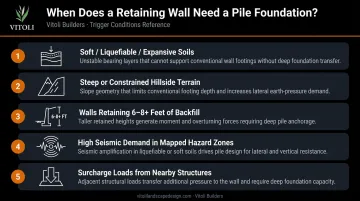
In summary, pile foundations are most likely required when a site involves:
- Soft, liquefiable, or expansive soils that can't support a spread footing
- Steep or constrained hillside terrain with limited footing footprint
- Walls retaining more than 6–8 feet of backfill under California code
- High seismic demand, particularly in mapped liquefaction or landslide zones
- Surcharge loads from nearby structures or driveways
Key Design Components of a Pile-Supported Retaining Wall
Wall Stem Design
The reinforced concrete stem resists lateral earth pressure and surcharge loads as a cantilever. It transmits bending moment and shear down to the pile cap below. Stem thickness and reinforcement are sized based on the retained height, soil type, and any applied surcharges.
Pile Cap Design
The pile cap is the structural bridge between the wall and its deep foundation. Engineers check it for:
- Bending moment in two perpendicular directions
- One-way (beam) shear across the cap width
- Punching (two-way) shear around each pile head
Pile cap failures are among the more common causes of deep foundation problems, which is why this element demands the same rigor as any other structural component in the system.
Pile Layout and Spacing
FHWA guidance recommends a minimum center-to-center pile spacing of 3 pile diameters (with an absolute minimum of 3 feet) to avoid group interaction effects. IBC requires group effect analysis for axial loads when spacing falls below 3 times the pile's least dimension, and for lateral loads when spacing in the direction of force is less than 8 times the least dimension.
Beyond spacing, pile layout must be arranged so no single pile exceeds its allowable capacity under any design load combination.
Battered (Angled) Piles for Lateral Resistance
When vertical piles alone can't resist the full horizontal sliding force from earth pressure and seismic loads, piles are installed at an angle. The horizontal component of their axial capacity then contributes directly to sliding resistance. This technique is most common on steep hillside retaining walls where seismic demand is high.
Load Combinations and the Geotechnical Report
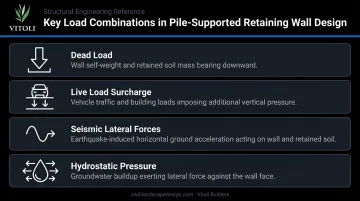
The design must consider multiple load combinations per CBC Chapter 16 and ASCE 7, including:
- Dead load (wall and soil weight)
- Live load surcharge (vehicles, structures)
- Seismic lateral forces
- Hydrostatic pressure from groundwater
The geotechnical report provides the inputs that make these calculations possible: allowable pile capacities in compression, tension, and lateral directions, plus soil parameters for earth pressure calculations. For hillside homeowners, this means the soils report isn't a formality — it directly determines whether your wall is engineered for your specific site conditions or built to generic assumptions that may not hold.
Critical Stability Checks for Pile-Supported Retaining Walls
Axial Pile Capacity
Unlike a spread footing — which only experiences compression — a pile-supported wall's overturning moment creates compression in some piles and tension (uplift) in others. Both conditions must be checked against allowable capacities. Tension capacity is especially critical for piles on the toe side of the wall, where uplift forces are highest.
Lateral Pile Capacity and Deflection
Each pile must resist its share of the horizontal sliding force. For vertical piles, this means bending — which requires checking pile deflection, bending moments, and shear forces along the pile's length. Lateral capacity is typically determined from soil p-y curves, a methodology described in detail in FHWA's lateral load design manual.
Global Slope Stability
Even if every individual pile passes its capacity check, the entire wall-soil system must be checked for deep-seated slope failure. A circular slip surface can pass below the pile tips, causing the slope to fail independently of the wall structure. On hillside sites, skipping this check is how well-designed walls end up in failure investigations.
Drainage and Hydrostatic Pressure
Caltrans' retaining wall design guidance states clearly: if wall drainage cannot be relied upon, the wall must be designed for full hydrostatic pressure. That can easily double or triple the lateral load on the wall compared to a drained condition.
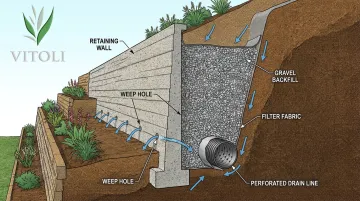
Proper drainage isn't an optional upgrade — it protects the engineering assumptions the wall was designed around. Vitoli Builders integrates all three drainage components as standard in every retaining wall system:
- Gravel backfill for percolation behind the wall face
- Perforated drain lines to redirect water away from the foundation
- Weep systems to relieve residual hydrostatic pressure before it builds up
Pile Types Used in Hillside Retaining Wall Construction
Drilled Concrete Piers (Caissons)
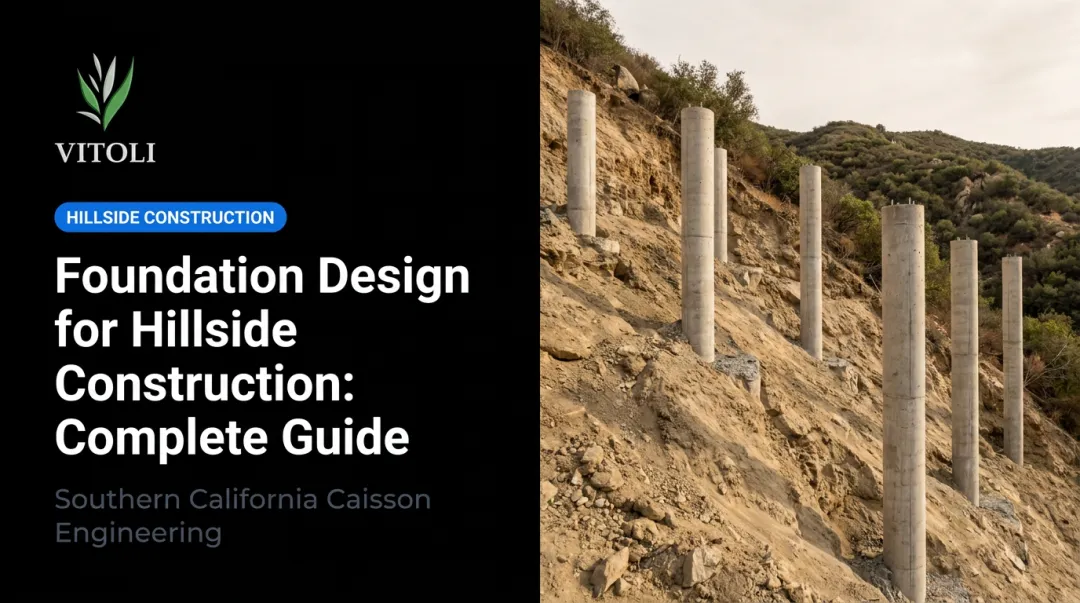
Drilled piers — commonly called caissons — are the dominant deep foundation type for retaining walls on Southern California hillside properties. The process: drill a hole with an auger, lower a reinforcing cage, and pour concrete to create a structural column that reaches competent material below the unstable surface.
Key advantages for hillside sites:
- Can be installed with compact equipment where large rigs can't access
- Depth can be adjusted in the field if the geotechnical engineer observes weaker material during drilling
- Produce engineered, inspectable foundations with predictable behavior
- Generate minimal vibration compared to driven piles — important near existing structures
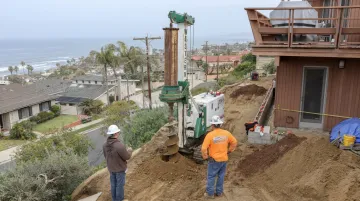
Caisson construction is Vitoli Builders' core deep foundation specialty. With over 1,800 hillside projects completed across Los Angeles and Ventura Counties, the team has sized and installed drilled piers across the full range of variable soil conditions common to Southern California terrain.
One practical note: LA County's GMED geotechnical report requirements specify that for deep foundations, on-site data must extend at least 10 feet below the foundation bottom — or 20 feet in liquefaction zones. That requirement shapes how deep the investigation needs to go before any pile depths can be finalized.
Steel H-Piles and Helical Piles
When caissons aren't the right fit, two alternatives come up: steel H-piles and helical piles. Steel H-piles are driven into the ground and work best when soil conditions allow driving and site access accommodates the equipment. They're less common than caissons on constrained residential hillside sites.
Helical (screw) piles are an increasingly used alternative on tight sites. They install with compact equipment, generate no soil spoils, and can be load-tested immediately after installation per ICC-ES AC358 testing protocols. However, LA County's guidelines note that helical piles are generally not permitted for new foundations or lateral resistance applications. That's a critical local restriction to verify with a licensed engineer before specifying them.
Southern California Hillside-Specific Considerations
Seismic Design Requirements
The 2025 California Building Standards Code (Title 24, effective January 1, 2026) requires dynamic seismic lateral earth pressure design for walls in Seismic Design Categories D through F supporting more than 6 feet of backfill. For most of Los Angeles and Ventura Counties, that means virtually every tall retaining wall needs a seismic analysis performed by a licensed structural engineer.
Seismic demand increases pile requirements meaningfully — both in terms of required pile capacity and the potential need for battered piles to handle horizontal force components.
Geotechnical Report and Permitting
Both LA County and Ventura County require a geotechnical investigation report before permits for pile-supported retaining walls will be approved. The requirements are specific:
Los Angeles County (per GMED):
- Reports must be prepared within one year of submittal
- Hillside reports require site maps at 1 inch = 40 feet or larger scale
- Deep foundation investigations must extend at least 10 feet below the foundation bottom
Ventura County:
- Requires static and seismic wall loads for walls over 6 feet
- For pile foundations, must include point of fixity plus moment and shear diagrams
- Expansive soils with an expansion index greater than 130 require documented mitigation measures
Working with a Hillside Specialist
Pile-supported retaining walls on hillside properties require three disciplines working in close coordination:
- Geotechnical engineering: soils data and pile capacity recommendations
- Structural engineering: wall system and foundation design
- Construction execution: precise caisson installation and phased wall building
Vitoli Builders' design-build model integrates all three through a single point of accountability, from initial site evaluation through caisson installation and wall construction. Their process begins with a detailed site assessment covering soil composition, slope grade, drainage patterns, and load requirements, then moves through engineering design, permit coordination, and phased construction with drainage integration built in throughout.
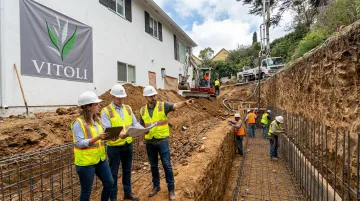
For hillside property owners in Los Angeles or Ventura County dealing with challenging terrain, getting a site consultation early — before design assumptions are locked in — is the best way to avoid cost surprises during the permit review process.
Frequently Asked Questions
What is the difference between a pile foundation and a standard footing for a retaining wall?
A standard spread footing transfers loads through bearing pressure on near-surface soil. A pile foundation uses deep structural elements to bypass weak surface layers and transfer loads to stable material below, while also providing tension and lateral resistance that a footing physically cannot.
When does a retaining wall need a pile foundation instead of a standard footing?
The main triggers are poor near-surface soil bearing capacity, limited footprint space on hillside sites, tall walls with high overturning demand, seismic zone requirements, and heavy surcharge loads from nearby structures or driveways. The final determination requires a geotechnical investigation.
What is the difference between a caisson and a pile in retaining wall construction?
Caissons are drilled-and-cast-in-place concrete piers, common in Southern California hillside residential work. Piles are typically driven or screwed into place. Both function as deep foundations, but caissons offer more installation control, minimal vibration, and field adjustability — advantages that matter on constrained hillside sites.
How deep do piles need to be for a retaining wall?
Depth is determined by the geotechnical report based on site-specific conditions. Piles must reach competent bearing material and develop the required axial and lateral capacity, which varies too widely by site to estimate without a soils investigation.
Do I need a geotechnical report for a pile-supported retaining wall in Los Angeles?
Yes. LA County and most Southern California jurisdictions require a geotechnical investigation report before pile-supported retaining wall permits will be issued. The report provides soil data, pile type and depth recommendations, and the design capacities the engineer of record needs to complete the structural design.
How much does a retaining wall with pile foundation cost compared to a standard retaining wall?
Pile-supported walls cost more than standard footing-based walls, with key drivers including drilling mobilization, caisson labor and materials, engineering fees, and permitting complexity. Because costs vary widely by wall height, pile depth, and site conditions, get a site-specific quote from a licensed hillside contractor.