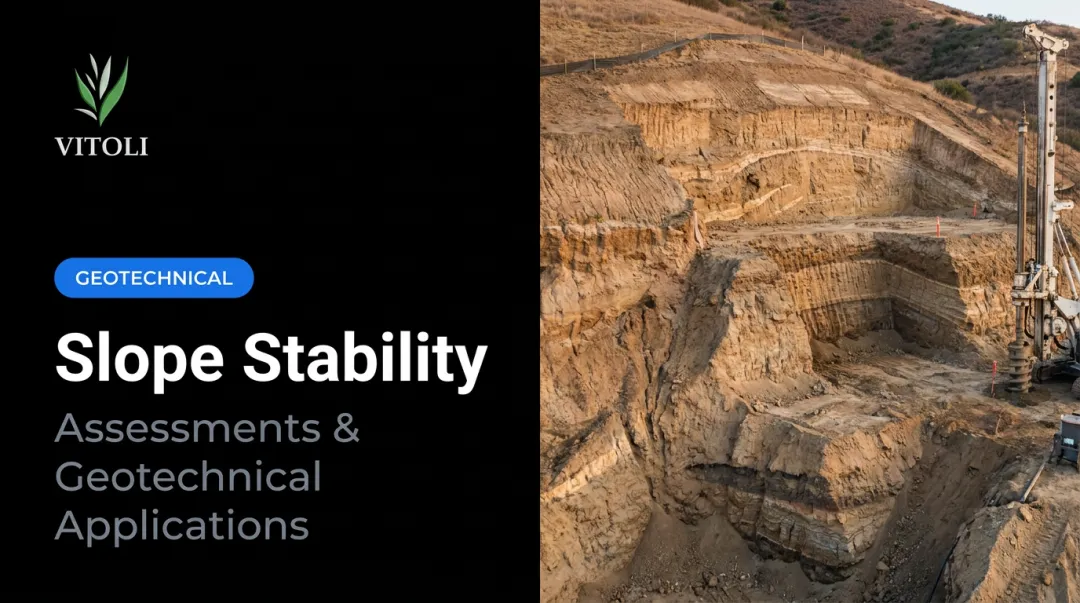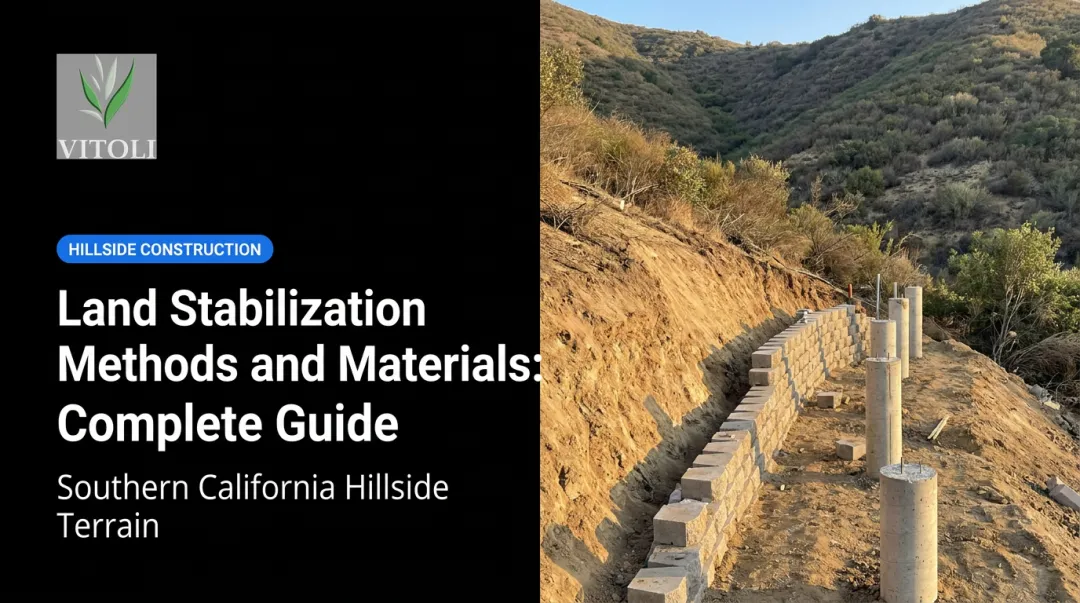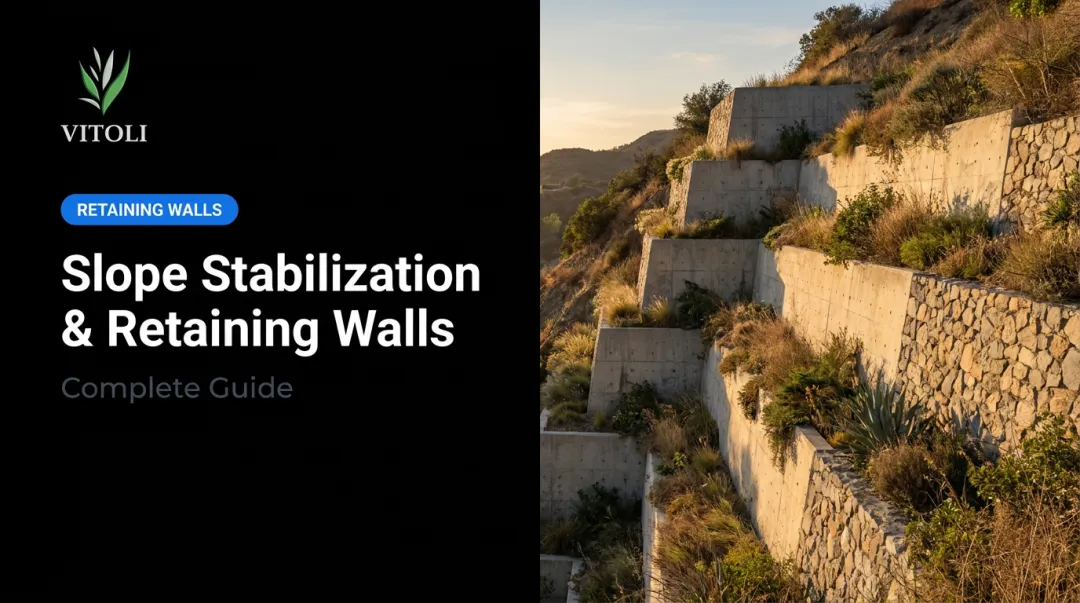
Slope stabilization covers a wide range of solutions — retaining walls, soil nailing, vegetation, drainage systems, and geosynthetics — and the right approach depends entirely on what's driving the instability at your specific site.
This article covers the core causes of slope failure, the warning signs homeowners can spot, the five primary stabilization methods, plant selection for Southern California, drainage management, and how to choose the right combination of solutions for your property.
Key Takeaways
- Slope stabilization prevents erosion, landslides, and structural damage on hillside properties
- Water infiltration is the single most common driver of residential slope failures in Southern California
- Five primary stabilization methods are available: retaining walls, soil nailing, bioengineering, rock bolts, and geosynthetics
- Drainage management is non-negotiable — even well-built walls fail without it
- Post-fire burn scars dramatically lower the rainfall needed to trigger debris flows
What Causes Slopes to Fail — and How to Spot the Warning Signs
The Physics Behind Slope Failure
Every slope exists in a balance between driving forces (gravity, water pressure, surcharge loads) and resisting forces like soil strength, root systems, and structural supports. When that balance tips, the slope moves.
Water is the most common tipping point. USGS research explains that intense or sustained rainfall saturates soil, raises groundwater levels, and increases pore water pressure — which directly reduces shear strength and triggers slope movement.
In Southern California specifically, shallow landslides commonly require about 10 inches of winter rain to saturate soils. After that threshold is reached, rainfall bursts of just 0.2 to 0.25 inches per hour can trigger failures.
Southern California's Specific Risk Factors
Several conditions make SoCal hillsides especially vulnerable:
- Long dry periods followed by intense storm events hit soils that have dried out and lost cohesion — a feast-or-famine rainfall pattern that repeats every season
- The 1971 San Fernando earthquake (M6.6) triggered documented landslides above the San Fernando Valley, loosening soil that remained unstable for years afterward
- Wildfire burn scars — after fire strips vegetation from a hillside, debris flows can occur after as little as 7 mm (0.3 inch) of rain in 30 minutes, per USGS data. Post-fire debris flow risk is highest during the first two rainy seasons after a fire
- Construction and grading — altering natural slope geometry removes lateral support and can destabilize terrain that was previously stable
Warning Signs Every Homeowner Should Know
According to USGS, watch for these indicators:
- Cracks or tension lines forming near the top of a slope
- Bulging or "bowing" ground at the base of a slope
- New springs or areas of saturated soil after rain
- Trees, fence posts, or utility poles tilting out of vertical alignment
- Sticking doors or windows, or new cracks in walls and foundations
- Water seeping directly from the slope face
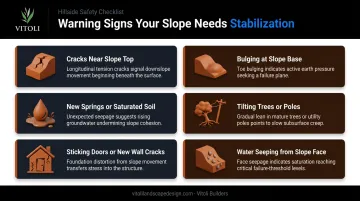
LA County Ready also advises listening for unusual sounds — trees cracking or boulders knocking — as audible warning signs during or after heavy rain.
Slope Stabilization Methods Explained
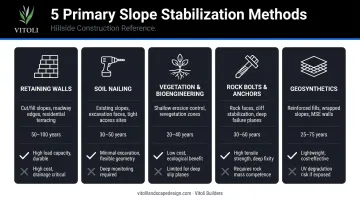
No single method works for every slope. The five primary approaches each address different conditions, and most effective real-world solutions combine more than one.
Retaining Walls
Retaining walls physically hold back soil by resisting lateral earth pressure (the constant outward push of soil mass downhill). Common materials include concrete, masonry block, natural stone, and poured-in-place systems. Each has different structural characteristics; concrete and masonry block are the workhorses for engineered hillside stabilization, while stone delivers a natural aesthetic on appropriate sites.
Critical design requirement: Every retaining wall must include proper drainage provisions. ICC Chapter 18 requires walls to be designed for hydrostatic pressure and water uplift. Without drainage aggregate backfill, perforated drain lines, and weep holes, water accumulates behind the wall and generates pressure that eventually causes failure.
Beyond pure structural function, retaining walls create usable terraced space on hillsides. A well-designed wall system stabilizes the slope and converts otherwise unusable terrain into functional outdoor living space.
Service life: FHWA guidance sets a minimum 75-year service life for permanent mechanically stabilized earth retaining walls.
Soil Nailing
Soil nailing reinforces a slope from within. Steel bars (nails) are drilled into the slope at regular intervals and grouted in place, then the exposed face is secured with shotcrete or wire mesh facing. The result is a composite reinforced mass that resists movement as a unified structure rather than relying on surface-level resistance alone.
Best applications:
- Steep cuts where space limits other solutions
- Sites needing both temporary construction support and a permanent fix
- Slopes with limited room for a retaining wall footprint
FHWA soil nail walls carry a design life of typically 50 to 75 years.
Vegetation and Bioengineering
Plant roots mechanically bind soil particles together. Deep-rooted species increase resistance to shallow erosion, and bioengineering takes this further by deliberately integrating living plants with structural elements (willow stakes, brush layering) for a combined mechanical and biological effect.
Vegetation works well on moderate slopes and offers environmental benefits no engineered system can match. The limitations are real, though: steep slopes, high fire-risk zones, and situations involving structural forces all require pairing vegetation with engineered solutions.
Plants also take time to establish root systems deep enough to matter — factor in establishment time when planning any bioengineering approach.
Rock Bolts and Ground Anchors
Two related techniques address rock-specific instability:
- Rock bolts are steel rods drilled perpendicular to the slope face and anchored into bedrock, increasing friction and shear resistance along rock discontinuities
- Ground anchors are tensioned systems used in more demanding structural applications where passive reinforcement isn't sufficient
Both are particularly relevant on Southern California hillsides, where decomposed granite and layered sedimentary rock create terrain susceptible to rockfall and sliding along natural fracture planes.
Geosynthetics
Geosynthetics (geotextiles and geogrids) are engineered materials installed within soil to improve its mechanical properties:
- Geotextiles filter and separate soil layers while allowing drainage
- Geogrids distribute load and reinforce the soil mass
Geosynthetics rarely stand alone. They're commonly installed behind retaining walls to improve drainage, or within compacted fill slopes to increase stability. FHWA's MSE wall guidance establishes geosynthetic-reinforced permanent walls at a minimum 75-year service life, making them a durable component of long-term systems.
Best Plants and Grasses for Slope Stabilization in Southern California
Southern California's dry summers, winter rains, and fire seasons demand plants that can survive drought, establish quickly, and persist through fire cycles. Deep-rooted native species outperform turf grass on most SoCal slopes because they require far less irrigation and recover better after fire.
Top native options for LA County and Ventura County slopes:
- Deer grass (Muhlenbergia rigens) — native bunchgrass used for bank stabilization, reaches 4–5 ft tall; listed by Calscape specifically for groundcover and bank applications
- Blue wild rye (Elymus glaucus) — perennial bunchgrass that spreads by rhizomes and functions as a soil stabilizer
- Ceanothus — Point Reyes ceanothus forms a dense mat, roots where stems contact soil, and is effective on steep slopes
- Toyon (Heteromeles arbutifolia) — evergreen shrub used for bank stabilization; can reach 10 ft in 3 years
- Coffeeberry (Frangula californica) — deep-rooted California native shrub suited to dry hillside conditions
Native shrubs outperform introduced species on water efficiency and fire resilience — a critical advantage when SoCal fire seasons can reset a slope's vegetation in hours.
On steeper slopes, vegetation needs reinforcement:
- Erosion control blankets (ECBs) provide immediate soil cover while plants establish — Caltrans rates short-term RECP blankets at 1-year longevity, longer-term TRMs at 3 years
- Hydroseeding with mulch and stabilizing emulsion can cover cut or fill slopes up to 2:1 gradient quickly and cost-effectively
- Hydraulic seed applied without mulch provides no immediate erosion protection — plants take weeks to establish, leaving bare soil exposed to the first rain
Drainage Management: The Overlooked Key to Slope Stability
Water drives more slope failures than any other factor. A well-engineered retaining wall or soil-nailed slope can still fail if water accumulates behind it, because pore water pressure reduces soil shear strength until the slope or structure gives way. Drainage isn't optional; it's the core of any stabilization system.
The Three Drainage Layers
Effective slope drainage works at three levels:
- Surface drainage: Grading and swales direct runoff away from the slope before it infiltrates
- Subsurface drainage: French drains, perforated pipes, and horizontal drains lower the groundwater table and prevent pressure buildup in engineered fills
- Structural drainage provisions: Weep holes in retaining walls, drainage aggregate backfill, and perforated drain lines integrated directly into the wall system
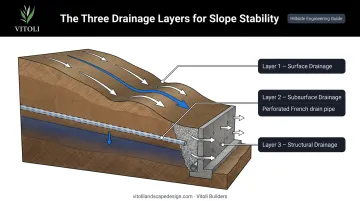
Vitoli Builders treats these three components as an integrated system in every retaining wall project. Gravel backfill, perforated drain lines, and weep systems are standard scope, not optional upgrades — hydrostatic pressure is one of the leading causes of wall failure on hillside properties.
Southern California's "Feast or Famine" Problem
California receives approximately 75% of annual precipitation between November and March, and NOAA data show atmospheric rivers alone cause more than 80% of flood damages in the state. Soils that have dried out over months of summer heat become less cohesive. Then a single storm event delivers what would normally be weeks of rain.
Drainage design for Southern California hillsides must account for these peak rainfall conditions. LA County Ready identifies mud and debris flow risk when rainfall exceeds 0.5 inches per hour or 3 to 4 inches per day — thresholds that Southern California regularly sees during atmospheric river events. Systems designed for average rainfall conditions will be overwhelmed by these peak events.
How to Choose the Right Slope Stabilization Approach
Factors That Determine the Right Method
| Factor | Impact on Method Selection |
|---|---|
| Slope steepness and height | Steeper slopes require engineered solutions; vegetation alone is insufficient above moderate grades |
| Soil type | Clay, sandy soil, and decomposed granite each respond differently to water and load |
| Degree of existing movement | Active movement requires immediate structural response before revegetation |
| Proximity to structures | Structures nearby increase consequence of failure and typically require engineered solutions |
| Intended use | A garden terrace vs. a building pad foundation require very different structural capacities |
Think in Systems, Not Single Solutions
Most residential hillside projects deliver the best outcomes through combined approaches. A typical well-designed system might include:
- Engineered retaining walls (concrete or masonry block) to manage lateral earth pressure
- Caissons drilled to stable bedrock to anchor the wall system on challenging terrain
- Integrated drainage — gravel backfill, perforated drain lines, weep systems — to eliminate hydrostatic pressure
- Native vegetation on the slope face above the wall to manage surface erosion and runoff
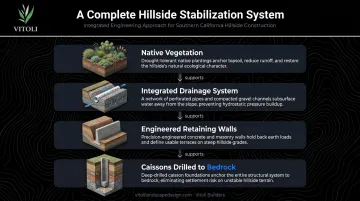
Each component supports the others. A wall without drainage fails. Drainage without structural support doesn't stop active movement. Vegetation without drainage becomes saturated and loses effectiveness.
Permitting Requirements in California
Most slope stabilization work involving grading requires permits before construction begins:
- City of Los Angeles: Grading permits are required for any work in the Hillside Grading Area; soil and geology reports must accompany plans where applicable
- LA County: Chapter 70 regulates grading, excavations, fills, and erosion/sedimentation control; geotechnical reports must be dated within 1 year of submittal
- Ventura County: No grading shall be performed without a permit; fill over 50 cubic yards requires approval; submittals include a geotechnical report and hydrology/hydraulics report
Start the permit conversation early. Grading permit applications, geotechnical reports, and plan check processes add time to project timelines — and working without permits on hillside properties in California creates significant liability.
Working with a Hillside Specialist
Navigating permits, soils reports, and structural design is easier when you're working with a team that does this every day. Vitoli Builders has spent over 20 years working exclusively on hillside terrain across Los Angeles County and Ventura County, completing more than 1,800 projects involving retaining walls, caissons, slope stabilization, and drainage systems.
The in-house design-build model means the team that evaluates your slope is the same team that designs and builds the solution — no handoffs, no gaps in accountability. CEO Rob Litman and his team begin every project with a comprehensive site evaluation covering soil composition, slope grade, drainage patterns, and load requirements. For projects over $25,000, Vitoli includes a complimentary 3D design package so homeowners can visualize the outcome before construction starts.
Frequently Asked Questions
What is slope stabilization?
Slope stabilization refers to any technique used to reinforce an unstable or at-risk slope to prevent erosion, landslides, or soil movement. The goal is to increase the slope's factor of safety to a level that ensures long-term stability — CGS Special Publication 117A requires factors above 1.5 for static conditions and above 1.1 under seismic loading.
What is the best grass for slope stabilization?
In Southern California, drought-tolerant natives like deer grass (Muhlenbergia rigens) and deep-rooted shrubs like ceanothus and toyon outperform turf grasses because they need less water and survive fire cycles. In erosion-prone regions generally, vetiver grass is widely used for its exceptionally deep root system.
What are the warning signs that a slope needs stabilization?
Watch for cracks or tension lines near the top of the slope, bulging or soil movement at the base, water seeping directly from the slope face, and tilting structures — trees, fences, retaining walls — near the slope edge. Sticking doors and new foundation cracks on structures nearby are also red flags.
How much does slope stabilization cost?
Costs vary widely based on slope size, method, soil conditions, and access. As a reference, hydroseeding runs $650–$2,200 for residential properties, while retaining walls range from $3,112 to $10,280 in non-California markets. Southern California hillside projects typically cost more due to engineering, permitting, and drainage requirements — a professional site assessment is the only reliable way to get an accurate number.
Does slope stabilization require a permit in California?
Yes. Most projects involving grading or significant earthwork require a grading permit from the local municipality. Projects near structures typically also require a geotechnical report. Requirements vary by city and county — consult a licensed contractor familiar with your jurisdiction before starting any work.
How long do slope stabilization measures last?
FHWA sets design life at 50–75 years for soil nail walls and at least 75 years for permanent MSE/geosynthetic retaining walls. Vegetation-based solutions improve over time as root systems mature. Periodic inspection after significant rain events or seismic activity helps catch drainage or structural issues before they escalate.