Key Takeaways
- California grading rules operate at two levels: state (CBC Appendix J) and local municipal code — requirements vary significantly by city and county
- Slope percentage determines buildable area; lots with 46%+ slopes typically face 90% natural open space requirements
- Grading limits apply to cumulative cut plus fill, not net difference — so volume calculations matter early
- Erosion control plans must be in place before October 1 for any project with exposed grading
- A geotechnical report, slope map certified by a registered civil engineer, and approved drainage plan are required before grading permits are issued
What Are Hillside Grading Standards and Why They Exist
Hillside grading standards are regulations governing how much land can be cut, filled, and reshaped on sloped properties. They operate at two distinct levels: the 2025 California Building Code (CBC) Appendix J sets the statewide baseline for grading administration, cut/fill slopes, drainage, terracing, and erosion control. Local jurisdictions then layer their own hillside ordinances on top — and they can be significantly more restrictive.
A homeowner in Calabasas, Malibu, or Thousand Oaks is working under at least two sets of rules simultaneously. Confirm which apply to your parcel before any design work begins.
These standards exist for concrete reasons. The January 2005 La Conchita landslide in Ventura County, documented by the USGS, destroyed or seriously damaged 36 houses and killed 10 people. Grading standards exist specifically to prevent that outcome. Their core goals are:
- Minimize slope erosion and landslide potential
- Protect natural ridgelines and existing drainage patterns
- Preserve neighborhood character on visible hillside terrain
- Reduce construction hazards for workers and neighboring properties
Who is subject to these standards? Any homeowner or developer planning grading, excavation, fill placement, retaining walls, or new construction on a hillside lot — including single-family residential properties. Even significant landscaping changes on steep slopes can trigger review, depending on the municipality.
How Hillside Slopes Are Classified
Slope classification is the starting point for every hillside development decision. Most Southern California municipalities use a percentage-based system — rise divided by run, multiplied by 100.
The Calimesa Municipal Code Chapter 18.55 provides one of the clearest examples of how this works in practice, and its framework is representative of the approach used across Southern California:
| Slope Range | Classification | Natural Open Space Required |
|---|---|---|
| 0–15% | Flat/gentle/rolling | 0% |
| 16–20% | Hillside | 20% |
| 21–25% | Steep hillside | 35% |
| 26–30% | Very steep hillside | 50% |
| 31–45% | Mountainside terrain | 75% |
| 46%+ | Rugged mountainside terrain | 90% |
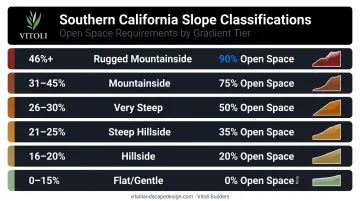
The open space requirement is not abstract — it directly limits how much of your lot can be disturbed, graded, or built upon. A lot where most of the acreage sits at 31–45% slope may have far less buildable area than its total square footage suggests.
Average slope is officially calculated using the formula (I × L × 0.0023) / A, where I is the contour interval in feet, L is the total length of contour lines in feet, and A is the site acreage. A registered civil engineer must prepare and certify this slope map. It forms the foundation of every subsequent grading decision.
Identifying Buildable vs. Restricted Areas on Your Property
Slopes at or above 46% are typically prohibited from grading without substantial engineering justification. Beyond slope percentage, prohibited development areas in California commonly include:
- Geologic hazard zones
- Areas subject to flooding or within floodplain boundaries
- Environmentally sensitive habitat areas
- Land within a defined setback distance from natural water bodies
- Ridgeline areas, which often carry additional horizontal setback restrictions from the ridgeline centerline
If you're purchasing hillside land or planning major construction, obtaining a slope map and preliminary soils report before committing to a project scope is worth doing before finalizing any project scope. Finding that 60% of a lot is unbuildable mid-design is an expensive lesson.
Grading Limits: How Much Earth Can You Move?
Understanding Cumulative Grading Totals
The most common misunderstanding in hillside grading: limits apply to the cumulative total of cut plus fill, not the net difference. If a project involves 600 cubic yards (CY) of excavation and 400 CY of fill, the cumulative grading total is 1,000 CY — not 200 CY. This distinction determines whether a project requires discretionary approval.
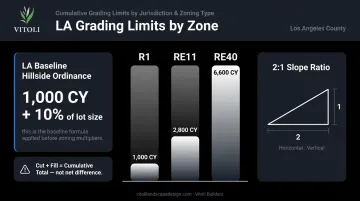
In Los Angeles, the current Los Angeles Municipal Code (LAMC) Section 12.21 C.10 sets the Baseline Hillside Ordinance (BHO) formula at 1,000 CY plus 10% of lot size in square feet, subject to zone-based caps:
| Zoning | Maximum Grading Cap |
|---|---|
| R1 | 1,000 CY |
| RE11 | 2,800 CY |
| RE40 | 6,600 CY |
Other jurisdictions use different thresholds. San Bernardino County requires grading permits for 100 CY or more of combined cut and fill. Ventura County distinguishes between Regular Grading (500 CY or less) and Non-Standard Grading (more than 500 CY). Each municipality sets its own thresholds — confirm the formula with your local building department before estimating volumes.
Manufactured slope gradient limits are set by CBC Appendix J at a maximum 2:1 ratio (horizontal to vertical) for both cut and fill slopes, unless a geotechnical report justifies a steeper design. CBC Appendix J also requires terraces at maximum 30-foot vertical intervals for qualifying slopes, with each terrace at least 6 feet wide.
What Grading Activities Are Typically Exempt
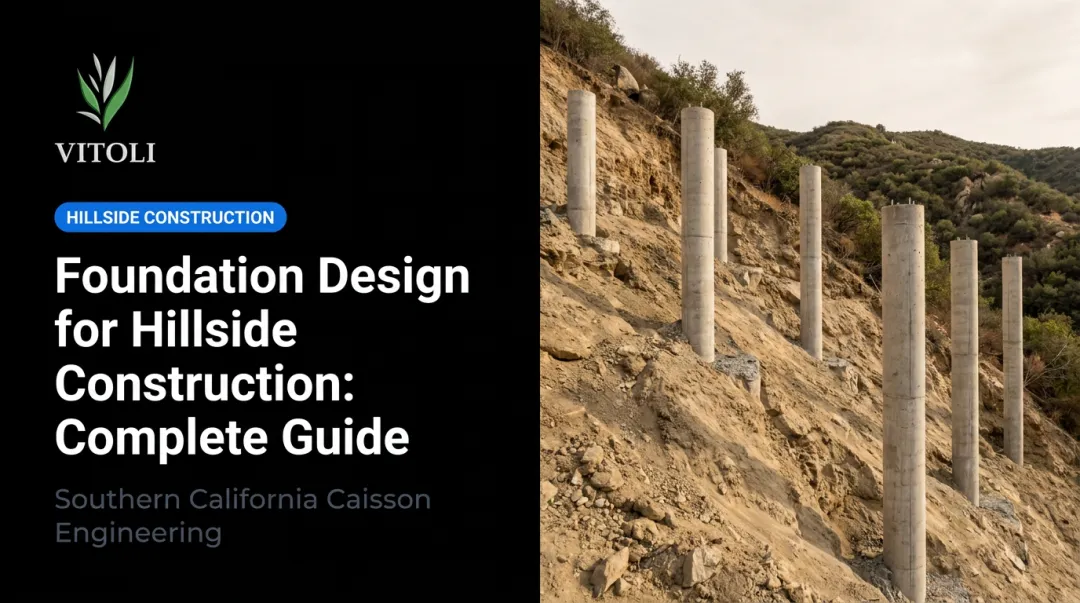
Some grading activities don't count toward cumulative totals. Under LAMC Section 12.21 C.10(f)(3)(i), excavation for caisson and pile foundations is exempt from the BHO grading and transport limits when no freestanding retaining walls are involved — this matters on complex hillside sites where deep foundations accompany significant grading.
Other common exemptions include remedial grading approved by the city engineer to correct a geologic hazard, and certain driveway grading up to a specified volume. Check your jurisdiction's code for the exact driveway threshold, as it varies by municipality.
One critical note: exempt grading still produces material that must be managed. The exemption affects counting toward the limit, not the logistics of handling that material on site.
Calculate grading volumes during schematic design — before construction documents are complete. Discovering an overage at plan check is a costly surprise. If a project does exceed the allowable quantity, a Zoning Administrator deviation is available under LAMC Section 12.21 C.10(f)(4) for Los Angeles projects, but it adds months to the permitting timeline and approval is not guaranteed.
Drainage, Erosion Control, and Slope Stability Requirements
Drainage Planning
Hillside grading inherently alters natural drainage patterns. Every grading plan must include an approved drainage strategy before building or grading permits are issued. Under LADBS plan-check guidance, this includes hydrology calculations, pad drainage design, subdrain systems, and discharge to approved locations. Critically, LADBS policy prohibits directing increased water discharge across interior lot lines to adjoining properties.
Erosion Control Timing
For projects over 200 CY in Los Angeles, temporary erosion controls are required between October 1 and April 15. The Los Angeles Bureau of Engineering states that if an approved Wet Weather Erosion Control Plan is not on site by October 1, the city can stop the project and cite the contractor or owner. Plan your construction schedule around this deadline if your project involves significant exposed grading.
Standard erosion control best management practices (BMPs) include:
- Silt fencing along disturbed slope edges
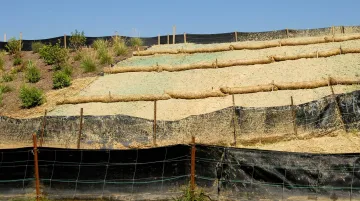
- Straw wattles on exposed graded slopes
- Stabilized construction entrances to prevent mud tracking
- Sediment traps at drainage discharge points
Beyond temporary BMPs, landscaping on manufactured cut-and-fill slopes is mandatory for most hillside projects, including automatic irrigation systems. California municipalities favor drought-tolerant, fire-resistant native species — plant selection that serves both regulatory compliance and long-term slope stability through root mass development.
Geotechnical Report Requirements
A licensed soils engineer and engineering geologist must investigate and certify soil bearing capacity, slope stability, drainage behavior, foundation recommendations, and any geologic hazards before hillside grading begins.
The California Geological Survey's SP 117A guidelines establish commonly accepted slope factors of safety at greater than 1.5 static and greater than 1.1 dynamic — values the geotechnical report must address. This report drives virtually every other grading decision and must be reviewed and approved before any work starts.
Retaining Walls and Grading Design Techniques
Retaining walls can reduce the volume of earth that needs to be cut by holding back existing grade — but they're also subject to their own height restrictions. Current LAMC standards for hillside areas permit either one retaining wall up to 12 feet, or two retaining walls up to 10 feet each separated by at least 3 feet. Exceeding these heights requires Zoning Administrator approval.
Terraced wall designs with planting between levels are a common approach to achieving greater total retained height while staying within individual wall limits. The aesthetic benefit is real too — tiered walls with integrated planting soften what would otherwise be a stark engineered face.
Landform Grading and Contour Design
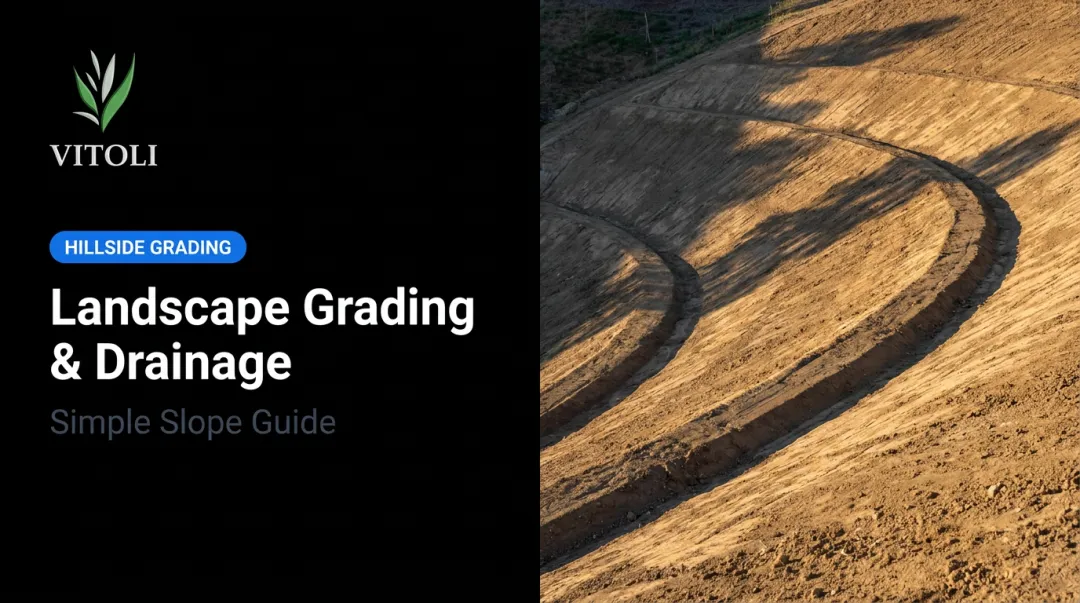
For projects in Los Angeles involving 1,000 CY or more of grading — whether through remedial grading, Zoning Administrator relief, or other approved exceptions — landform grading is required under LA Planning's Baseline Hillside Ordinance Grading Handout. Rather than creating flat, engineered cut slopes, landform grading uses curved, variable-ratio contours that simulate natural terrain — producing a graded slope that reads as part of the landscape rather than an obvious engineering intervention.
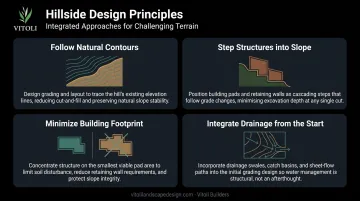
Several design principles apply across California hillside ordinances and are worth understanding before finalizing any grading plan:
- Follow natural contours on slopes 16% and above — grading must track existing contour lines rather than cutting straight paths through the hillside
- Step structures into the slope — split-level floor plans and terraced pads minimize total grade disturbance
- Minimize building footprint — flattening an entire hillside lot to fit a standard floor plan creates both regulatory and engineering problems
- Integrate drainage from the start — grading design and drainage systems need to be planned together, not sequentially
For complex hillside sites requiring caissons, tiered retaining walls, or significant pad creation, grading design and structural systems need to be planned together. Vitoli Builders handles this integration across Los Angeles County and Ventura County, bringing retaining wall construction, caisson installation, drainage, and grading design under a single in-house team.
The Hillside Grading Permit Process
What Triggers a Grading Permit
Under CBC Appendix J Section J103.2, grading permits are required for most earthwork beyond shallow excavation. Specifically in California hillside areas, a permit is required for:
- Import or export of earth material
- Fill placement
- Excavation deeper than 2 feet or creating cut slopes over 5 feet
- Any work that alters existing drainage patterns
- All work in designated hillside grading areas, regardless of volume
Grading permits are separate from building permits and go through a distinct review track — typically with the city's grading or engineering division, not the standard building plan check counter.
Submittal Package Requirements
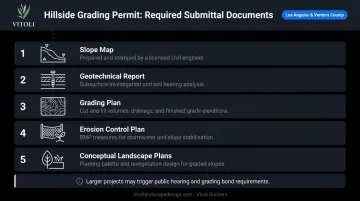
A complete hillside grading permit submittal typically includes:
- Slope map prepared and certified by a registered civil engineer
- Geotechnical report approved by the city engineer
- Grading plan showing existing and proposed contours, cut/fill quantities, and drainage
- Erosion control plan
- Conceptual landscape plans for all cut-and-fill slopes
Larger projects carry additional requirements beyond the standard package. In Los Angeles, any project importing or exporting more than 1,000 CY in a Hillside Grading Area triggers a public hearing process for haul route approval under LABC 7006.7. Grading bonds are required above 250 CY of cut or fill in designated hillside areas under LABC 7006.5.7 — budget for that bond as part of your project cost.
The inspection sequence requires continuous geotechnical observation during fill placement and compaction testing, along with rough grade and final grade inspections. Certified as-built grading plans must be submitted once grading is complete.
The grading bond will not be released — and construction cannot proceed to occupancy — until all grading approvals and certifications are in order. Plan for this sequencing when setting your project timeline.
Frequently Asked Questions
Do I need a permit for hillside grading?
Yes. Grading permits are required for most hillside earthwork in California — covering excavation, fill placement, earth import/export, and drainage alterations. Specific triggers vary by city, but working without a permit can result in stop-work orders and mandatory removal of unpermitted grading.
What is a good grade for landscaping on a hillside?
For planted hillside areas, a maximum 3:1 slope (about 33%) is manageable for landscaping and erosion control. A 2:1 slope (50%) is the regulatory maximum for manufactured slopes in most California jurisdictions, while gentler grades of 4:1 or flatter allow better water infiltration and root establishment.
What slope percentage is considered a hillside for grading regulation purposes?
Most California municipalities trigger hillside development regulations at 16% slope or greater. Slopes of 0–15% are generally exempt from hillside-specific rules, though standard grading permits may still apply for earthwork above the volume threshold.
What is cut and fill in hillside grading?
"Cut" is earth excavated from higher ground to lower an elevation; "fill" is compacted material placed to raise an elevation. California hillside grading limits are based on the cumulative total of cut plus fill — not the net difference between the two.
How do I prevent erosion after hillside grading?
Install erosion control BMPs immediately — silt fencing, straw wattles on exposed slopes, stabilized drainage channels, and automatic irrigation on graded areas. California regulations require erosion control plans to be in place before October 1 for projects with significant exposed grading.
What is landform grading and when is it required?
Landform grading uses curved, variable-ratio slopes that simulate natural terrain rather than flat engineered cut faces. In Los Angeles, it is required for projects involving 1,000 CY or more approved through remedial grading, Zoning Administrator relief, or other listed exceptions, per the City of Los Angeles Landform Grading Manual.