Introduction
Grading a hillside is nothing like leveling a flat backyard. On a steep Southern California slope, you're dealing with active erosion channels, unstable soils, drainage that actively threatens your foundation, and regulatory requirements that don't apply to standard yard work.
The stakes are real. LA County's 2025 All-Hazards Mitigation Plan identifies approximately 284 square miles of county land exposed to land-movement hazards, with an estimated 1.2 million residents potentially affected. In Ventura County, 4,743 buildings sit in very-high landslide-risk zones with exposed property value around $2.92 billion.
This guide covers the full hillside grading process: measuring your slope percentage, executing cut-and-fill, managing permits, and recognizing when grading alone isn't enough to solve the problem.
Key Takeaways
- Hillside grading cuts high areas and fills low ones to reduce gradient, redirect runoff, and stabilize terrain
- Slopes at 2:1 (50% grade) or steeper require professional engineering, mechanical equipment, and a grading permit
- Design drainage before any earthmoving begins; unmanaged runoff accelerates erosion and undoes grading work
- When grading can't solve the problem alone, retaining walls and terracing are the structural next step
When to Grade a Hillside — and What You'll Need First
Conditions That Justify Grading
Not every sloped yard needs a full grading project. These specific conditions do:
- Water draining toward the home's foundation after rain
- Visible erosion channels forming on the slope
- Soil that has shifted, cracked, or feels unstable underfoot
- Terrain too steep to landscape or use safely
When Grading Isn't Enough on Its Own
Some site conditions make standalone grading impractical or insufficient:
- Slopes steeper than 2:1 require engineered structural solutions, not just earthmoving — the grade drops more than half the horizontal distance
- If a bulldozer can't safely reach the slope, grading scope is constrained from the start
- Expansive clay or unstable bedrock can make cut-and-fill unreliable without additional soil engineering
- If a retaining wall is needed regardless, grading scope should be planned around it from the beginning
What Must Be in Place Before You Start
- Locate and mark underground utilities — call 811 before any digging
- Verify permit requirements — both LA County and Ventura County require grading permits triggered by as little as 50 cubic yards of earthwork (see Step 2 for details)
- Check foundation exposure — maintain at least 6–8 inches of foundation above the final soil line
- Assess timing — avoid grading in saturated soil conditions or immediately before rainy season without erosion control staged and ready
Essential Equipment
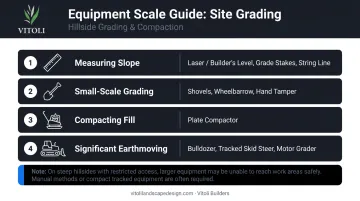
| Scale of Work | Equipment Needed |
|---|---|
| Measuring slope | Laser or builder's level, grade stakes, string line |
| Small-scale grading | Shovels, wheelbarrow, hand tamper |
| Compacting fill | Plate compactor |
| Significant earthmoving | Bulldozer, tracked skid steer, or motor grader |
Equipment access on a steep hillside can be the limiting factor. A slope that's technically gradable may not be safely reachable by the machinery required, which affects both project scope and cost before a single cut is made.
How to Grade a Hillside: Step-by-Step
Step 1: Measure the Existing Slope and Calculate Your Grade
USGS confirms the standard formula: percent slope = elevation change ÷ horizontal distance × 100.
In practice: drive two stakes, run a string line between them at a fixed horizontal distance, measure the vertical drop with a line level. A 3-foot drop over 10 feet of horizontal run equals a 30% grade.
Key grade thresholds to know:
- 2–5% — ideal range for surface drainage
- 25% — LA County's Hillside Management Area Ordinance regulates development at this threshold and steeper
- 33% (3:1) — California's engineering benchmark for steep slopes; triggers additional drainage and terrace design requirements
- 50% (2:1) — California Appendix J's maximum cut/fill slope unless justified by geotechnical data
Walk the full hillside, not just the area near your foundation. Mark erosion channels, saturated zones, and any areas where soil has already moved — these tell you where water is concentrating and where structural risk is highest.
Step 2: Obtain Permits and Plan for Drainage
Permit thresholds vary by county:
| County | Key Exemption Limits | Hillside Trigger |
|---|---|---|
| LA County | 50 cubic yards, 2 ft cut depth, 3 ft fill depth | Fill over 1 ft on terrain steeper than 5:1 (20%) is not exempt |
| Ventura County | 50 cubic yards, less than 2 ft deep | Cut slope max 5 ft vertical height, no steeper than 2:1 |
Unpermitted grading in either county carries serious consequences. LA County inspectors can issue written Stop Work Orders, and interfering with inspector access is classified as a misdemeanor under county code.
Plan drainage before touching a shovel. Determine where water will go after regrading — surface swales, catch basins, perforated drain pipe, and French drains are the standard tools. California Appendix J requires all graded surfaces to drain to an approved drainage system, with a 2% minimum gradient for drainage swales. Grading without a drainage plan is the single most common reason hillside projects fail within one or two rainy seasons.
Step 3: Clear the Hillside and Establish Working Boundaries
- Remove all vegetation, root systems, loose debris, and organic material — organic material left under compacted fill creates settlement risk over time
- Set grade stakes at regular intervals down the slope to mark target elevation
- Clearly designate cut zones (where soil is removed) and fill zones (where soil is added) before any earthmoving begins
Step 4: Execute the Cut and Fill Process
The cut-and-fill method removes soil from the upper portion of the hillside and uses it to build up the lower portion — reducing overall gradient. When balanced correctly, minimal soil needs to be imported or hauled away, keeping both cost and disruption lower.
The critical rule: fill must be compacted in layers.
California Appendix J and LA County Grading Guidelines both specify 90% compaction per ASTM D1557 (Modified Proctor) in lifts not exceeding 12 inches. Ventura County requires 93% compaction for fill deeper than 40 feet. Loose, uncompacted fill on a hillside is a landslide risk — especially during Southern California's rain season.
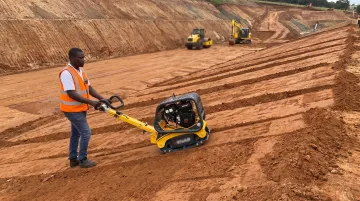
Use a plate compactor or mechanical tamper after each lift. Do not dump large volumes and spread them without compacting in between.
Slopes at or above 2:1, or any project involving significant earthwork, require engineering coordination to execute cut-and-fill safely and in compliance with local codes. Vitoli Builders (CA License #1043914) brings over 20 years of hillside construction experience across Los Angeles and Ventura Counties — the kind of terrain-specific expertise that makes the difference between a stable slope and a costly failure.
Step 5: Restore the Surface and Stabilize the Soil
Once final grade is confirmed and compacted:
- Spread 3–4 inches of topsoil over the graded area
- Verify grade percentage one final time against your target before finishing
- Apply erosion control immediately — bare soil on a freshly graded hillside cannot wait
Appropriate stabilization options depending on slope angle and season:
- Erosion control blankets (fastest deployment)
- Hydroseed (good for moderate slopes, needs time to establish)
- Native ground cover (best long-term option for Southern California landscapes)
USGS research on post-fire Southern California slopes shows debris flows can trigger after as little as 7mm of rain in 30 minutes. Even without fire history, bare graded soil is highly vulnerable to the first rainfall event.
Key Variables That Affect Hillside Grading Results
Two hillsides at the same percentage grade can behave very differently. These variables determine the actual outcome.
Slope Angle and Grade Percentage
Steeper slopes require more soil volume moved, more compaction effort, and carry higher failure risk during and after grading. California engineering standards cap cut and fill slopes at 2:1 (50%) without geotechnical justification. Above 25–30%, terracing or retaining walls typically become part of the solution rather than grading alone.
Soil Type and Composition
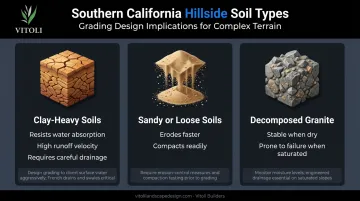
Southern California hillsides commonly contain expansive clay soils that swell when wet and crack when dry, as well as decomposed granite and shale. Each behaves differently:
- Clay-heavy soils: resist water absorption, generate higher runoff velocity, and require careful drainage design
- Sandy or loose soils — erode faster but compact more readily
- Decomposed granite: stable when dry, but prone to failure once saturated
A soil report is typically required for permitted hillside grading projects in LA County. Ventura County's building code classifies expansive soils by Expansion Index, with soils above index 130 requiring special licensed engineer design.
Drainage Design and Water Flow Control
Regrading changes the path water takes across the property. Without intentional drainage design, runoff can concentrate in previously stable areas and create new erosion problems.
A civil engineer sizes the right combination of swales, French drains, and outlet points for the specific terrain. When these are integrated at the design stage, a graded hillside can remain permanently stable.
Equipment Access and Terrain Constraints
On many Southern California properties, the slope itself limits what equipment can safely operate. When heavy equipment can't reach the work area, the job shifts to:
- Smaller tracked machines suited to tight or steep access
- More manual labor for precision shaping
- A phased approach that extends both timeline and cost
Understanding these constraints early helps avoid mid-project surprises.
Common Mistakes When Grading a Hillside
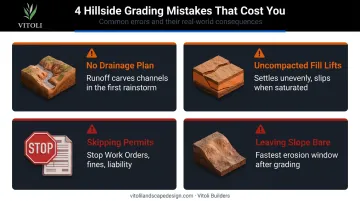
- No drainage plan: Runoff accelerating down a freshly graded slope will carve erosion channels in the first rainstorm if no interception points are built in
- Fill placed without compacting in lifts: Loose fill settles unevenly and can slip under saturated conditions, damaging hardscape and any structures downhill
- Skipping permits: In LA County and Ventura County, unpermitted hillside grading exposes homeowners to Stop Work Orders, fines, and ongoing liability
- Leaving the slope bare: The gap between grading completion and established vegetation is when erosion damage moves fastest — ground cover or erosion blankets should go in immediately
When Grading Alone Isn't Enough: Alternatives for Steep Hillsides
Grading works well for mild to moderate slopes. Above roughly 2:1, or when the goal is creating usable flat space rather than just redirecting runoff, grading needs structural and planting reinforcement.
Retaining Walls and Terracing
When a hillside is too steep for stable cut-and-fill, retaining walls create structural terraces that hold soil in place and produce flat zones for patios, gardens, or lawn areas. Vitoli Builders integrates this approach across Southern California, combining grading with engineered walls and caissons on terrain that demands it.
Key considerations:
- California's Building Code generally requires permits for walls over 4 feet from footing bottom to wall top (or where surcharge loads apply)
- Ventura County exempts walls only 3 feet or under — lower than the statewide baseline
- All walls above threshold height require engineering and drainage systems behind the wall to prevent hydrostatic pressure buildup
French Drains and Subsurface Drainage Systems
When hillside soil is saturated and water is moving below the surface, regrading the top layer alone won't fix the problem. French drains intercept groundwater and redirect it before it builds pressure against slopes or structures.
Trade-off: French drains add installation cost and need periodic maintenance to prevent clogging, but are often essential on clay-heavy hillsides where surface grading alone gives a false sense of stability.
Erosion-Control Planting and Ground Cover
Where structural solutions address the underground and mechanical side of slope stability, planting handles the surface layer. For areas too steep to grade — or where the goal is stabilization rather than usable space — deep-rooted native plants and ground covers hold soil effectively. They're particularly well-suited to Southern California landscapes, where fire-adapted natives provide added fire resistance.
Limitation: Planting doesn't change the grade or fix drainage patterns, takes a full season to establish, and isn't sufficient on severely unstable slopes. Best used alongside structural solutions, not instead of them.
Frequently Asked Questions
How do you grade a steep hillside?
Steep hillsides require the cut-and-fill method executed with mechanical equipment, with fill compacted in lifts per ASTM D1557 standards. Slopes above 2:1 typically require retaining walls as part of the solution and professional engineering rather than DIY execution.
How much does it cost to regrade a hillside?
General yard leveling ranges from roughly $1,000 to $45,000 per acre according to Angi's 2025 cost data, but Southern California hillside grading costs depend on slope severity, soil conditions, access for equipment, cubic yards moved, drainage structures needed, permits, and engineering fees — making project-specific estimates highly variable.
What does a percentage grade mean for a hillside?
Grade percentage equals rise divided by run, multiplied by 100 — so an 8% grade drops 8 inches per 100 inches of horizontal distance, and a 25% grade drops 25 inches. Anything above roughly 33% (3:1 ratio) is considered steep by California engineering standards, and 50% (2:1) is the maximum allowed without geotechnical justification.
Do I need a permit to grade a hillside in California?
Most California counties — including LA County and Ventura County — require grading permits for earthwork exceeding 50 cubic yards, cuts deeper than 2 feet, or fills on slopes steeper than 5:1 (20%). Thresholds vary by county, so verify with your local planning department before starting any hillside earthwork.
What equipment is needed to grade a hillside?
Basic grading requires a laser or builder's level, grade stakes, and a plate compactor for fill layers. Significant earthmoving adds a bulldozer, tracked skid steer, or motor grader, with the right choice depending on slope angle and site access.
When is grading alone not enough for a steep hillside?
When a slope exceeds roughly 2:1, when the goal is creating flat usable space rather than just reducing runoff, or when subsurface water is the main issue, grading must be combined with retaining walls, terracing, or drainage systems to achieve lasting results.