Introduction
On a Southern California hillside lot, usable flat space is a genuine asset — one most properties don't have enough of. That's why terraces rank among the highest-impact outdoor investments a homeowner can make, converting steep, unusable slopes into functional living space that extends the home outward.
Demand backs this up. The AIA's 2025 Home Design Trends Survey found 55% net increased demand for outdoor living spaces — and separately flagged that 49% of respondents cited difficult lot preparation as a significant development factor. Homeowners want the space. The hillside is where the budget lives.
Terrace construction costs vary more than any other outdoor project. A basic patio on a flat lot and a fully engineered hillside terrace might look similar on paper, but differ by $50,000 or more in practice.
Getting that estimate wrong at the start — or working with a contractor who leaves structural costs out of the bid — leads to mid-project surprises that are expensive to fix and hard to absorb.
This guide breaks down what terrace construction actually costs in Southern California, what drives those costs, and how to build a realistic budget before the first shovel hits the ground.
Key Takeaways
- Terrace costs range from $5–$50/sq ft for basic surfaces to $100+/sq ft for engineered hillside builds
- On hillside lots, structural elements — grading, retaining walls, caissons — typically cost more than the finished surface
- LA County labor runs 20% above the national average, pushing every cost tier higher
- Retaining walls over 4 feet require permits in LA County; grading over 50 cubic yards typically triggers permit review
- Budget a 10–20% contingency on hillside projects — unexpected site conditions are the leading cause of overruns
How Much Does Terrace Construction Cost?
Terrace construction has no single fixed price. A basic patio and a hillside engineered terrace can differ by tens of thousands of dollars for similar square footage, and misreading that gap is the most common budgeting mistake homeowners make.
The table below organizes costs into three tiers. BLS data shows LA construction wages averaging $37.00/hour versus $30.73/hour nationally — a 20.4% premium that pushes every tier higher in Southern California than national benchmarks suggest.
| Tier | Typical Cost Range | What It Includes |
|---|---|---|
| Entry-Level | $5–$20/sq ft | Minimal excavation, compacted base, standard concrete or pavers, basic edging |
| Mid-Range | $20–$50/sq ft | Moderate grading, quality pavers or stone, edge restraints, simple drainage |
| High-End / Hillside | $80–$150+/sq ft (all-in) | Full engineering, retaining walls, caissons, premium materials, integrated drainage, permits |
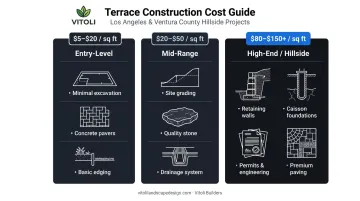
Here's what each tier actually covers — and which lot types each one fits.
Entry-Level Terrace
What's included: Minimal excavation, compacted gravel base, standard concrete pavers or poured concrete ($3–$8/sq ft for concrete nationally), basic edging.
What's excluded: Structural grading, retaining walls, engineered drainage, premium finishes.
Best for: Flat or near-flat lots, smaller footprints, homeowners prioritizing function over aesthetics.
Mid-Range Terrace
What's included: Moderate site prep and grading, quality paving materials (concrete pavers run $4.50–$21/sq ft; brick pavers $8–$25/sq ft), edge restraints, simple drainage channels.
What's excluded: Major retaining structures, complex multi-level layouts, irrigation or lighting integration.
Best for: Gentle slopes, homeowners wanting a durable, attractive space without full structural engineering.
High-End / Hillside Terrace
This tier covers the full scope of hillside construction — nothing is excluded because everything is required:
- Full site engineering and precision grading
- Retaining walls in block, poured concrete, or natural stone
- Caissons or deep footings where soil conditions demand them
- Premium paving: flagstone ($15–$30/sq ft) or large-format porcelain ($3–$35/sq ft)
- Integrated drainage, waterproofing, permits, and structural inspections
For sloped or hillside lots in LA and Ventura Counties, this tier is the norm — not the exception.
Key Factors That Drive Terrace Construction Cost
Pricing is shaped by site conditions, design decisions, material choices, and regulatory requirements. On hillside properties, site conditions alone can double the cost of an otherwise straightforward project.
Terrain and Slope
Flat lots require minimal site prep. Hillside lots demand excavation, rough grading, slope stabilization, and soil export — each of which carries its own cost. One Southern California hillside contractor estimates hillside grading can cost 3–10x more per cubic yard than flat-lot work, with soil export running $30–$50/cubic yard.
The slope angle directly determines whether retaining walls, caissons, or engineered footings are required. LA County requires an approved grading plan and permit once excavation or fill exceeds 50 cubic yards — a threshold that most hillside terrace projects cross.
Material Selection
Material cost is just one part of the surface budget — heavier or larger materials also increase installation labor and complexity. Here's a practical comparison:
| Material | Installed Cost (National) |
|---|---|
| Poured concrete | $3–$8/sq ft |
| Concrete pavers | $4.50–$21/sq ft |
| Brick pavers | $8–$25/sq ft |
| Natural flagstone | $15–$30/sq ft |
| Large-format porcelain | $3–$35/sq ft |
On a hillside project, surface material is rarely the dominant cost driver. Choose your surface carefully, but settle the structural scope before finalizing any material budget.
Retaining Walls and Structural Requirements
Hillside terraces almost always require retaining walls to hold back soil and create a level surface. Costs vary significantly by wall type:
- Nationally: $40–$360/linear ft for 2–6 ft walls
- Southern California (contractor estimates): $300–$900/linear ft
Where soil conditions or wall height demand it, caissons — deep drilled piers anchored to bedrock — may be required. Contractor estimates for SoCal residential caisson work run $15,000–$50,000 per pier. That's a line item that catches most homeowners off guard. Vitoli Builders includes caisson installation as a core service — and the assessment of whether they're needed is built into the pre-construction site evaluation, not billed as a separate study.
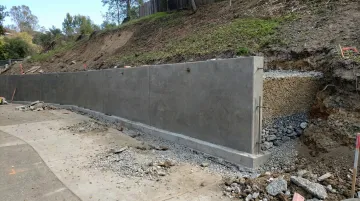
Under LA County code, any retaining wall over 4 feet (measured from bottom of footing to top of wall) requires a permit. Walls of any height that support a surcharge or slope also require permit review — which covers most hillside terrace applications.
Drainage and Waterproofing
Retaining walls and grading control the structure — drainage controls what happens after every rainstorm. According to the USGS, adequate drainage is the most critical element of landslide mitigation, and on a hillside terrace, skipping it isn't a cost-savings move — it's a liability.
Current drainage system costs from Angi's 2026 benchmark data:
| System Type | Cost Range |
|---|---|
| French drain | $20–$50/linear ft |
| Trench drain | $30–$70/linear ft |
| Surface/swale drainage | $5–$15/linear ft |
| Yard drainage overall | $10–$50/linear ft |
If the terrace is built over a structure — a garage or basement — waterproofing membranes add another cost layer. On hillside projects, Vitoli Builders integrates drainage as a structural component from day one: gravel backfill, perforated drain lines, and weep systems are built into retaining walls, not added as afterthoughts.
Permits and Engineering Fees
California's regulatory environment adds real cost to hillside terrace projects. Here's what to budget for:
- Geotechnical report: $3,000–$6,000 for flat SoCal lots; $10,000–$20,000+ for hillside sites
- Structural wall engineering: $15,000–$50,000 for significant wall engineering
- LA County grading fees: Published annually by LA County Public Works; fee depends on project scope and valuation
- Engineering-required threshold: Grading over 5,000 cubic yards, or grading that supports a structure, requires a licensed civil engineer's stamped plans
Most of these costs are non-negotiable on hillside projects. Building them into the budget at the planning stage — not discovering them mid-bid — is one of the clearest advantages of working with a contractor who knows the local code requirements.
Full Terrace Construction Cost Breakdown
Beyond cost per square foot, a terrace project involves distinct cost categories — and on hillside lots, underestimating the structural ones is the most common source of budget surprises.
| Cost Category | Typical Range | Notes |
|---|---|---|
| Surface materials | $3–$35/sq ft depending on material | Estimate after structural scope is confirmed |
| Site prep & grading | Highly variable; $30–$50/cu yd for soil export (SoCal estimate) | Often the single largest labor cost on hillside lots |
| Retaining walls | $300–$900/linear ft (SoCal contractor range) | Height, material, and engineered design all affect cost |
| Caissons | $15,000–$50,000 per pier (directional estimate) | Required when terrace loads must reach bedrock |
| Drainage systems | $10–$70/linear ft depending on type | Non-negotiable on hillside; budget from the start |
| Permits & engineering | $3,000–$50,000+ depending on scope | Geotechnical + structural engineering + county fees |
| Contingency | 10–20% of total project cost | Higher end for complex hillside builds |
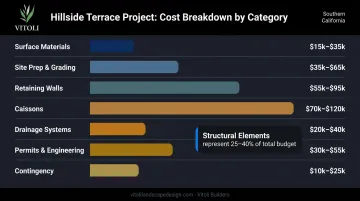
On hillside projects, structural elements — foundations, grading, and retaining walls — routinely account for 25–40% of the total project budget before a single paver is laid. Knowing that upfront shapes every other decision, from material selection to phasing.
Budget vs. High-End Hillside Terrace: What's the Real Difference?
On a hillside property, the choice between a budget build and a premium terrace shows up most clearly in structural integrity and long-term performance — not just aesthetics.
| Dimension | Budget Build | High-End / Engineered |
|---|---|---|
| Structural approach | Minimal prep, basic compaction | Full engineering: retaining walls, caissons, engineered footings |
| Materials | Standard concrete or basic pavers | Natural stone, large-format porcelain, premium finishes |
| Drainage | Surface slope only | Integrated French drain system, weep systems, waterproofing |
| Permits | Often skipped or minimal | Properly permitted and inspected |
| Lifespan expectation | 5–10 years before repair or replacement on hillside | 20–30+ years with proper engineering |
| Cost starting point | $5–$20/sq ft surface cost | $80–$150+/sq ft all-in |
A budget terrace on a hillside that lacks proper drainage and structural support often requires full replacement within a decade. Remediation — tearing out a failed wall or re-grading after erosion — costs far more than doing it correctly the first time.
In Southern California, where usable outdoor square footage commands a premium, a properly engineered hillside terrace converts otherwise unusable slope into livable, valuable space. NAR's 2023 Remodeling Impact Report puts national cost recovery for a new patio at 95% — and that figure doesn't account for the outsized demand for functional outdoor living in the LA and Ventura County markets. Build it right once, and the investment holds.
How to Estimate the Right Budget for Your Terrace
Start with the Site, Not the Wish List
Before selecting materials or sketching a layout, have the site assessed. Slope angle, soil type, existing drainage, and proximity to the home's foundation determine whether your project is a $20,000 patio or an $150,000+ engineered terrace.
Unexpected site conditions discovered mid-construction are the primary cause of hillside project cost overruns — and the most expensive surprises are the ones that weren't scoped before work began.
Build the Full Cost Stack
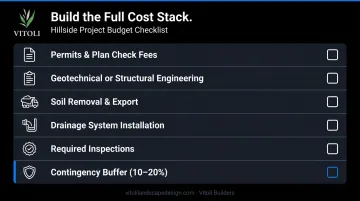
Your budget needs to include more than materials and labor. Before finalizing a number, account for:
- Permits and plan check fees
- Geotechnical or structural engineering reports
- Soil removal and export
- Drainage system installation
- Required inspections
- Contingency buffer of 10–20% — use the higher end on hillside projects where subsurface conditions are uncertain
Work with a Hillside Specialist
Knowing what belongs in your budget is only half the equation. The other half is making sure your contractor knows what to include in the first place.
An accurate estimate for a hillside terrace requires a contractor who has worked hillside terrain before — not a general landscaper who may leave retaining walls, caissons, or drainage out of the bid entirely.
Vitoli Builders brings in-house design, engineering, and a dedicated project manager — Oz Tzalalihin — who reviews every scope for cost-reduction opportunities before work begins. Projects scoped this way rarely carry the change orders that catch homeowners off guard mid-construction.
Frequently Asked Questions
How much does it cost to make a terrace?
A basic flat-lot terrace starts around $5–$20/sq ft for the surface. A hillside engineered terrace in Southern California runs $80–$150/sq ft or more when grading, retaining walls, drainage, and permits are included. The gap between those numbers comes down almost entirely to what the site requires structurally.
How much does a hillside terrace cost compared to a flat-yard terrace?
Hillside terraces typically cost 3–5x more per square foot than flat-lot equivalents. The structural elements (retaining walls, grading, caissons, drainage) often exceed the cost of the finished surface, which is why flat-lot benchmarks don't translate to hillside projects.
Do I need a permit to build a terrace in California?
In LA County, retaining walls over 4 feet require a permit, as do walls of any height that support a slope or surcharge. Grading above 50 cubic yards typically crosses the permit threshold. Requirements vary by jurisdiction, so checking with your local building department before finalizing scope is essential.
What is the cheapest way to build a terrace?
Use a simpler paving material (standard concrete or basic pavers) and keep the footprint manageable. More importantly, have the site assessed before finalizing scope — mid-project changes driven by unidentified conditions are far more costly than any material upgrade. Choosing a material is a minor decision; understanding what the slope requires is the major one.
How long does terrace construction take?
A simple flat-lot patio takes a few days to a week. A complex hillside terrace with retaining walls, caissons, and permits can take several months; in California, LADBS hillside retaining wall permits alone can run 8–16 weeks. Budget the permitting timeline before committing to a completion date.
Does building a terrace increase home value?
NAR estimates 95% cost recovery for new patios nationally, and Southern California's climate and lot premiums make outdoor living space consistently one of the highest-ROI improvements a homeowner can make. A properly engineered hillside terrace adds functional square footage that buyers in the LA market actively value.