The stakes are real. A deck not properly separated from the pool bond beam can press against the pool wall and crack the shell — a documented failure path that turns an aesthetic problem into a structural one. Drainage failures undermine both the pool structure and the surrounding hardscape. Surface cracking from inadequate base prep typically shows up 12–24 months after installation, long after the contractor has moved on.
This guide walks through the complete process: material selection, site assessment, installation sequencing, and the most common problems — with enough detail to help you ask the right questions before breaking ground.
Key Takeaways
- Hillside pool terraces require specialist engineering — retaining walls, caissons, and multi-level grading are standard
- Surface slip resistance is non-negotiable; pool decks require a minimum 0.60 wet DCOF per ANSI A326.3
- Site assessment — soil, drainage, permits, structural load — must happen before any installation begins
- Installation follows a strict sequence (grading → base → surface → drainage → features) — skipping any phase causes long-term failures
- Run a water test before regular use to confirm drainage flow and catch any low spots
What Makes a Pool Terrace "Dreamy": Design Elements That Elevate the Space
A pool terrace is the full outdoor living environment surrounding the pool — multiple levels, defined seating and dining zones, integrated steps, shade structures, and features that make the space feel like a destination rather than a utilitarian perimeter.
Material Options and What Each Delivers
Material choice drives both the look and the long-term performance of your terrace. The key options:
- Natural stone and travertine — timeless aesthetic, naturally slip-resistant when unpolished, and performs well in intense sun. Dark pavements absorb 80–95% of sunlight, so light-colored stone keeps surfaces cooler underfoot — a genuine advantage in Southern California summers
- Concrete pavers — flexible in pattern and color, easy to repair individually, and allow water to drain through joints. Pool deck gravel base should be 6–12 inches deep, with a 1-inch bedding layer and compaction in 2–3 inch lifts per Unilock's installation guide
- Wood and composite decking — warm, organic feel well-suited to semi-elevated or above-ground settings. Composite products outperform natural wood for moisture resistance, and some lines offer meaningful slip resistance improvements over standard competitors
- Stamped concrete — cost-effective and pattern-versatile, but contraction joints must be cut to at least 1/4 of slab thickness to control cracking, and regular sealing is essential in sun-exposed climates
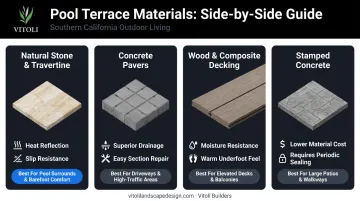
For pool-wet surfaces specifically, look for products rated at or above 0.60 wet DCOF under ANSI A326.3 — the benchmark for swimming pool decks and recreation areas involving constant water exposure.
The Role of Multi-Level Terracing
Two or more tiers do something a flat deck can't: they create defined zones for lounging, dining, and spa access, add visual dimension, and on sloped properties, they turn a terrain constraint into a deliberate design choice.
Features that push a terrace from functional to truly standout:
- Cascade walls or deck jets that animate the water's edge
- Integrated step lighting and ambient lighting at grade level
- Tanning shelves or swim-up ledges at the pool's edge
- Pergola or shade structure positioned to complement the sun angle
- Landscaping woven into terrace edges rather than planted around them
All of these features work best when the terrace and pool are planned together from day one. Retrofitting a deck around an existing pool limits your options, increases cost, and routinely produces a disjointed result — the deck and pool read as separate decisions rather than one cohesive design.
Before You Build: Site Assessment, Prerequisites & Permits
No installation decision is valid until the site has been properly assessed. On a flat lot, this is relatively straightforward. On a hillside, it determines whether the project is even feasible at its planned scope.
What a Proper Site Assessment Covers
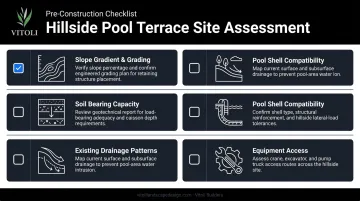
- Slope gradient and grading requirements — how much cut and fill is needed to create level terrace surfaces
- Soil bearing capacity — insufficient bearing capacity means caissons or deeper footings before any hardscape can be placed. Hillside pool work may require caissons drilled 20, 30, or even 50 feet to reach stable soil or bedrock
- Existing drainage patterns — where water naturally flows across the site determines where drains go and what structures are at risk
- Pool shell compatibility — coping and bond beam must be complete and cured before decking is attached or abutted. A deck pressed against an uncured or poorly designed bond beam is one of the documented paths to pool shell cracking
- Equipment access — the terrace plan must account for filter, pump, and equipment panel access without requiring surface removal
California Permit Requirements
Permit requirements in Southern California are specific and consequential. Skipping them doesn't just risk a fine — it can halt construction mid-project and create title problems when you sell.
| Jurisdiction | Key Thresholds |
|---|---|
| LA County | Grading exemptions apply only below 50 cubic yards and 2 ft excavation depth; retaining walls under 4 ft exempt only if not supporting surcharge |
| City of Los Angeles | Grading permits required for hillside grading areas, retaining wall cuts, and new pool excavations |
| City of Ventura | Decks exempt only if under 200 sq ft, under 30 in above grade, and unattached to dwelling |
| Ventura County | Separate permit review required for retaining walls connected to structures or within exit paths |
A 20x20 pool deck — 400 square feet — already exceeds the City of Ventura's deck-size exemption threshold. Most hillside pool terraces with retaining walls will require permits in both LA and Ventura Counties. Unpermitted grading in LA County can trigger stop-work orders, doubled permit fees, and NPDES-related daily fines of $50–$500.
Verify requirements with your local building department before any design is finalized. Verify requirements with your local building department before any design is finalized. Drainage planning falls under the same rule — it must be resolved before design is locked in, not retrofitted afterward.
Drainage Planning as a Prerequisite
PHTA-5 — the American National Standard for Residential Inground Swimming Pools — requires pool decks to drain away from the pool structure or toward deck drains. Linear drain products should be placed at least 3 feet 1 inch from the inside pool wall.
Plan trench drains and channel drains in the layout before any base material is placed. Adding them afterward requires demolishing finished work, re-grading the sub-base, and risking slope errors that can't be corrected without starting over.
For hillside properties across Los Angeles and Ventura Counties, work with a specialist who has direct experience in caissons, retaining walls, and complex terrain before finalizing any terrace plan. Vitoli Builders brings over 20 years of hillside construction expertise to projects across both counties and can identify drainage and grading issues before they become expensive problems.
How to Install a Swimming Pool Terrace: Step-by-Step
Pool terrace installation follows a defined sequence. The most common mistakes happen when contractors skip ahead or underestimate what base preparation actually requires.
Grading and Ground Preparation
This phase sets everything else up. Key steps:
- Excavate to planned depth — typically 6–12 inches depending on material and base requirements
- Establish drainage grade — slope the sub-grade away from the pool structure and toward planned drain locations
- Compact the sub-base with a mechanical plate compactor, working in 2–3 inch lifts
- Install geotextile fabric between sub-base and subgrade on unstable soils to prevent soil migration
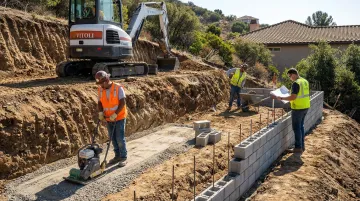
On hillside or multi-level terraces, this phase also involves cutting and filling earth, installing geotextile fabric, and constructing retaining walls before the terrace base can be laid. Caisson footings are often required as well. Of all the phases, this one is most consistently underestimated in both time and cost.
Laying the Base and Foundation
With grading complete, the base goes in next. A proper base consists of:
- Compacted gravel sub-base (crushed stone or decomposed granite) at 6–12 inch depth for paver applications
- 1-inch bedding layer of sand or mortar over the compacted base
- Concrete slab with rebar reinforcement for stamped concrete applications
- Framed substructure on concrete footings or helical piles for wood or composite decking
The base must be fully level, compacted, and allowed to settle — or cure in the case of concrete — before surface installation begins. Cut corners here and the surface will crack, shift, or drain poorly — problems that are expensive to fix once the terrace is in use.
Installing the Terrace Surface, Steps, and Features
Set coping at the pool edge first. This anchors the terrace boundary and defines the transition from water to hardscape. Then:
- Lay field material working outward, maintaining consistent joint spacing and drainage slope
- Build steps and tier transitions before surrounding field surface is completed — not after
- Rough in step lighting during framing or base work
- Set trench drains before placing surface material
- Install pergola or structure footings before pouring or setting surrounding hardscape
Feature sequencing is just as critical as material sequencing. Retrofitting lighting conduit or drain lines after surface installation means cutting through finished hardscape — compromising waterproofing at every penetration and breaking up the compacted base beneath.
Post-Installation Checks
Before the terrace goes into regular use:
- Grading check — use a level across multiple points to confirm consistent drainage slope
- Water test — run water across all surfaces and observe flow; confirm no pooling at the pool edge or near any structure
- Step inspection — verify consistent riser heights and confirm non-slip surface condition on all treads
- Coping tap-test — tap coping stones to identify hollow spots indicating insufficient mortar bond
A surface that looks finished can still hide drainage voids, undercured mortar joints, or low spots that only show up after heavy rain. Catching these before first use takes an hour. Fixing them after costs significantly more.
Common Pool Terrace Installation Problems and How to Fix Them
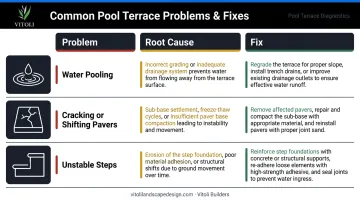
Most pool terrace problems trace back to three root causes: drainage failures, base preparation shortcuts, and inadequate structural footings. Recognizing the pattern early saves significant repair cost.
Poor Drainage and Water Pooling Near the Pool Shell
Problem: Water accumulates at the pool edge or against the house foundation rather than draining away.
Likely cause: Insufficient base grade, missing or undersized channel drains, or a base that settled unevenly after installation.
Fix: Regrade affected sections and install or upsize trench drains at low points. In severe cases, lift the surface material, re-compact the base, then resurface.
Surface Cracking or Pavers Shifting
Problem: Cracks appear in stamped concrete or pavers shift within 1–2 years of installation.
Likely cause: Inadequate base compaction, insufficient slab thickness, or water trapped under the surface from poor drainage. For concrete, contraction joints cut shallower than 1/4 of slab thickness will cause cracks to appear randomly rather than at planned locations.
Fix: For isolated paver shifts, reset individual units after resolving the drainage cause. For slab cracking, surface cracks can be filled — but recurring cracks point to a base or drainage problem that needs to be resolved before any resurfacing work begins.
Unstable or Uneven Steps Between Terrace Levels
Problem: Steps rock underfoot or develop uneven riser heights over time.
Likely cause: Steps built without adequate footing depth, or fill material behind the riser was not compacted — causing the earth to settle and pull the step backward or downward.
Fix: Excavate behind affected steps, recompact fill, and relay on a proper compacted aggregate or concrete footing. Add rebar or concrete adhesive anchoring on stone or paver steps.
| Problem | Root Cause | Fix |
|---|---|---|
| Water pooling at pool edge or foundation | Low base grade, undersized drains, uneven settlement | Regrade, upsize drains, re-compact base if needed |
| Cracking concrete or shifting pavers | Poor compaction, thin slab, trapped moisture | Reset pavers; resolve drainage before resurfacing cracks |
| Rocking or uneven steps | Shallow footings, uncompacted fill behind risers | Excavate, recompact, relay on concrete footing with rebar |
Pro Tips for a Beautiful, Long-Lasting Pool Terrace
These three principles separate pool terraces that hold up beautifully over time from ones that require costly fixes within a few years.
Sequence underground work first. Complete all lighting conduit, drain lines, and irrigation before the terrace base is laid. Finish any retaining wall or structural work before grading begins. Going back to add these after surface installation adds significant cost and disrupts finished work.
Choose materials rated for wet environments, not general patio use. In Southern California's intense sun, light-colored unpolished natural stone (travertine, limestone) stays meaningfully cooler underfoot than dark concrete. Research shows pavement color and texture changes can reduce surface temperature by up to 5°C. More importantly, verify the product's wet DCOF rating before specifying it for pool surrounds.
Hillside sites need hillside specialists. On any sloped property, the terrace design must account for lateral soil pressure on retaining walls, seasonal ground movement, and the combined weight of water features, spa installations, and water-filled pool shells. These are not general-contractor calculations: they require experience with hillside terrain, engineered drainage, and deep foundation systems.
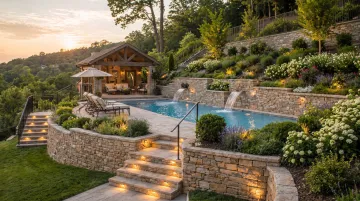
In terrain-heavy markets like Los Angeles and Ventura Counties, working with a specialist from the start is far less expensive than fixing a poorly engineered terrace afterward.
Frequently Asked Questions
What is a terrace pool?
A terrace pool is a swimming pool integrated into a tiered or stepped outdoor space — typically on sloped terrain — where the pool and surrounding hardscape are designed across multiple levels to work with the natural grade of the land rather than against it.
What is a swim-up pool terrace?
A swim-up terrace (or ledge) is a submerged or partially submerged shelf at the pool's edge where swimmers can sit or stand in shallow water, often adjacent to a bar or seating area. Depths typically range from 6 to 18 inches, making it a natural fit for hillside pool designs where the terrace level sits adjacent to the water.
How much does a 20x20 pool deck cost?
Material costs vary significantly. Travertine pavers run approximately $15–$27 per square foot installed, putting a 400 sq ft deck at $6,000–$10,800 before grading. Basic stamped concrete runs roughly $8–$12 per square foot. Hillside or sloped sites in Southern California add meaningful cost through grading, retaining walls, permits, and potential caisson work.
What is the best material for a pool terrace in Southern California?
Unpolished travertine, concrete pavers, and composite decking perform well in Southern California conditions. Light-colored, slip-resistant, and heat-tolerant materials are the priority — verify wet DCOF ratings and confirm any product is rated for pool-wet environments, not just general patio applications.
Do I need a permit to build a pool deck or terrace in California?
Yes, in most California jurisdictions. Permits are required for pool decking and hardscape, particularly on hillside lots where retaining walls are involved — and most pool terraces easily exceed the narrow exemption thresholds that apply to simple ground-level patios. Check with your local building department before breaking ground.
How long does it take to install a pool terrace?
Timelines vary with site complexity. A simpler hillside terrace might wrap up in 2–4 weeks, while a multi-level design with retaining walls, custom stonework, and engineered foundations can take several weeks to a few months. Permit processing and material lead times add to the schedule on most Southern California hillside projects.