
The challenge is that slope failure rarely announces itself clearly. By the time movement is visible, the underlying problem has usually been developing for weeks, months, or longer. The 2023 Rolling Hills Estates landslide is a case in point—UCLA researchers found the slope had likely begun moving the previous winter, with residents first noticing cracks in their homes months before the situation became critical.
This guide covers what slope stability actually means for residential property owners, the factors that threaten it, warning signs to watch for, how professional assessments work, and what solutions exist when a slope needs intervention.
Key Takeaways:
- A Factor of Safety above 1.5 is the minimum standard for residential slopes in the City of Los Angeles
- Poor drainage is among the most common triggers of hillside failure in Southern California
- Warning signs include ground cracks, bulging walls, unexpected seepage, and sticking doors
- Slope stability assessments combine site investigation, lab testing, and engineering analysis
- Solutions range from retaining walls and caissons to drainage improvements and vegetation
What Is Slope Stability and Why Does It Matter?
Slope stability refers to a slope's ability to resist movement. At its most basic, it's a balance between two competing forces: the shear stress pushing the slope to move (driven by gravity, water weight, and structural loads) and the shear strength of the soil or rock holding it in place.
When shear strength exceeds shear stress, the slope stays put. When that balance tips the other way, movement follows.
The Factor of Safety Explained
Engineers express this balance as the Factor of Safety (FoS)—a ratio of resisting forces to driving forces. For residential hillside properties in the City of Los Angeles, LADBS sets the minimum acceptable static FoS at 1.5, with a minimum pseudo-static (seismic) FoS of 1.1.
What these numbers mean in plain terms:
- FoS of 1.5: Resisting forces are 50% greater than driving forces—considered stable under normal conditions
- FoS of 1.0: Forces are exactly balanced, a marginal state where any added stress can trigger movement
- FoS below 1.0: Driving forces exceed resistance—an active engineering red flag requiring urgent attention
The FoS is not a fixed property of a slope. Rainfall, construction activity, vegetation loss, and seismic events can all shift it—sometimes quickly.
For hillside property owners, those shifts carry real consequences. Slope instability can result in:
- Structural damage to foundations, retaining walls, and hardscape
- Legal liability if a failure affects neighboring properties
- Direct risk to life—the 2005 La Conchita landslide in Ventura County destroyed or severely damaged 36 homes and killed 10 people
Key Factors That Affect Slope Stability
Understanding what drives instability helps homeowners recognize risk before visible signs appear.
Soil and Rock Properties
Two soil parameters matter most:
- Cohesion — how strongly soil particles bond together (clay soils have high cohesion; sandy soils have low cohesion)
- Internal friction angle — how well particles interlock and resist sliding under load
Southern California's geology varies considerably from one hillside community to the next. A slope that's stable in one neighborhood may face completely different conditions a mile away. This variability is precisely why geotechnical assessments require site-specific investigation rather than regional generalizations.
Those same soil properties interact directly with a second major force: water.
Pore Water Pressure and Drainage
Pore water pressure forms when water trapped within soil pores pushes outward against particles, weakening contact between them and reducing shear strength. According to USGS, shallow landslides and debris flows are commonly triggered by intense rainfall, while deep-seated failures can result from gradual infiltration occurring over weeks or months.
Poor drainage compounds the problem. Without an outlet, water accumulates inside the slope — raising pore pressure, softening the soil matrix, and eroding the friction that holds the hillside in place.
Slope Geometry, Loads, and Seismic Forces
Three additional factors round out the stability picture:
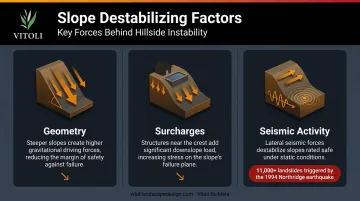
- Geometry: Steeper and taller slopes generate higher gravitational driving forces. Grading changes that alter slope angle—even small ones—can meaningfully shift the FoS.
- Surcharges: Structures near the slope crest (homes, pools, driveways, retaining walls) add weight that increases driving forces. Loading an inadequately assessed slope is a common trigger for residential hillside movement.
- Seismic activity: Ground shaking introduces dynamic lateral forces that can destabilize slopes rated stable under static conditions. The 1994 Northridge earthquake triggered more than 11,000 landslides across approximately 10,000 km², with dozens of homes in the Santa Monica Mountains damaged by reactivated deep block slides.
Warning Signs of Slope Instability
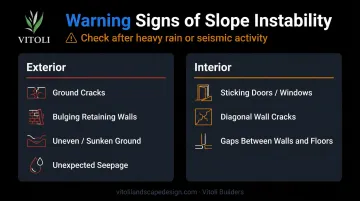
FEMA and USGS identify consistent warning signs that homeowners can observe without professional equipment. If you notice any of these—especially after heavy rain or seismic activity—treat them as urgent.
Exterior warning signs:
- Fresh cracks along the slope crest or near retaining structures, especially ones that appear after storms
- Bulging or bowing retaining walls, or fences and utility poles that appear to lean downslope
- Uneven or sunken ground: depressions, steplike drops in yard surfaces, or pathways that no longer sit level
- Unexpected water seeping from slope faces, new wet patches, or changes in surface runoff direction
Interior warning signs:
- Doors and windows that stick or jam for the first time
- New diagonal cracks in walls or ceilings
- Gaps forming between walls and floors or ceilings
None of these signals guarantee imminent failure, but each one means something is shifting beneath the surface. In the Rolling Hills Estates case, residents noticed interior cracks months before the situation turned critical. Earlier professional evaluation likely would have changed the outcome.
How a Slope Stability Assessment Works
A slope stability assessment is a multi-phase engineering process—structured to produce defensible, quantified results that hold up to regulatory and structural scrutiny.
Site Investigation and Lab Testing
The assessment begins with a site visit covering slope geometry, drainage conditions, visible distress signals, and land history. Subsurface investigation follows—through soil borings or test pits—to collect samples for laboratory analysis.
Labs measure the parameters that feed directly into stability calculations:
- Cohesion and internal friction angle (shear strength parameters)
- Unit weight and moisture content
- Groundwater depth and pore water pressure conditions
Analysis Methods
Geotechnical engineers use two primary approaches:
| Method | How It Works | Best Used For |
|---|---|---|
| Limit Equilibrium (LEM) | Divides slope into slices; calculates force balance across each | Most residential assessments—fast and well-validated |
| Finite Element (FEM) | Models stress and strain across the entire slope mass | Complex, high-risk, or unusual slope configurations |
Both methods are recognized by ASCE as the major approaches for slope stability analysis. For most residential properties, LEM provides the rigor needed without the added complexity of FEM.
What the Report Delivers
At the end of the assessment, the homeowner receives a geotechnical report documenting:
- Soil and groundwater conditions found on-site
- Calculated FoS values under both static and seismic loading
- Identified failure modes and their relative likelihood
- Engineering recommendations for mitigation, if needed
California's CGS Special Publication 117A requires geotechnical reports in mapped seismic hazard zones to specifically address slope stability. For most Southern California hillside properties, that makes this documentation a regulatory requirement, not an optional step.
Slope Stabilization Solutions
The right solution depends on the specific cause and severity of instability. Most residential hillside projects combine two or three approaches working together.
Retaining Walls and Caissons
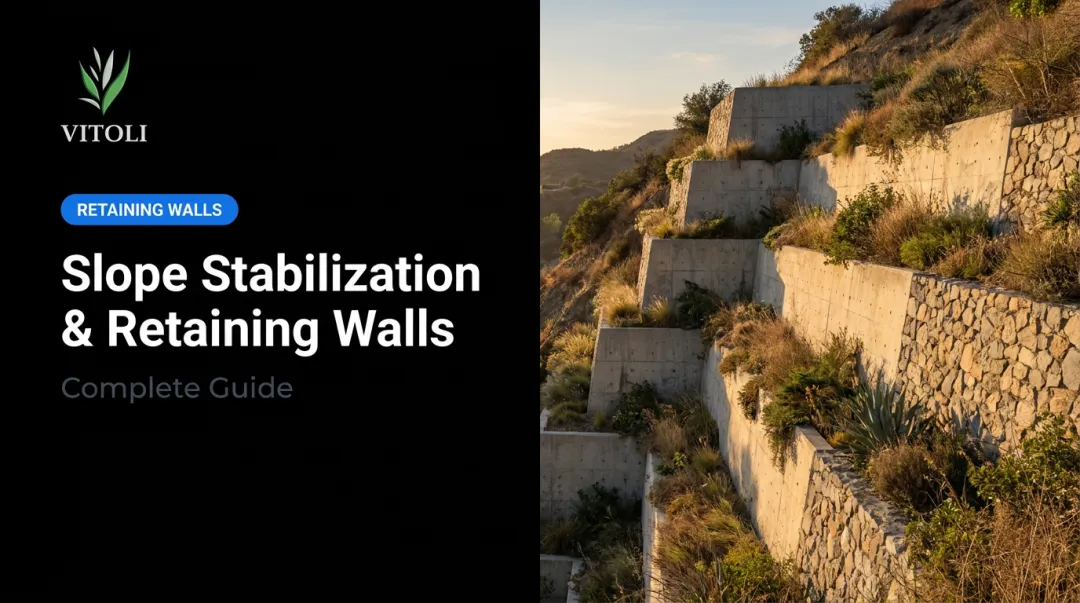
Engineered retaining walls intercept lateral earth pressure and hold soil in place. Vitoli Builders constructs walls using concrete, masonry block, stone, and poured-in-place systems—with material selection driven by site-specific soil analysis, slope grade, and load calculations rather than a default preference.
On properties with challenging or unstable soil conditions—common across Calabasas, Malibu, Westlake Village, and Hidden Hills—caisson systems provide deep foundational support. Caissons are drilled to engineered depths and diameters, reinforced with steel, and filled with concrete to form load-bearing columns that transfer structural forces down to stable ground.
Retaining walls are then anchored to or constructed atop these caisson grids, creating a system that resists both lateral earth pressure and vertical loads from structures above.
Drainage integration is built directly into wall construction—not added later. Gravel backfill, perforated drain lines, and weep systems relieve hydrostatic pressure at the wall face, addressing one of the leading causes of retaining wall failure on hillside properties.
Drainage Improvements
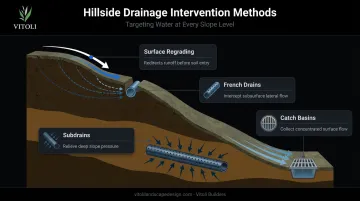
Correcting water infiltration is often the most cost-effective intervention available. When pore water pressure drops, the FoS rises—directly. Each drainage method targets a different point in water's path through and across a slope:
- Surface regrading redirects runoff before it enters the soil profile
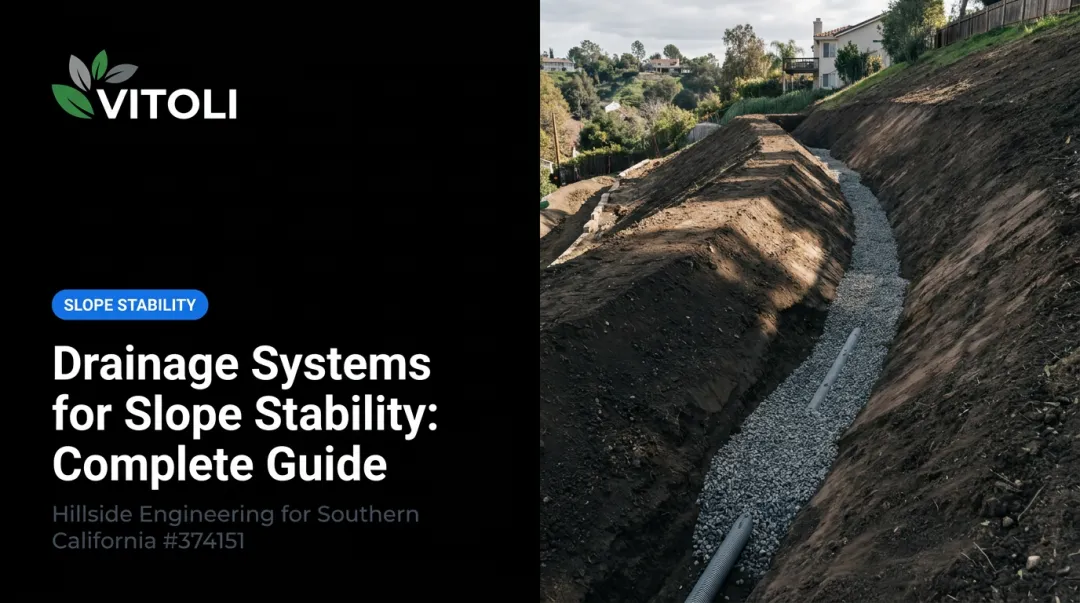
- French drains intercept subsurface flow and route it away from the slope
- Subdrains relieve pressure deep within the slope body
- Catch basins collect and channel concentrated surface flow at low points
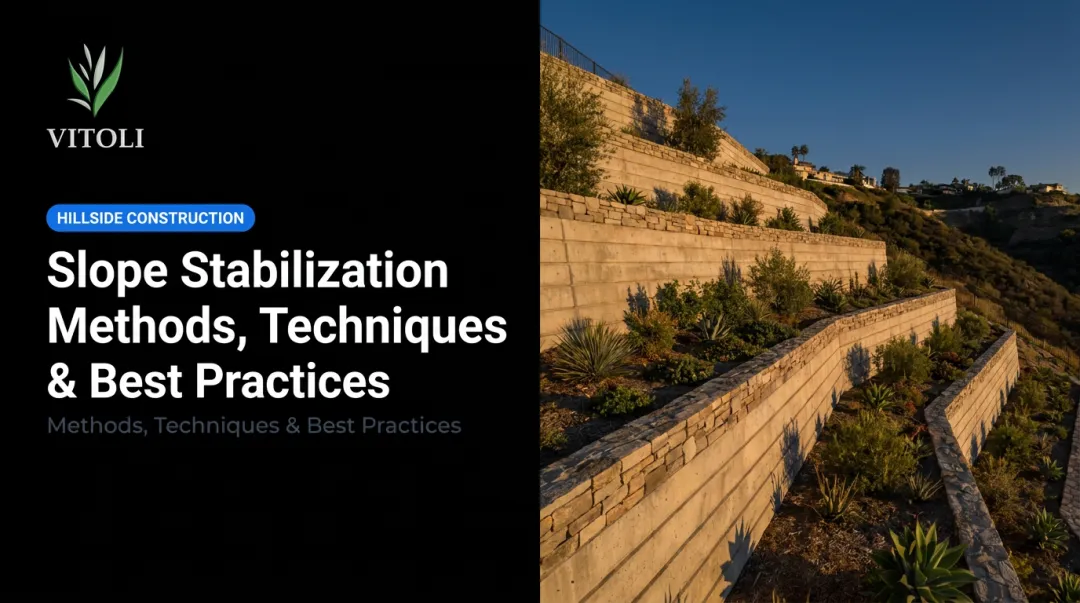
Vitoli's approach to grading treats drainage and terrain modification as inseparable. Completed projects typically feature tiered, terraced systems where regraded slopes, retaining walls, and drainage infrastructure are designed and built as a single integrated system.
Vegetation and Erosion Control
Deep-rooted plants reinforce shallow soil layers and reduce surface runoff. This matters especially in fire-affected areas—post-fire slopes in Southern California can generate debris flows from as little as 7 mm (0.3 inches) of rain in 30 minutes, according to USGS data on burned watersheds.
Vitoli selects plants specifically for root depth and soil-binding performance, coordinating planting with structural work so vegetation reinforces—rather than merely covers—stabilized slopes.
When to Call a Hillside Specialist
Some situations don't allow for a "wait and see" approach:
- Before purchasing a hillside property — existing slope conditions may not be visible during a standard home inspection
- Before any grading, excavation, or construction near a slope crest — adding loads or altering geometry without assessment is one of the most common triggers for hillside movement
- When any warning signs appear — cracks, bulging, seepage, or interior structural symptoms warrant professional evaluation, not monitoring
- After significant rainfall or seismic activity — conditions can change rapidly, and delayed failures are well-documented
California's permitting requirements for hillside construction are rigorous. In the City of Los Angeles, grading in designated hillside areas or exceeding 5,000 cubic yards is classified as Engineered Grading under LAMC Section 91.7004. Both LA County and Ventura County have parallel review processes for retaining walls, shoring, and hillside grading.
Geotechnical findings must translate directly into permitted construction plans. The gap between a geotechnical report and a completed, permitted, functional retaining wall is where inexperienced contractors frequently create problems.
Vitoli Builders has completed over 1,800 hillside projects across LA and Ventura Counties. Their design-build model keeps engineering, design, and construction under one team — so assessment recommendations drive actual construction decisions, not just paperwork.
Frequently Asked Questions
What is slope stability?
Slope stability refers to a slope's ability to resist movement — specifically, the balance between the soil or rock's shear strength and the shear stress imposed by gravity, water, and external loads. Engineers measure this balance using the Factor of Safety.
What are the signs of slope instability?
The most visible warning signs include ground cracks near the slope crest, bulging or leaning retaining walls or fences, uneven or sunken ground surfaces, unexpected water seepage from the slope face, and interior indicators like sticking doors or diagonal wall cracks.
How do you stabilize a slope?
Stabilization depends on the cause and severity of instability. A geotechnical assessment guides the approach, with common solutions including engineered retaining walls, drilled caissons, drainage improvements, slope regrading, and deep-rooted vegetation.
What is the Factor of Safety in slope stability?
The Factor of Safety is a ratio of resisting forces to driving forces on a slope. In the City of Los Angeles, a static FoS of 1.5 is the minimum acceptable standard for residential slopes. A value near or below 1.0 indicates the slope is at or past the threshold of failure.
When should I get a slope stability assessment?
Seek an assessment before buying a hillside property, before any grading or construction near a slope, after observing any distress signs, or following significant rainfall or seismic events in your area.
How does rainfall affect slope stability in Southern California?
Heavy or prolonged rainfall saturates soil, raising internal water pressure and reducing shear strength. Southern California's dry summers followed by intense winter storms make post-rain periods a frequent trigger for hillside movement. Deep infiltration can cause delayed failures weeks after the rain stops.