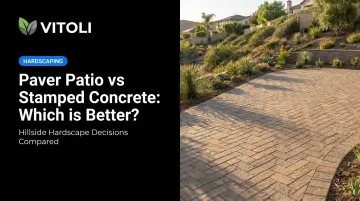
Both are legitimate hardscape choices. Both can look stunning. But they perform very differently under Southern California conditions — and on hillside or sloped lots, that performance gap can be significant.
The decision hinges on more than aesthetics. Upfront cost, long-term durability, maintenance requirements, and how your specific terrain behaves all factor in. This guide breaks down everything you need to know to make the right call for your property.
Key Takeaways
- Pavers cost more upfront but are easier to repair and hold up better on sloped terrain
- Stamped concrete costs less initially but needs resealing every 2–3 years and patches visibly when damaged
- Southern California's UV exposure and clay soils accelerate cracking and fading in stamped concrete
- On hillside properties, pavers are the stronger choice due to their modular flexibility and drainage compatibility
- Neither material is universally superior — terrain, budget, and intended use drive the right answer
Paver Patio vs. Stamped Concrete: Quick Comparison
| Factor | Paver Patio | Stamped Concrete |
|---|---|---|
| Installed Cost (LA) | $9–$28/sq ft | $15–$30/sq ft |
| Compressive Strength | ~8,000 psi (ASTM C936) | ~3,000 psi (residential benchmark) |
| Cracking Risk | Low — individual units flex independently | Moderate — rigid slab prone to cracking |
| Repair | Simple — swap individual units | Difficult — color and pattern matching rarely seamless |
| Maintenance | Re-sanding joints; occasional resetting | Resealing every 2–3 years |
| UV Durability | High — no sealer dependency | Moderate — sealer degrades under intense SoCal sun |
| Best For | Slopes, pool decks, long-term investment | Flat lots, curves, budget-driven projects |
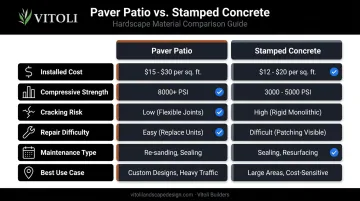
In Los Angeles, stamped concrete isn't automatically the cheaper option. Angi's 2026 local pricing data shows pavers at $9–$28/sq ft and stamped concrete at $15–$30/sq ft, ranges that overlap considerably. Site conditions, slope access, and finish level often matter more than the material category itself.
What Is a Paver Patio?
Paver patios are modular hardscape surfaces built from individually laid units — concrete pavers, clay brick, travertine, or natural flagstone — set over a compacted gravel and sand base. The interlocking structure is what gives them their durability and flexibility.
The Structural Advantage
Each paver unit sits independently. When the ground shifts — from clay soil expansion, moisture changes, or seismic activity — the surface flexes rather than fractures. No single point of failure. On hillside properties or lots with expansive soils (common throughout Los Angeles and Ventura County), this modular behavior is a measurable engineering advantage backed by real performance data.
The strength numbers back this up. ASTM C936 concrete paving units are manufactured to an average compressive strength of 8,000 psi, with no individual unit below 7,200 psi. Common residential poured concrete, by comparison, typically targets around 3,000 psi for weather-exposed flatwork. That gap in material density translates to real-world resistance against heavy loads and surface wear.
Design Range and Use Cases
Beyond structural performance, pavers offer a wide design vocabulary:
- Pattern options: herringbone, running bond, fan patterns, basketweave
- Material types: concrete pavers, clay brick, travertine, natural flagstone
- Surface texture: three-dimensional, tactile — reads as premium rather than printed
Best suited for:
- Sloped or hillside yards where ground settling is an ongoing concern
- Pool decks, outdoor kitchens, and multi-level terraces
- Driveways with vehicle traffic
- Phased construction — pavers can be built out in stages over multiple seasons, with new sections matching existing material
On hillside and terraced lots, the paver surface is only part of the system. Vitoli Builders integrates drainage infrastructure — perforated drain lines, gravel backfill, and weep systems — directly beneath paver installations on multi-level properties across Los Angeles and Ventura County.
That coordination between surface and subsurface is what determines long-term performance. A well-drained paver base holds its position for decades; one without it starts shifting within a few years.
What Is Stamped Concrete?
Stamped concrete is poured-in-place concrete that's colored and imprinted with textured stamps while still wet to mimic the look of natural stone, brick, slate, or wood. The result is a continuous, seamless surface — no visible joints between individual pieces.
Design Strengths
This is where stamped concrete delivers real advantages:
- Flowing shapes: curves and organic layouts that would require excessive cutting with individual pavers
- Color customization: integral pigments, color hardeners, antiquing releases
- Large seamless areas: unified aesthetic across expansive entertainment surfaces
On flat lots with straightforward geometry, these strengths come together well — but the same properties that make it visually appealing introduce a structural trade-off.
The Core Vulnerability
Stamped concrete is a rigid monolithic slab. It will eventually crack — the only variables are when and where. Control joints are required during installation to manage cracking, but those joints interrupt the pattern's visual continuity. On California properties with clay-heavy soils, LA City planning documents confirm that clayey soil volume changes can cause uplift or cracking of rigid elements like slabs-on-grade. Stamped concrete and expansive soil aren't an ideal pairing.
The SoCal Maintenance Reality
Southern California's UV environment adds another layer of ongoing cost. According to the EPA's UV Index guide, Los Angeles regularly experiences Very High UV exposure — and that intensity degrades acrylic concrete sealers over time, causing yellowing, fading, and surface dulling. Brickform's sealing guidance recommends UV-stable sealers to prevent this degradation.
Stamped concrete requires resealing every 2–3 years. Professional sealing runs $1.35–$2.50/sq ft according to Angi — a recurring cost that adds up over time.
Worth noting: freshly applied sealer can temporarily create a slippery surface, which is a real concern on pool decks and outdoor entertaining areas.
Best suited for:
- Flat to gently sloped lots where ground movement is minimal
- Large patio surfaces and front entry walkways
- Projects with curves or irregular shapes that would require excessive paver cutting
- Budget-conscious projects on stable, well-drained ground
Which Is Better for Southern California Outdoor Spaces?
Southern California's climate changes the usual calculus. Without freeze-thaw cycles, stamped concrete avoids one of its biggest failure modes in colder climates. But the region creates its own set of challenges that shift the comparison.
The Hillside Factor
On graded, terraced, or sloped lots — which describe a significant portion of properties across the hills of Los Angeles and Ventura County — pavers are the stronger long-term choice. The reasons are practical:
- Modular pavers flex with ground movement; rigid slabs crack under the same stress
- Individual units can be lifted to access subsurface drainage without disturbing the surface
- Paver layouts can be reconfigured as landscapes evolve — poured concrete cannot
Vitoli Builders defaults to pavers for sloped and terraced installations across Southern California for exactly these reasons. Caisson foundations, retaining walls, integrated drainage, and paver surfaces function as a unified engineering system — each component reinforcing the others.
Long-Term Cost of Ownership
No head-to-head 10-year study exists for this comparison in the SoCal market, but the cost drivers are well understood:
Stamped Concrete recurring costs:
- Professional resealing every 2–3 years: $1.35–$2.50/sq ft per application
- Crack repair (color and pattern matching): often requires professional decorative concrete specialists
- Severe cracking: may require full slab replacement
Paver recurring costs:
- Joint re-sanding: periodic, low cost
- Resetting shifted units: occasional, localized
- Replacement of damaged units: straightforward, no surface disruption
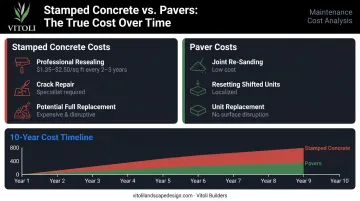
The upfront cost gap between the two narrows in Los Angeles. Factor in resealing cycles and the real possibility of costly stamped concrete repairs, and the 10-year picture often favors pavers on anything but a flat, stable lot.
Property Value
Zillow's 2024 research found that bluestone patios are associated with a 2.3% sale premium — natural stone and premium hardscape installations carry measurable resale appeal. The NAR Remodeling Impact Report supports outdoor feature investment broadly. Stamped concrete adds visual appeal, but the available data points more strongly toward high-quality paver and natural stone installations in premium SoCal neighborhoods.
Clear Situational Recommendations
Choose pavers when:
- Your lot is sloped, terraced, or hillside
- The project includes a pool, outdoor kitchen, or multi-level design
- Longevity and repairability are priorities
- You're making a long-term investment in the property
Choose stamped concrete when:
- Lot is flat with stable soil conditions
- Design requires curves or flowing shapes that pavers can't match cost-effectively
- Upfront cost is the primary constraint
- Surface isn't adjacent to a pool or wet area where sealer slip risk matters
Frequently Asked Questions
Which is better: a paver patio or stamped concrete?
Neither is universally better. Pavers offer greater durability, simpler repairs, and superior performance on slopes; stamped concrete costs less upfront and handles curves more effectively. The right choice depends on your lot's terrain, your maintenance tolerance, and how long you plan to own the property.
How much does a 20x20 paver patio vs. stamped concrete patio cost?
For a 400 sq ft patio in Los Angeles, Angi's 2026 local data puts pavers at roughly $3,600–$11,400 and stamped concrete at $6,000–$12,000; hillside sites can push paver costs to $8,400–$14,400 (Install-It-Direct, 2026). Site conditions drive the final number more than material category — get local bids.
Does stamped concrete crack in Southern California?
Yes, it can. SoCal's warm climate eliminates freeze-thaw cracking, but stamped concrete remains vulnerable to ground movement from clay soil expansion, seismic activity, and improper base preparation. Control joints help manage cracking but don't eliminate the risk — especially on hillside or expansive-soil sites.
Can you install pavers on a sloped or hillside patio?
Yes. Pavers are well-suited for sloped terrain because their modular design accommodates ground movement without surface failure and allows for proper drainage integration. A properly compacted base with adequate drainage systems is essential — critical on any hillside installation.
Which lasts longer: a paver patio or stamped concrete?
Both can last 25–30+ years with proper installation and maintenance. Pavers have a practical longevity advantage: damaged individual units can be replaced without disturbing surrounding material. Stamped concrete repairs are rarely seamless, and significant cracking may require full slab replacement.
Does a paver patio add more home value than stamped concrete?
Both add value, but Zillow's 2024 data links premium hardscape — particularly natural stone and high-quality pavers — to measurable sale premiums. In LA and Ventura County's premium neighborhoods, paver and stone installations tend to appraise more favorably than stamped concrete.
Your lot's terrain, soil conditions, and long-term ownership goals will point you toward the right answer — and a contractor who knows SoCal hillsides will help you avoid the costly mistakes that come from choosing the wrong material for the wrong site. If you're planning a patio project in Los Angeles or Ventura County, connect with Vitoli Builders for a consultation tailored to your property.