Most generic walkway guides ignore these realities. They don't account for the fact that LA's fault system gives Southern California a 60% probability of a magnitude 6.7+ earthquake in the next 30 years, or that LA County's stormwater rules now favor permeable surfaces. The wrong material on the wrong site doesn't just look bad over time — it cracks, erodes, or creates drainage problems that cost far more to fix than the original installation.
This guide covers the five materials best suited to LA's specific conditions, what each actually costs, and how to match the right choice to your property.
Key Takeaways
- Concrete pavers balance durability, drainage, and seismic flexibility better than most alternatives for LA properties
- Natural flagstone and porcelain pavers suit premium properties where aesthetics justify higher installation costs
- Decomposed granite is the most drought-compatible and affordable option for garden paths
- Stamped/poured concrete has the lowest upfront cost, but seismic activity and soil movement make cracking a real long-term risk
- Slope, drainage, and HOA restrictions can change which material makes sense — total cost of ownership matters more than price per square foot
Why LA's Climate and Terrain Demand a Smarter Material Choice
Los Angeles puts walkway materials through a stress profile most regions never see in combination.
UV and heat are the starting point. The NWS recorded a UV Index of 11 — classified as "extreme" — for LA in summer 2026. Dark surfaces absorb and radiate heat, making them uncomfortable underfoot and accelerating material degradation. Light-colored, UV-stable materials are a practical specification for any LA walkway, not an optional upgrade.
Rainfall patterns create a different kind of problem. LA's dry spells give way to sudden, intense rain events that hit compacted, often hydrophobic soil. Without permeable or well-drained walkway surfaces, runoff concentrates along paths and causes erosion. LA County's Low Impact Development Standards Manual now requires small residential projects to include at least two stormwater BMPs — and when porous pavement is selected, it must cover at least 50% of site pavement. Permeable walkway surfaces aren't just environmentally preferable; they increasingly reflect local policy direction.
Seismic movement is the factor most guides skip entirely. Southern California has more than 300 faults capable of magnitude 6+ earthquakes.
Rigid, monolithic surfaces — like a single poured concrete slab — crack along fault-influenced soil movement and require expensive, visually obvious repairs. Interlocking or segmental materials flex with minor ground movement and allow individual-piece replacement.
These three stressors show up differently depending on your property's layout. A quick summary of what each one demands from your material choice:
- UV and heat: prioritize light color, UV-stable finishes, and low thermal mass
- Stormwater: favor permeable or gapped surfaces with proper sub-base drainage
- Seismic activity: choose segmental or interlocking systems over monolithic slabs
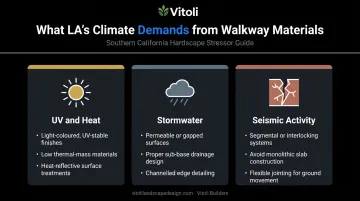
For hillside properties, these three stressors compound further. Slope drainage and soil stability add their own requirements, addressed in the section below.
Best Outdoor Walkway Materials for LA Homes
The five materials below were evaluated for performance under Southern California's specific conditions, compatibility with LA's home styles — from Spanish Revival to California Contemporary — and real-world durability in seismically active, sun-intensive environments.
Concrete Pavers
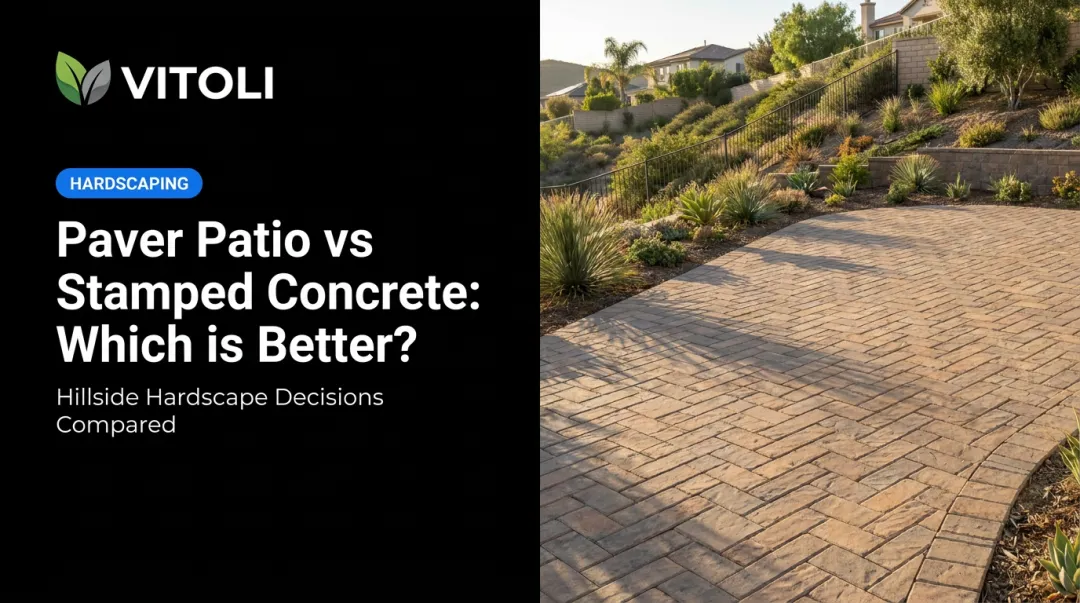
Concrete pavers are the most widely installed walkway material across LA, and the reasoning holds up. Their interlocking construction creates a flexible pavement system that accommodates minor ground movement without large-scale cracking — a meaningful advantage in a seismic zone. Individual damaged pieces can be replaced without disturbing the surrounding surface, keeping repair costs manageable over the long term.
For LA specifically, pavers offer several practical advantages:
- Drainage between joints reduces runoff during heavy rain events
- Slip-resistant finishes are available for wet-weather safety
- Wide design range — from tumbled travertine-look to sleek contemporary — suits LA's architectural diversity
- Gentle slope compatibility makes them practical for many hillside front entries
Manufacturers like Unilock and Belgard back their concrete paving products with lifetime transferable warranties for residential use, though actual service life depends heavily on installation quality and sub-base preparation.
| Attribute | Details |
|---|---|
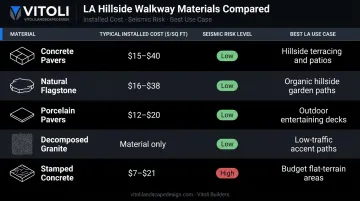
| Typical Installed Cost | $15–$40/sq ft (national range; LA bids vary based on access, drainage, and base depth) |
| Durability & Maintenance | Long lifespan; periodic joint re-sanding and sealing; individual pavers replaceable |
| Best For in LA | Front entries, high-traffic paths, contemporary or traditional homes, gentle hillside grades |
Natural Flagstone
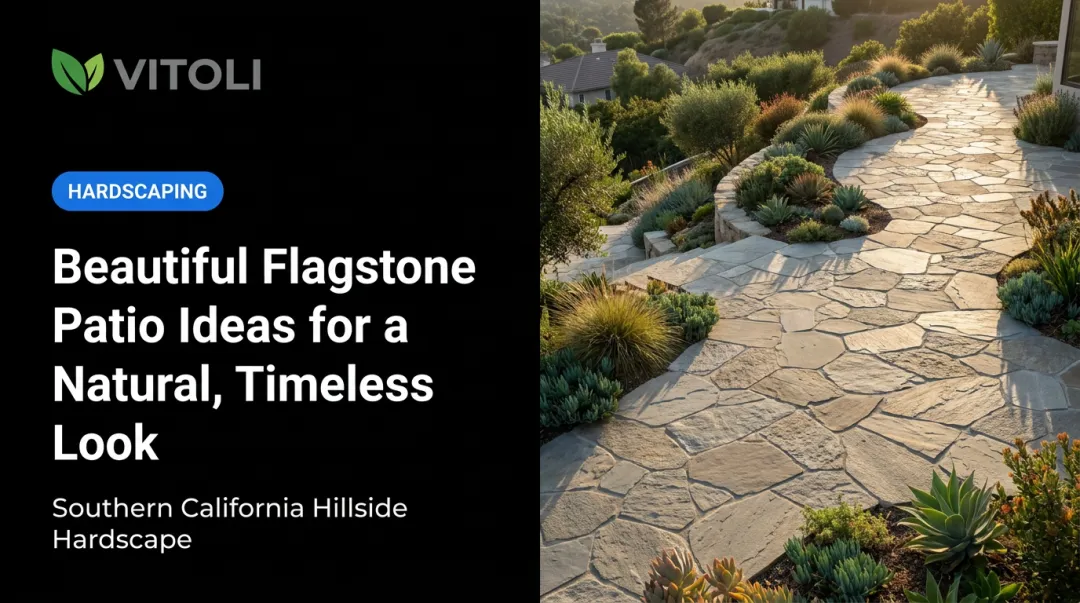
Natural flagstone — including bluestone, travertine, and slate — delivers a timeless, organic aesthetic that no manufactured material fully replicates. Each piece is unique in shape and color, which works particularly well with Spanish Revival, Mediterranean, and ranch-style homes common across LA County and Ventura County.
The LA-specific case for flagstone, especially travertine, is its thermal performance. Lighter-colored natural stone stays measurably cooler underfoot compared to dark concrete — a genuine quality-of-life factor during Southern California summers. Travertine and similar light stones also integrate naturally with drought-tolerant garden beds and native planting schemes, which aligns with how most LA homeowners are now approaching landscape design.
One honest caveat: installation on sloped or irregular terrain requires skilled labor. Key considerations for hillside sites:
- Dry-laid flagstone on moving or poorly drained soil can migrate and become uneven over time
- Steep grades require mortared setting with an engineered base — worth the additional cost
- Proper sub-base preparation is as important as stone selection on any hillside property
| Attribute | Details |
|---|---|
| Typical Installed Cost | $16–$35/sq ft (stone walkways); $29–$38/sq ft (flagstone-specific; national estimates) |
| Durability & Maintenance | Extremely durable; periodic sealing prevents staining; individual stones may need releveling |
| Best For in LA | Premium front entries, garden paths, Spanish Revival and Mediterranean homes, drought-tolerant settings |
Porcelain Pavers
Porcelain pavers have become a go-to choice in LA's luxury residential market over the past several years. Manufactured to be UV-stable and non-porous, they won't fade under intense Southern California sunlight and won't absorb water, oil, or residue the way natural stone can.
Belgard and Unilock both produce outdoor porcelain lines with documented colorfastness and stain resistance, and unlike natural stone, porcelain requires no periodic sealing. The large-format tile aesthetic aligns cleanly with LA's growing appetite for minimalist and contemporary design.
The one specification detail that matters: slip resistance varies by finish. Smooth porcelain becomes dangerous when wet, and shaded walkways stay damp longer than sun-exposed ones. Specify textured, outdoor-rated porcelain with a Dynamic Coefficient of Friction (DCOF) rating above 0.42 for wet conditions — and confirm the specific product's technical sheet before ordering.
| Attribute | Details |
|---|---|
| Typical Installed Cost | $12–$20/sq ft installed (proxy estimate; not LA-specific) |
| Durability & Maintenance | Highly durable and UV-resistant; no sealing required; textured finish essential for wet conditions |
| Best For in LA | Modern and contemporary homes, pool-adjacent walkways, homeowners prioritizing low maintenance |
Decomposed Granite (DG)
Decomposed granite is the natural fit for LA's drought-tolerant landscape movement. Made from weathered granite that compacts into a permeable, firm surface, DG pairs visually and ecologically with California native plants, xeriscaping, and low-water garden designs in a way that no manufactured material matches.
For walkway use, stabilized DG — pre-blended with an organic or polymer binder — is the right choice over loose DG. Stabilized versions hold together underfoot, resist erosion better during rain events, and last longer without constant re-compacting. That said, even stabilized DG has real limitations:
- Performs best on flat to gently sloping ground
- Can erode or become muddy on steep grades during heavy rain
- Requires proper edging to prevent migration into planting beds
- May track into interior spaces near entry doors
Installed cost data for stabilized DG is sparse — no reliable source provides a clean LA-specific per-square-foot number. Stabilized DG material alone runs roughly $100–$225 per cubic yard, with professional labor adding to the total. Get local quotes rather than relying on national averages.
| Attribute | Details |
|---|---|
| Typical Installed Cost | Material: $100–$225/cubic yard stabilized (labor additional; no clean LA installed $/sq ft available) |
| Durability & Maintenance | Moderate lifespan; may need periodic re-compacting and edging; avoid on steep grades |
| Best For in LA | Garden paths, native landscape settings, casual side-yard walkways, budget-conscious projects |
Stamped / Poured Concrete
Poured concrete — including decorative stamped varieties — offers the clearest cost advantage of any material on this list. Standard concrete walkways run $7–$17/sq ft installed nationally, with stamped concrete coming in at $10–$21/sq ft. For flat terrain and utilitarian paths, it's a practical, familiar choice that can last decades with proper installation.
The LA-specific caveats are real, though:
- Seismic cracking is the primary risk. Poured concrete is a monolithic slab — when soil shifts, it cracks, and repairs are visible and difficult to make look seamless. Control joints (placed every 8–12 feet for a 4-inch slab, per NRMCA guidelines) reduce but don't eliminate this risk.
- Heat absorption makes dark stamped concrete uncomfortable barefoot in summer. Light-colored or cool-finish concrete mitigates this.
- Drainage depends entirely on site grading. An impermeable slab on a hillside without proper drainage channels can redirect water in problematic directions.
For flat-lot properties with good drainage and a homeowner who wants custom aesthetics at lower material cost, stamped concrete can work well. On hillside properties with active soil movement, it's the highest-risk option on this list.
| Attribute | Details |
|---|---|
| Typical Installed Cost | $7–$17/sq ft (standard); $10–$21/sq ft (stamped) |
| Durability & Maintenance | Long lifespan if properly installed; cracking risk in seismic zones; resealing every 4–5 years |
| Best For in LA | Budget-conscious homeowners on flat terrain, utilitarian paths, properties with custom stamped aesthetic goals |
How to Choose the Right Walkway Material for Your LA Home
The most common mistake LA homeowners make is choosing a material based on appearance or upfront cost alone. Here's what actually determines whether a walkway performs well over 10–20 years:
Traffic and use pattern — A front entry path used daily by multiple people and delivery traffic needs a durable, low-maintenance surface like pavers or flagstone. A garden stroll path behind the house has different requirements — DG or informal flagstone stepping stones may be perfectly adequate.
Slope and drainage — Steeper grades need textured surfaces, secure installation (mortared or properly restrained), and integration with drainage systems. Materials that work beautifully on flat terrain — loose DG, smooth porcelain, unreinforced concrete slabs — can become safety hazards on a hillside.
Total cost of ownership — Lower upfront cost doesn't always mean lower overall cost.
- DG requires periodic re-compacting and top-ups
- Concrete cracks and is expensive to repair without visible seams
- Pavers and flagstone cost more upfront, but individual pieces replace cheaply and both materials can last 25–50+ years with minimal intervention
Permitting and HOA requirements — Most residential walkways within a property boundary don't require a City of Los Angeles permit. Permits may be required when a walkway connects to a public sidewalk, involves significant grading, or ties into drainage structures.
If you're in an HOA community, architectural approval is typically required for visible exterior changes. Submit material, color, and drainage plans before construction starts — not after approvals are denied.
Special Considerations for Hillside Walkways in Los Angeles
Hillside properties — from the Hollywood Hills to Calabasas to Malibu — introduce complexity that flat-lot walkway guides don't address. Slopes create drainage channeling, soil stability concerns, and safety requirements that affect both material selection and installation method.
Material Recommendations by Slope Grade
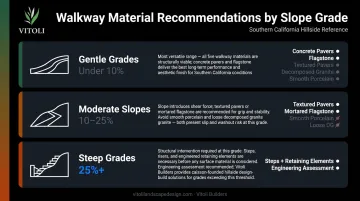
- Gentle grades (under 10%): All five materials are viable with proper drainage planning. Concrete pavers and flagstone offer the best long-term performance.
- Moderate slopes (10–25%): Textured concrete pavers or mortared flagstone are preferred. Dry-laid stone without edge restraint can migrate. Avoid smooth porcelain and loose DG.
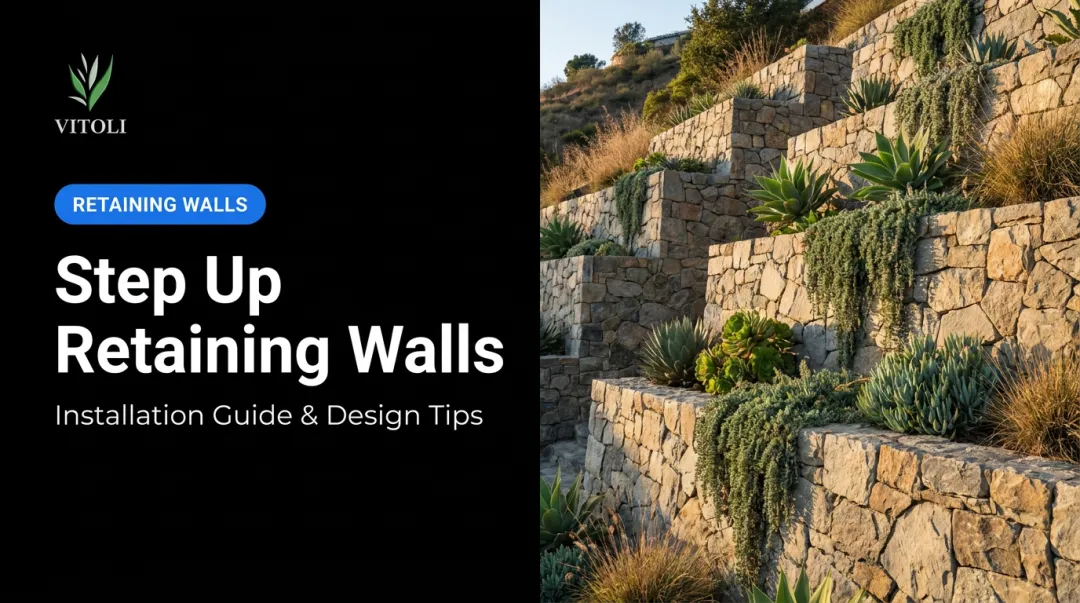
- Steep grades (25%+): The walkway itself becomes a structural decision. Incorporating steps, retaining elements, and level landings between walkway runs is necessary — this goes beyond material selection and requires engineering assessment.
Drainage Integration
On hillside walkways, drainage isn't optional. Water channeling along a path during rain events can undermine even well-installed surfaces.
Vitoli Builders — a hillside construction specialist serving LA County and Ventura County with over 1,800 hillside projects — integrates drainage solutions as standard practice for sloped hardscape installations. The walkway surface and the drainage system are designed together, not separately. Solutions commonly include:
- Gravel backfill beneath paved surfaces
- Perforated drain lines routed away from the path
- Weep systems embedded in retaining or border elements
LA County's grading guidelines add another layer of planning. Hillside projects on slopes of 25% or steeper can trigger stormwater mitigation requirements, and excavations over 50 cubic yards or deeper than 2 feet require a grading permit. Knowing these thresholds before breaking ground helps avoid delays and unexpected costs mid-project.
Conclusion
There's no single best walkway material for every LA home. The right choice depends on your site conditions, design goals, and budget. Here's where each material tends to land:
- Concrete pavers and natural stone — strongest overall balance of durability, repairability, and aesthetics
- Decomposed granite — best for native landscape settings where permeability and an organic look matter more than formality
- Porcelain — ideal for modern builds where low maintenance and UV stability are the priority
- Stamped concrete — works on flat, budget-conscious projects with careful installation
On hillside sites especially, terrain, drainage, and slope can override aesthetic preferences entirely. Before committing to a material, consult with a local hardscape professional who can assess your actual ground conditions.
Contact Vitoli Builders for a walkway design consultation tailored to your LA property. They serve Los Angeles County and Ventura County — reach them at 866-575-5795 or Info@vitolilandscapedesign.com.
Frequently Asked Questions
What is the best material for an outdoor walkway?
There's no universal answer — it depends on traffic, terrain, and aesthetic goals. Concrete pavers are the most versatile choice for most LA properties, thanks to their durability, seismic flexibility, and individual-piece repairability.
What is the cheapest material for an outdoor walkway?
Decomposed granite and poured concrete are the most affordable options. Stabilized DG is especially cost-effective for casual garden paths, while standard poured concrete runs $7–$17/sq ft installed. Poured concrete can crack over time and may need patching, so weigh upfront savings against long-term upkeep.
What walkway material holds up best in Los Angeles heat and sun?
Porcelain pavers and light-colored natural stone — particularly travertine — perform best under intense UV. Both resist fading and stay cooler underfoot compared to dark concrete or asphalt, which absorb and radiate heat significantly in Southern California summers.
Do I need a permit to install a walkway in Los Angeles?
Most residential walkways within a property don't require a permit. However, permits may be required when the walkway connects to a public sidewalk, involves significant grading, or ties into drainage structures — confirm with the City of Los Angeles Bureau of Engineering or a licensed contractor before starting.
How long do outdoor walkways last in Southern California?
Natural stone and concrete pavers can last 25–50+ years with proper installation, while decomposed granite typically needs re-compacting every few years. Lifespan varies based on installation quality, sub-base preparation, and site conditions — especially on hillside properties.
Is decomposed granite a good walkway material for Los Angeles?
Stabilized DG is a practical choice for LA properties with native or drought-tolerant landscaping — it's permeable, natural-looking, and affordable. It performs best on flat to gently sloping ground with proper edging and a stabilizing binder. Avoid it on steep grades or near entry doors where tracking is a concern.