For homeowners and builders on Southern California hillsides, this isn't abstract engineering. Sloped terrain, expansive clays, seismic risk, and loose surface soils are everyday conditions across Los Angeles County and Ventura County. Understanding when deep foundations are required — and which type is appropriate — matters before a single shovel breaks ground.
This article covers what deep foundation systems are, the four main types, the conditions that make them necessary, and how the selection decision is made.
Key Takeaways
- Deep foundations transfer structural loads through weak near-surface soil to a competent bearing layer at depth
- Required conditions include surface soils that can't support loads, sloped or unstable sites, and seismic risk zones
- The four main types — caissons, driven piles, micropiles, and helical piles — each suit different soil and load conditions
- Geotechnical investigation must happen before selecting any foundation type
- On Southern California hillside properties, caissons are the most common solution
What Is a Deep Foundation System?
A deep foundation is a structural element installed at significant depth to transfer building loads through weak near-surface soils to competent bearing material below (dense gravel, compacted earth, or bedrock). Unlike shallow foundations that rely on near-surface soil strength, deep foundations bypass the problem layer entirely.
Two core engineering goals drive this approach:
- Bearing capacity — the soil's ability to resist load without shear failure
- Settlement control — limiting compression over the structure's life to acceptable tolerances
When near-surface soils can't meet either requirement, a deep foundation system is the engineered path forward — and understanding the difference from shallow systems explains why.
How Deep Foundations Differ from Shallow Foundations
Shallow foundations — spread footings, slab-on-grade, mat foundations — work well on stable, flat sites with moderate loads. They distribute load across near-surface soil directly beneath the footing.
According to FHWA's Geotechnical Engineering Circular No. 6, shallow foundations are generally defined as bearing at a depth less than about two times the foundation width. Deep foundation systems are used when settlement risk, poor ground conditions, slope instability, or geometry make shallow systems inadequate. That distinction is driven entirely by site conditions — not contractor preference or budget.
Types of Deep Foundations
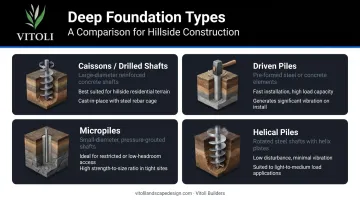
Four main deep foundation types appear in residential and hillside construction. Selection is always driven by soil profile, structural load, and site constraints — not cost alone.
Caissons (Drilled Shafts)
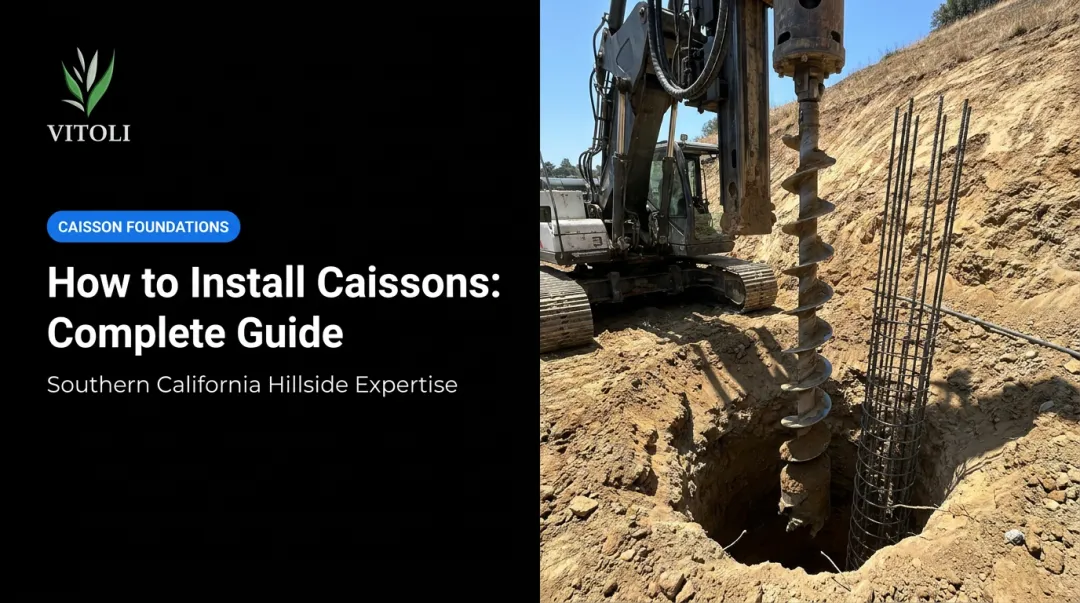
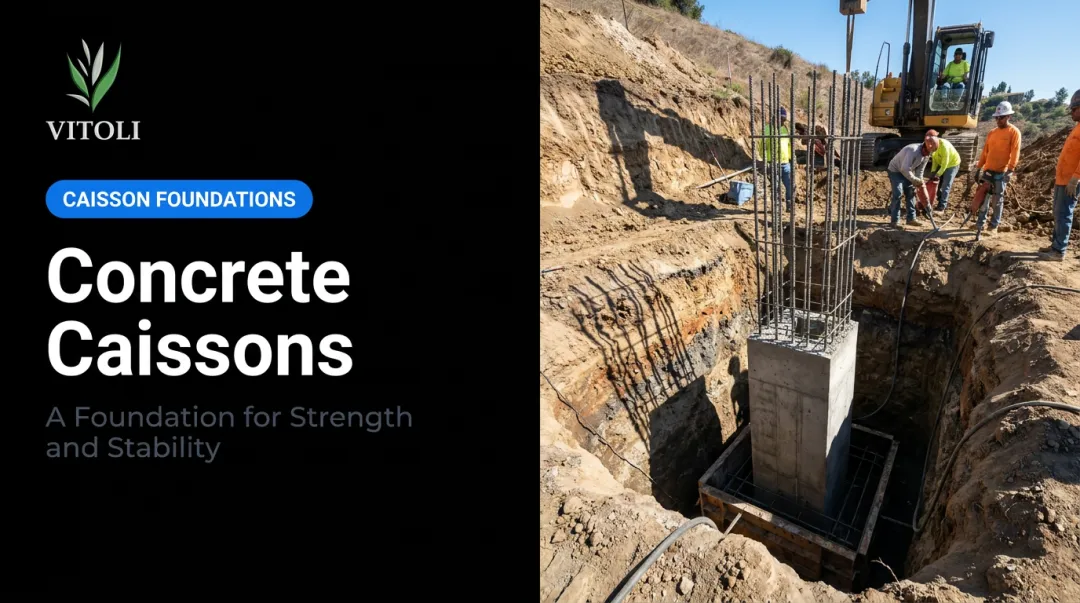
Caissons — also called drilled shafts or bored piles — are large-diameter reinforced concrete elements constructed in place. The process: a rotary drill bores a hole to the required depth, a steel reinforcing cage is lowered in, and concrete is placed from the bottom up.
FHWA's Drilled Shafts manual describes three construction methods — dry, casing, and wet (slurry) — selected based on groundwater and soil stability conditions. Rock-socketing is used when the shaft must be anchored into bedrock for very high load capacity.
Caissons generate minimal vibration, work well in restricted access conditions, and can be sized for a wide range of loads. These characteristics make them the most common deep foundation type for hillside residential construction in Southern California.
Vitoli Builders performs caisson installation as a core service on sloped residential sites across LA County and Ventura County, covering soil assessment, precision drilling, reinforcing steel placement, and concrete placement.
Driven Pile Foundations
Driven piles are pre-formed structural elements — steel H-piles, pipe piles, or precast concrete — hammered or pressed into the ground until they reach the required bearing depth or refusal.
Key characteristics:
- Install relatively quickly compared to drilled shafts
- Capacity verification is straightforward during installation
- Generate significant noise and vibration during driving
That vibration is a real constraint near existing structures or in residential neighborhoods, which limits their use on typical Southern California hillside residential projects.
Micropiles
Where vibration and access are the limiting factors, micropiles fill the gap. They are small-diameter drilled and grouted piles reinforced with a central steel bar. FHWA defines them as typically 100–300 mm in diameter — roughly one-third the diameter of a standard drilled shaft.
Their primary advantage is access. Micropiles can be installed:
- On steep slopes with limited working area
- In low-headroom environments
- Within or adjacent to existing structures
This makes them the standard choice for foundation underpinning and remedial work where conventional drilling equipment can't physically reach the installation point.
Helical Piles
Helical piles — screw piles — are steel shafts with welded helical bearing plates, rotated into the ground with a hydraulic torque drive. They install quickly and cause minimal site disturbance.
They perform best on light-to-medium load applications where speed and low site disturbance are priorities. They are not appropriate for heavy structural loads, very hard soils, or sites with significant boulders or cobbles.
Per ICC-ES AC358 criteria, helical pile capacity is product-specific and soil-specific — it must be verified through an ICC-ES evaluation report and geotechnical design, not assumed from general guidelines.
When Are Deep Foundations Required?
Weak or Compressible Near-Surface Soils
Soft clays, organic soils, loose fills, and saturated silts cannot support significant structural loads without excessive settlement. When standard penetration test (SPT) N-values indicate very loose or soft conditions, a geotechnical engineer will evaluate whether near-surface soils can carry the imposed load at all. If they can't, deep foundations that bypass the problem layer are the engineering answer.
No single N-value automatically triggers a deep foundation requirement. The data must be corrected and interpreted by a licensed geotechnical engineer relative to the specific structure and its imposed loads.
Hillside and Sloped Terrain
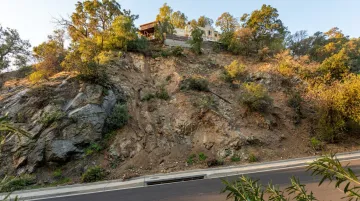
On sloped sites, surface soils are prone to lateral movement, shallow bearing failure, and erosion. A shallow footing bearing near the slope face offers little resistance to sliding — and no resistance once the slope moves.
USGS research on Southern California landslide hazards documents the region's susceptibility to rainfall-triggered and seismically induced slope failures, including deep-seated events in Ventura County. The California Geological Survey maps liquefaction and earthquake-induced landslide zones that directly affect foundation design decisions across the region.
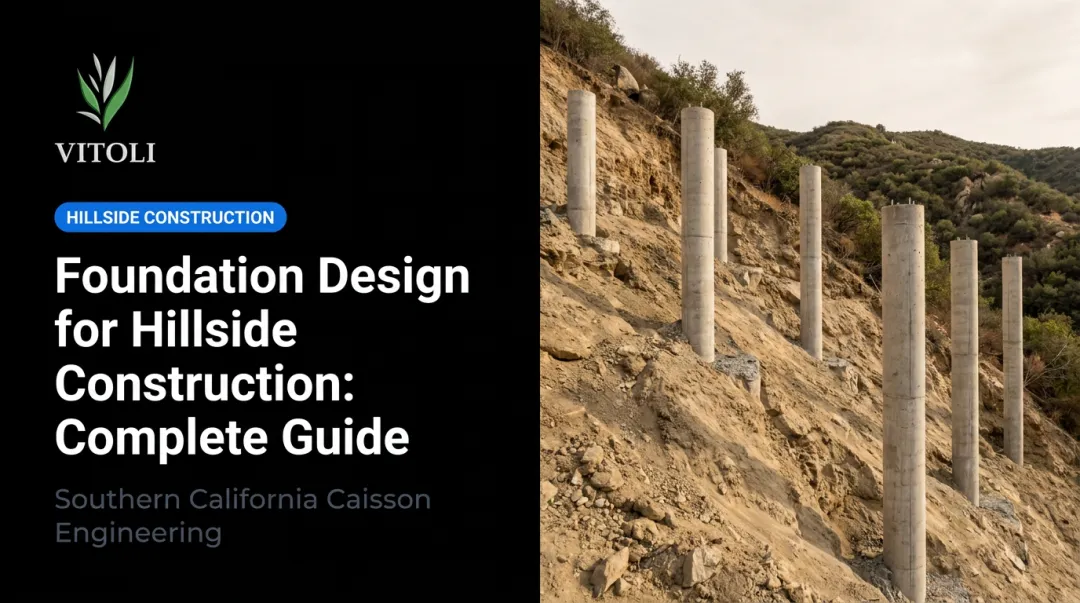
A deep foundation anchored into stable strata below the slope's active failure zone is the only reliable way to achieve both vertical and lateral stability. This is the dominant condition driving deep foundation use on residential hillside properties throughout Los Angeles County and Ventura County — and the primary reason caisson systems are so common in this market.
Seismic and Lateral Load Conditions
Hillside terrain and seismic risk are closely linked in Southern California. California's seismic environment generates significant lateral loads and overturning forces at the foundation level — demands that tall structures and multi-story hillside homes amplify further.
Deep foundations engage surrounding soil along their full embedded depth, mobilizing passive resistance that a shallow footing cannot develop. Under the 2025 California Building Code (CBC) — effective January 1, 2026 — structures assigned to Seismic Design Categories C through F require geotechnical investigation that includes seismic hazard evaluation. This is standard practice, not an exception, for most Southern California residential foundation projects.
Expansive, Collapsible, or Chemically Aggressive Soils
Three soil conditions commonly push projects toward deep foundations:
- Expansive clays swell and shrink with moisture changes, imposing cyclic heave forces on shallow foundations
- Collapsible soils lose strength suddenly when wetted, creating unpredictable settlement risk
- Chemically active ground degrades foundation materials over time if the concrete mix and reinforcement aren't specified for the exposure
Deep foundations that extend through the active problem zone into stable material below reduce these risks — though the specific soil chemistry must be assessed to determine appropriate concrete mix and reinforcement protection.
Key Factors That Affect Deep Foundation Selection
Soil Investigation Findings
No deep foundation type can be responsibly selected without a site-specific geotechnical investigation. This typically involves borehole drilling, soil sampling, and in-situ penetration testing to characterize soil resistance with depth.
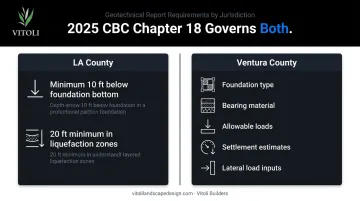
In California, foundation design must comply with the 2025 CBC Chapter 18, which governs soils and foundations. Local requirements add further specificity:
- LA County: Exploration must extend at least 10 feet below the proposed foundation bottom (or 20 feet in liquefaction-prone areas)
- Ventura County: Geotechnical reports must address foundation type, bearing material, allowable loads, settlement estimates, and lateral load inputs for pile design
Foundation selection follows the investigation — never the other way around.
Structural Load and Site Constraints
Two additional factors shape every foundation decision:
Load profile:
- Static dead loads from building weight
- Dynamic live loads from occupancy and use
- Seismic and lateral loads, including slope creep forces on hillside sites
Each load type creates different foundation demands. The required pile geometry — diameter, depth, spacing — follows directly from load analysis combined with soil resistance data.
Site access constraints:
- Steep slopes limiting equipment maneuverability
- Proximity to existing structures or retaining walls
- Underground utilities and property line setbacks
- Noise restrictions in residential areas
On hillside residential sites, drilling rig access is frequently the controlling variable. It influences pile diameter, spacing, and sometimes the choice between a conventional drilled shaft and a micropile. Vitoli Builders' site assessment accounts for slope grade, drainage patterns, and equipment access before any drilling begins.
Common Misconceptions About Deep Foundations
"Deep foundations are only for large commercial buildings." Any site with weak, unstable, or sloped near-surface soils may require a deep foundation, regardless of building size. Single-family hillside homes regularly require caisson foundations to achieve the stability that a shallow footing simply cannot provide on compromised terrain. LA County and Ventura County geotechnical report requirements apply to residential grading and building permits — not just commercial projects.
"Any contractor can install a deep foundation." Deep foundation installation requires specialized drilling equipment, site-specific engineering design, and proper sequencing with retaining walls, grading, and drainage systems. On a hillside, several mistakes can escalate into structural failure:
- Incorrect pile depth for site-specific soil conditions
- Inadequate concrete mix or curing practices
- Failing to account for lateral earth pressure loads
A contractor without hillside foundation experience lacks the context to catch these problems before they become expensive. Vitoli Builders has completed over 1,800 hillside projects involving slope stabilization, retaining walls, and caisson systems. That volume of repetition on unpredictable terrain is what separates a competent installation from a costly one.
"Deep foundations are always the answer when soil is soft." They're not. FHWA's ground modification guidance documents cases where soil improvement methods — compaction grouting, stone columns, or similar techniques — allowed shallow foundation construction where deep foundations would have otherwise been specified. When near-surface soils are only moderately weak and structural loads are light, a well-designed mat foundation or ground improvement approach may be more economical. The decision belongs to a licensed geotechnical or structural engineer reviewing actual site data.
Conclusion
Deep foundation systems — caissons, driven piles, micropiles, and helical piles — solve one engineering problem: getting structural loads past weak, unstable, or sloped near-surface soils to a competent bearing layer. The choice among them follows from soil investigation data, load requirements, site constraints, and applicable building codes.
For hillside property owners in Southern California, where expansive soils, seismic risk, and sloped terrain converge, this isn't theoretical knowledge. A foundation system chosen without proper site investigation can mean costly remediation years down the line — or a structure that never performs to its service life.
That's where in-house expertise matters. Vitoli Builders combines caisson installation experience with on-site assessment, so foundation recommendations reflect actual soil conditions and site geometry — not a generic specification applied from off-site.
Frequently Asked Questions
How much does a deep foundation cost?
Caisson pricing depends on shaft diameter, depth, construction method, rock-socketing requirements, reinforcement design, site access, and permit requirements. No reliable ballpark exists without a geotechnical investigation. The investigation defines the design, and the design defines the cost.
What is the lifespan of a deep foundation?
Reinforced concrete caissons are engineered to last the full service life of the structure. Actual durability depends on concrete quality, cover thickness, reinforcement protection, soil chemistry, and groundwater exposure — factors addressed in the structural design specifications.
What are the three types of foundation systems?
The three broad categories are shallow foundations (spread footings, mat foundations, slab-on-grade), deep foundations (caissons, driven piles, micropiles, helical piles), and specialty systems such as floating or buoyancy rafts. Site conditions and structural loads determine which applies.
What is an example of a deep foundation?
A caisson (drilled shaft) is the most common example in Southern California hillside residential construction. It's a reinforced concrete element drilled into hillside terrain, caged with rebar, and poured in place to anchor a structure to bedrock or dense bearing strata well below unstable surface material.
What is the difference between a deep and shallow foundation?
A shallow foundation transfers load to near-surface soil directly beneath the footing. A deep foundation bypasses weak near-surface material entirely, carrying load to a competent layer at depth. Soil quality, site conditions, and structural load drive that decision — not budget preference.
Do hillside homes in Southern California need deep foundations?
Many do — particularly in Los Angeles County and Ventura County, where sloped terrain, seismic conditions, and variable surface soils make shallow foundations inadequate. A site-specific geotechnical investigation is the only way to determine what a specific property actually requires.