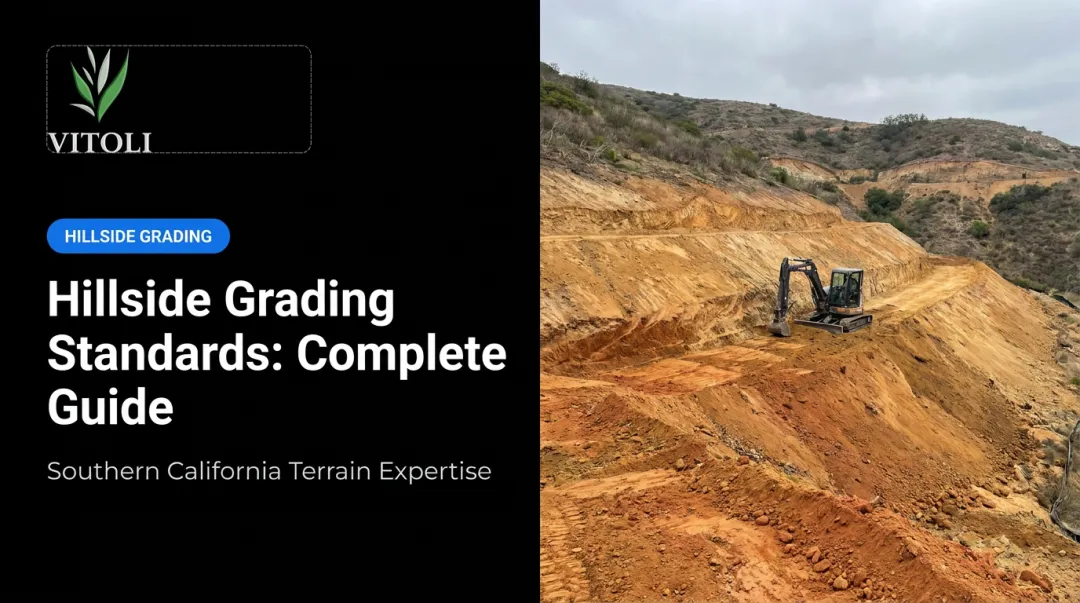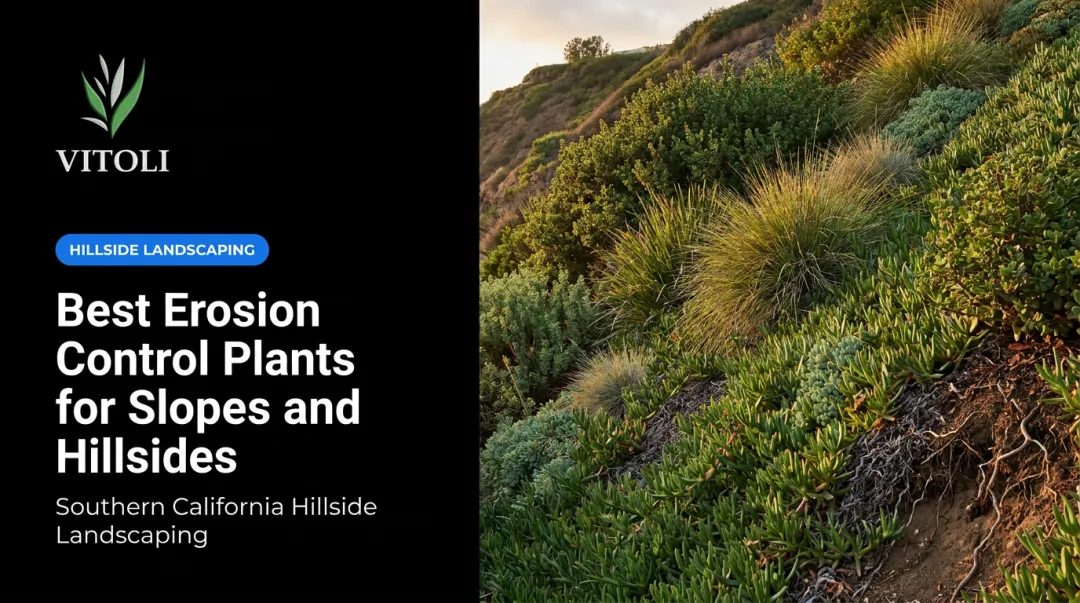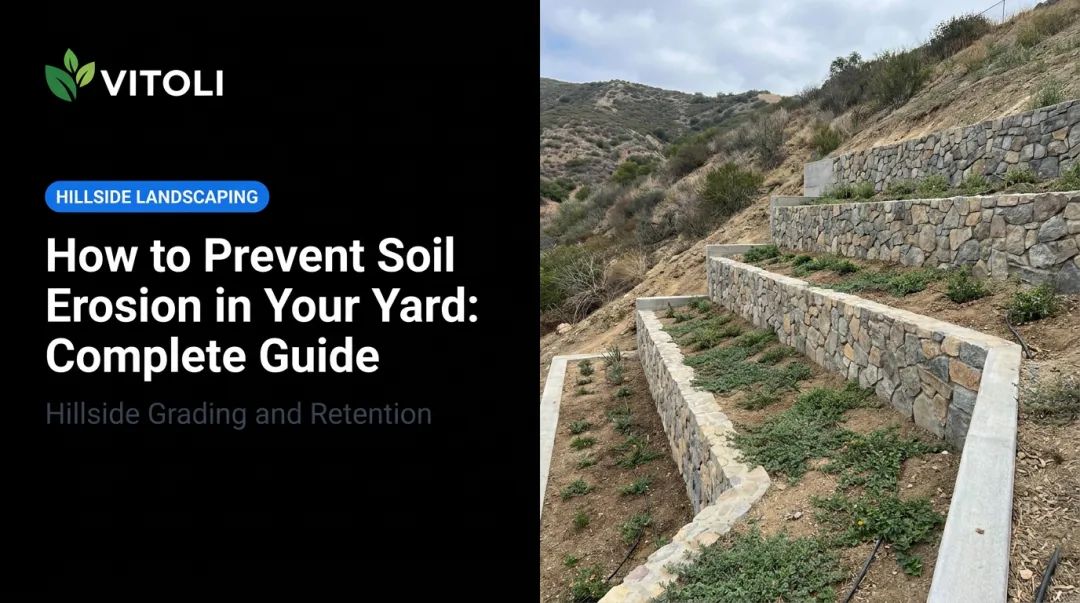
An Erosion and Sediment Control Plan (ESCP) is what stands between a well-managed project and that scenario. Yet many property owners treat it as paperwork rather than a legitimate risk management tool — until a stop-work order arrives.
This guide covers what an ESCP actually is, what it must include, how to build one step by step, and what happens when one is missing. It's written for property owners, contractors, and developers working on any land-disturbing activity — particularly those dealing with the steep gradients common across Southern California hillside properties.
Key Takeaways
- An ESCP is required for most projects disturbing one acre or more under federal NPDES rules, with many California cities requiring one for smaller sites
- A complete plan includes a site map, existing conditions assessment, grading plan, BMP selection map, revegetation strategy, and narrative report
- Steeper slopes generate exponentially more sediment runoff — making gradient one of the highest-risk variables in any ESCP
- Federal Clean Water Act violations can reach $68,445 per day, per violation
- On hillside sites, ESCPs are especially critical — exposed soil on steep terrain erodes far faster than on flat ground
What Is an Erosion and Sediment Control Plan?
An ESCP is a site-specific, written and mapped strategy that identifies erosion risk areas, outlines control measures, and sets a schedule for implementation across each phase of a construction project. Every element is tailored to your site's actual conditions — not pulled from a generic template.
Erosion is the detachment and movement of soil particles by water, wind, or construction activity. Sedimentation is what happens next — that displaced material deposits downstream into waterways, storm drains, and sensitive areas.
Both problems must be addressed. An ESCP that only prevents initial soil movement but ignores where that soil ends up is incomplete.
Who Needs One?
EPA's Construction Stormwater Program requires a Clean Water Act permit for any project disturbing one acre or more — or smaller sites that are part of a larger common plan of development that will ultimately disturb one acre or more.
But the federal threshold isn't the only trigger. Several California jurisdictions require erosion control documentation for projects well below one acre:
| Jurisdiction | Requirement |
|---|---|
| Hemet, CA | All projects, regardless of size |
| Covina, CA | Sites under 1 acre must submit an Erosion Control Plan |
| Yorba Linda, CA | Sub-acre projects where required by municipal code |
| Paso Robles, CA | All grading and building plans, regardless of size |
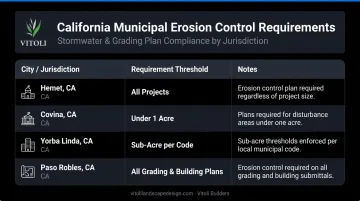
For Southern California hillside projects specifically, Los Angeles County requires an approved ESCP for grading activities during rainy season (October 15 to April 15), and Ventura County's grading permit checklist mandates an effective combination of BMPs at construction sites.
Key Components of an Erosion and Sediment Control Plan
A complete ESCP combines several interconnected components that together document how erosion will be managed from initial grading through final stabilization.
Site Location Map
Every ESCP starts with a detailed map showing the project's boundaries, existing topography, drainage patterns, proximity to water bodies or storm drains, access points, and areas of planned soil disturbance. This is the foundation everything else builds on.
Existing Site Conditions Assessment
Before any grading begins, the plan must document pre-construction soil types, vegetation coverage, slope gradients, and hydrology. This baseline identifies the highest-risk zones and informs which BMPs are appropriate where.
Grading Plan and Disturbance Schedule
The grading plan documents proposed finished grades, phased construction timelines, and the sequence of soil exposure. The goal: minimize the window of time soil sits unprotected. Controls must be active before disturbance — not installed after the fact.
BMP Selection and Placement Map
This section specifies exactly which Best Management Practices will be installed and where — relative to disturbance areas and drainage pathways. Each BMP must be mapped to a specific location, not just listed. Common controls include:
- Silt fences along slope toes and downhill perimeters
- Inlet protection at storm drain openings
- Check dams in swales and drainage channels
- Fiber rolls for slope interruption and flow control
Revegetation and Final Stabilization Plan
The plan must include a permanent stabilization strategy for after construction: seeding, hydroseeding, sodding, or native plantings, with a timeline and success criteria. Both EPA's Construction General Permit guidance and California's 2022 CGP define final stabilization as achieving 70% or more uniform perennial vegetation cover relative to native background.
Narrative Report
The narrative connects every component into a single, readable document — covering project scope, phasing, identified risks, selected controls, maintenance responsibilities, and inspection schedule. A well-written narrative makes compliance reviewable and keeps the entire project team aligned on erosion responsibilities from start to closeout.
Best Management Practices for Erosion and Sediment Control
BMPs fall into two categories, and an effective ESCP uses both:
- Erosion prevention — keeps soil in place before it moves (mulching, hydroseeding, erosion control blankets, surface roughening)
- Sediment control — captures soil that has already moved (silt fences, fiber rolls, sediment basins, inlet protection devices)
Slope-Specific BMPs
Hillside sites demand additional attention. A 2021 peer-reviewed study found that sediment yield on machine-compacted soil rose from 1.36 g/m² at 5% slope to 4.08 g/m² at 30% slope — a threefold increase driven purely by gradient. Steeper sites aren't just more difficult to work on; they produce fundamentally more erosion risk per square meter of exposed soil.
For hillside construction, effective slope-specific BMPs typically include:
- Erosion control blankets — rolled material that holds seed and soil in place during establishment
- Check dams — small barriers installed in drainage channels to slow water velocity
- Slope drains — lined conduits that carry stormwater down a slope without scouring the surface
- Terracing — reshaping a slope into a series of level benches to interrupt water flow
- Rock riprap — protective stone placed at the base of slopes where concentrated flow exits
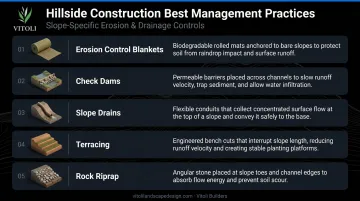
On hillside sites in Los Angeles County and Ventura County, the terrain complexity typically demands a combination of these measures. Soil composition, drainage patterns, and slope angle all vary from site to site — and BMP selection has to follow those variables, not the other way around.
Stormwater Diversion and Sediment Basins
Managing where runoff goes is just as important as slowing it down. Berms, swales, and lined channels divert stormwater away from exposed soil before it picks up sediment — particularly on sites where flow travels downslope toward streets or waterways.
Larger sites with high runoff potential often require sediment basins or traps: detention areas where suspended sediment settles out before water is discharged. On high-risk sites, sediment basins are a standard permit requirement, not a discretionary add-on.
Maintenance and Inspection
BMPs are not set-and-forget installations. They require:
- Regular inspection — especially within 24-48 hours after rain events
- Repair or replacement as construction phases change
- A maintained inspection log as part of permit compliance
California's 2022 Construction General Permit specifies visual inspections before qualifying precipitation events, monthly inspections, and inspections tied to specific compliance thresholds. A silt fence with a breach, a buried base, or accumulated sediment at capacity provides no meaningful protection — and will fail inspection accordingly.
How to Create an Erosion and Sediment Control Plan Step by Step
Step 1 — Site Assessment
Start with a thorough site walkthrough. Document topography, soil erodibility, existing vegetation, drainage paths, and any sensitive receptors (neighboring properties, waterways, or storm drains) that need protection. This is the data that drives every decision that follows.
Step 2 — Determine Permit Requirements
Identify your regulatory obligations before drafting anything:
- Federal: EPA NPDES Construction General Permit (1 acre or more)
- State: California's 2022 Construction Stormwater General Permit (Order WQ 2022-0057-DWQ), requiring a Stormwater Pollution Prevention Plan (SWPPP) developed by a Qualified SWPPP Developer (QSD)
- Local: Los Angeles County and Ventura County both impose requirements beyond state minimums — check with the relevant public works department
Enrollment in California's SMARTS system (Stormwater Multiple Application and Report Tracking System) is required for projects covered under the state CGP. The FY 2025-26 annual fee is $511 plus $54 per acre of disturbance, capped at $11,311.
Step 3 — Develop Site Maps and Grading Plan
You'll work with a civil engineer to produce the core documents: a site map showing disturbance areas, drainage patterns, and BMP placements. In California, the SWPPP and any amendments must be developed by a credentialed QSD. These maps then directly inform which BMPs you select and where they go.
Step 4 — Select and Schedule BMPs
Match BMPs to your specific site conditions:
- Slope gradient — steeper slopes require more robust erosion controls
- Soil type — sandy or clay-heavy soils behave differently under rain
- Project duration — longer timelines need durable, maintainable controls
- Precipitation season — California's wet season (October–April) sets hard deadlines
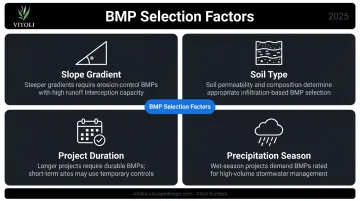
Controls must be active before soil is disturbed — not installed reactively after a rain event exposes a problem.
Step 5 — Assign Responsibility and Set Up Inspection Protocol
The completed plan must designate a qualified person for implementation, maintenance, and inspections. Under California's CGP, this role belongs to a Qualified SWPPP Practitioner (QSP) — a separate credential from the QSD who developed the plan.
California-licensed Professional Engineers (Civil), Professional Geologists, and Engineering Geologists may self-register as QSD/QSP through SMARTS.
On hillside sites in LA County and Ventura County — where steep grades, unstable soils, and proximity to drainage channels all converge — these steps carry real consequences if rushed. Vitoli Builders' work on hillside terrain routinely integrates erosion control planning alongside grading, retaining walls, and foundation work, treating it as a structural requirement rather than a permit formality.
Regulatory Requirements and Consequences of Non-Compliance
The Federal Framework
The EPA's Construction General Permit under the National Pollutant Discharge Elimination System (NPDES) requires stormwater management documentation for any project disturbing one acre or more. California implements this through the 2022 Construction General Permit (CGP), administered by the State Water Resources Control Board. Contractors enroll and submit compliance reports through SMARTS, the state's online tracking portal.
Penalties for Non-Compliance
Under Clean Water Act Section 309(d), federal civil penalties for violations assessed on or after January 8, 2025 can reach $68,445 per day, per violation. Administrative penalties range from $27,378 per violation (Class I) up to a total cap of $342,218 for Class II violations.
Beyond federal penalties, non-compliant sites in Los Angeles County and Ventura County face:
- Stop-work orders halting all construction activity
- Permit suspension or revocation
- Civil liability for downstream property damage or water quality impacts
- Triggered inspections from neighbor complaints or post-rain compliance patrols
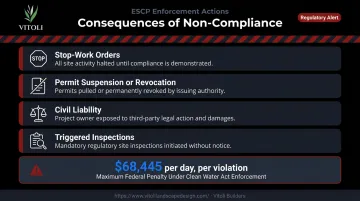
LA County's Stormwater Inspection Program actively monitors construction sites, and sites above one acre must retain their ESCP/SWPPP on-site, available for review at any time. On hillside sites — where grading exposes more disturbed soil and runoff moves faster — a single complaint or post-rain patrol can result in a stop-work order that stalls a project for weeks. Getting the plan right before breaking ground costs far less than correcting it under enforcement pressure.
Frequently Asked Questions
What is an erosion and sediment control plan?
An ESCP is a site-specific document that identifies erosion risks on a construction or grading site and outlines the BMPs, schedules, and measures that will prevent soil loss and protect surrounding areas from sediment runoff. It covers both erosion prevention and downstream sediment capture.
How much does erosion and sediment control plan review cost in California?
In California, the State Water Resources Control Board charges $511 plus $54 per acre annually under the Construction General Permit (CGP), capped at $11,311. Other states vary widely — North Carolina DEQ, for example, charges $119 per acre for standard review and $264 per acre for express review.
What is the difference between an ESCP and a SWPPP?
An ESCP focuses specifically on preventing soil erosion and sediment movement. A SWPPP is broader, covering all construction-related stormwater pollutants — concrete washout, fuel storage, materials handling, and post-construction stormwater management. In California, the ESCP is typically a component within the SWPPP.
Who is required to prepare an erosion and sediment control plan?
In California, the SWPPP (which incorporates the ESCP) must be prepared by a credentialed Qualified SWPPP Developer (QSD). California-licensed civil engineers and professional geologists may self-register as QSD/QSP through the SMARTS portal and must keep the plan on site for inspector review throughout the project.
What are the most effective erosion control methods for slopes and hillsides?
Slope-specific measures include erosion control blankets, hydroseeding, check dams, slope drains, and terracing. The right combination depends on gradient, soil type, proximity to drainage features, and the current construction phase — no single BMP works for every hillside scenario.
What happens if a construction site doesn't have an erosion and sediment control plan?
Missing or non-compliant ESCPs can trigger stop-work orders, daily fines reaching tens of thousands of dollars per violation, permit revocation, and legal liability for downstream environmental damage. In most cases, compliance costs far less than the combined penalties and remediation expenses.