
Introduction
Choosing a garden boundary in Southern California is rarely straightforward. Unlike a simple backyard fence decision, homeowners here contend with sloped terrain, wildfire risk zones, water restrictions, HOA architectural standards, and the practical demands of year-round outdoor living. Get it wrong and you're looking at a boundary that fails structurally, violates local code, or needs replacement in a decade.
The three core options — hedges, walls, and fences — each solve a different version of the problem. Hedges offer living, ecological boundaries that shift with the seasons. Walls deliver permanent structural performance. Fences cover the middle ground: faster to install, flexible in design, and lower upfront cost than masonry.
This guide breaks down all three in the context of Southern California properties: costs, maintenance, regulatory considerations, and when each option actually makes sense, particularly on the hillside lots common across Los Angeles and Ventura Counties.
Key Takeaways
- Hedges provide the most natural boundary but take 3–7 years to establish and require ongoing maintenance
- Walls are the most durable option, with the highest upfront cost but the lowest long-term maintenance — especially on sloping terrain where a retaining function is needed
- Fences offer the fastest installation and most design flexibility at the lowest initial price point
- Fire risk, drought tolerance, and HOA restrictions are SoCal-specific factors that can eliminate or favor certain options
- Combining boundary types — a low masonry wall base with a fence or hedge above — often delivers the best outcome on hillside properties
Hedge vs. Wall vs. Fence: Quick Comparison
Here's a side-by-side overview using current trade cost data for the Southern California market.
| Feature | Hedge | Masonry Wall | Fence |
|---|---|---|---|
| Installed cost | $10–$45/linear ft | $60–$240/linear ft | $25–$50/linear ft (wood, LA) |
| Time to full privacy | 3–7 years | Immediate | Immediate |
| Privacy level | Moderate–high (once established) | High | Moderate–high |
| Maintenance | High (trimming, irrigation) | Low | Moderate (wood) to Low (metal) |
| Lifespan | Indefinite with care | 50–100+ years (masonry) | 10–20 years (wood) |
| Fire risk | Higher near structures | None | High (wood), Low (metal) |
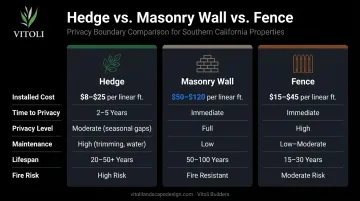
Cost data sourced from HomeGuide (hedges), HomeGuide (walls), and Angi (fences). Ranges reflect trade estimator benchmarks; actual costs vary with terrain complexity, materials, and labor in the LA/Ventura County market.
Cost Notes by Boundary Type
- Hedges run $10–$45/linear ft installed; 4–6 ft privacy specimens land at the higher end. The upfront cost is low, but irrigation and ongoing maintenance add up over time.
- Masonry walls range from $60–$120/linear ft for a 4 ft block wall to $90–$180/linear ft for 6 ft. On hillside properties, engineered foundations, drainage systems, and geotechnical requirements push costs well beyond these baseline figures.
- Wood fences in Los Angeles run $25–$50/linear ft installed. Cedar and redwood hold up best in SoCal's climate; composite options are available as an alternative, typically in the $11–$45/linear ft range.
Maintenance at a Glance
- Hedges: Trim 1–3 times per year; irrigate through establishment and ongoing for non-native species; replace sections lost to pest or disease damage
- Walls: Periodic inspection for cracking after heavy rain or seismic activity; drainage outlet maintenance on hillside walls
- Fences: Stain, seal, or paint wood every 2–3 years; replace damaged panels; treat metal components to prevent rust
Garden Hedges: The Living Boundary
A hedge boundary is a planted row of shrubs or trees trained to form a continuous privacy screen. It's the most ecological option — and the most demanding to establish.
Hedge Styles and Species for Southern California
Two broad categories apply here:
Formal hedges use species that hold a tight shape under regular shearing — Italian cypress, privet, or pittosporum. Italian cypress is a popular SoCal choice for its tall, narrow profile, though Cal Poly SelecTree notes it performs best as a screen rather than a trimmed hedge.
Informal hedges rely on native or Mediterranean-adapted shrubs that fill in without constant clipping. Good options include:
- California lilac (Ceanothus) — drought-tolerant, native, provides screening and wildlife habitat
- Lemonade berry (Rhus integrifolia) — California native, evergreen, good for informal hedging
- Toyon (Heteromeles arbutifolia) — native, can reach 10 ft in three years when well-sited, per Calscape
One caveat: pittosporum is widely used in SoCal but UC WUCOLS classifies it as moderate water use in both South Coastal and South Inland Valley regions — don't treat it as a low-water-use plant.
Fire Risk and Water Restrictions
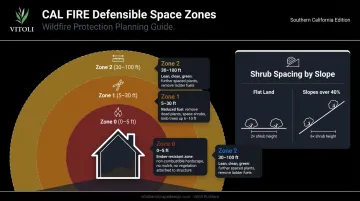
This is where hedges get complicated in Southern California. CAL FIRE's defensible space guidelines identify the first 0–5 feet from a home as Zone 0 — the most critical ember-resistant zone. Shrub spacing requirements vary by slope: 2x shrub height on flat land, 6x shrub height on slopes over 40%. Dense hedge plantings near structures in fire-prone areas like Calabasas hillsides or Hidden Hills require careful compliance with these standards.
Water costs are a separate concern. LADWP prohibits outdoor watering between 9 a.m. and 4 p.m., and roughly 40% of residential water use in California goes outdoors. Hedge irrigation during establishment adds real ongoing cost in a drought-conscious environment.
Ecological Benefits Worth Noting
Hedges do things walls and fences can't. According to USDA NRCS Hedgerow Planting Standard Code 422, hedgerows provide food, cover, and habitat connectivity while reducing wind, dust, and noise. For homeowners prioritizing biodiversity or a naturalistic garden aesthetic, that ecological function is difficult to replicate with hard structures.
When a Hedge Makes Sense
Good fit for:
- Rear garden boundaries where softness is preferred over a hard structure
- Front yards in HOA-governed neighborhoods restricting solid walls or tall fences above 42 inches
- Flat properties with time to establish planting and a naturalistic design goal
Poor fit for:
- Hillside lots with strict vegetation clearance requirements
- Properties needing immediate privacy
- Small urban yards where root systems may conflict with paving or drainage
Garden Walls: Built to Last
A masonry garden wall — brick, natural stone, concrete block, or poured concrete — is the permanent end of the spectrum. Once built properly, it requires almost no ongoing maintenance and performs structurally in ways a hedge or fence cannot.
Why Hillside Properties Change the Calculation
On flat ground, a garden wall is primarily an aesthetic and privacy structure. On sloped terrain, it becomes a structural one. LA County's residential code (R404.4) requires retaining walls to be designed for stability against overturning, sliding, excessive foundation pressure, and water uplift. Seismic loading recommendations apply to hillside walls under LA County Public Works purview, making wall design a legitimate engineering exercise in hillside conditions.
For hillside properties specifically, every retaining or boundary wall warrants a full site evaluation covering soil composition, slope grade, drainage patterns, and load requirements before design begins. Vitoli Builders approaches each hillside wall project this way across Los Angeles and Ventura Counties.
Integrated drainage is a critical part of that process. Gravel backfill, perforated drain lines, and weep systems built directly into the wall address hydrostatic pressure — the leading cause of wall failure in hillside conditions.
Permitting Reality in LA County
- Freestanding block walls or fences over 6 feet require a building permit
- Retaining walls over 3 feet high, or those supporting a surcharge (such as a slope or building), require a permit
- Front-yard walls in residential zones are generally limited to approximately 3.5 feet; side and rear yards to 6 feet
HOA overlays add another layer. Hidden Hills architectural standards, for example, require retaining walls exceeding 4 feet to be permitted and approved by the Architectural Review Committee in advance.
Functional Advantages
Beyond permanence, a well-designed masonry wall:
- Provides immediate privacy upon completion
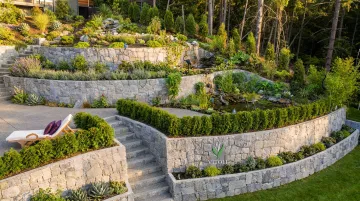
- Can double as a seating ledge or raised planter border
- Requires minimal upkeep — occasional inspection after rain or seismic events
- Integrates architecturally with the home in ways that add long-term curb appeal
When a Wall Makes Sense
Good fit for:
- Hillside or sloping properties where retaining function is required alongside boundary definition
- Pool surrounds and tiered outdoor living zones
- Front property lines in higher-security neighborhoods
- Homeowners prioritizing long-term durability and minimum maintenance
Poor fit for:
- Tight budgets requiring fast installation at low upfront cost
- Properties where a lighter, more permeable boundary is ecologically or visually preferred
Garden Fences: Fast, Flexible, and Cost-Effective
Fences are the most commonly chosen boundary solution — and for flat or gently sloping properties, they're often the right call. They install quickly, come in dozens of styles, and cost significantly less upfront than masonry.
Material Options for the SoCal Climate
| Material | SoCal Suitability | Maintenance |
|---|---|---|
| Redwood / Cedar | Excellent — naturally rot-resistant, aesthetically warm | Stain every 2–3 years |
| Pressure-treated pine | Budget option; weathers poorly under intense UV | Regular sealing required |
| Aluminum / powder-coated steel | Sleek modern look, virtually maintenance-free | Minimal |
| Vinyl / composite | Low maintenance, but UV exposure can degrade appearance | Occasional cleaning |
Redwood and cedar hold up to California's heat and UV exposure better than pine, and their warm tone complements contemporary SoCal architecture. That said, any wood fence in Southern California carries one consideration worth addressing before you commit to a material: fire risk.
Fire Risk with Wood Fencing
Wood fencing poses a documented fire risk in Southern California's high-risk zones. CAL FIRE's home hardening guidance specifically recommends replacing combustible fencing attached to or within 8 feet of a home with noncombustible material. Wildfire Partners states directly that combustible fencing can act as a fuse, drawing fire toward the structure. Homeowners in fire-prone areas — Malibu, hillside Calabasas, and similar zones — should research fire-resistant fencing materials before defaulting to wood.
Key Limitations on Hillside Properties
Fences solve privacy quickly but have structural limits on slopes:
- Posts can destabilize as soil shifts on hillsides
- Wood panels have a limited lifespan compared to masonry
- They provide no retaining function — critical if your boundary also sits on a slope that moves
On hillside lots, a fence works best as the upper element of a combination solution — not as a standalone boundary.
Which Garden Boundary Is Right for You?
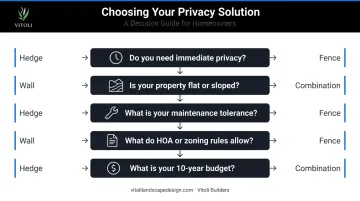
The right boundary depends on five factors worth evaluating honestly before committing:
- Do you need immediate privacy, or can you wait 3–5 years?
- Is your property flat or on a slope requiring retaining capability?
- What is your long-term maintenance tolerance?
- What do your HOA or local zoning rules allow?
- What's your realistic budget — both upfront and over 10 years?
Clear Situational Guidance
Choose a hedge if: You prioritize ecological value, have a flat property, prefer a naturalistic aesthetic, and have time for a 3–5 year establishment period. Stick to drought-tolerant California natives where possible.
Choose a wall if: Your property is sloped or hillside terrain where retaining function matters, you want permanent boundary performance with minimal long-term maintenance, or you're building a pool surround or tiered outdoor living environment. For hillside properties in LA and Ventura Counties specifically, working with an experienced specialist like Vitoli Builders — who designs and engineers these systems in-house — is worth the consultation.
Choose a fence if: You need fast installation, have a moderate budget, and are working with a reasonably flat lot without significant soil retention demands.
The Combination Approach
On complex properties, the most practical solution often combines boundary types. A low masonry wall — 12 to 24 inches — provides structural base and retaining function, while a fence panel on top or a hedge planted behind adds the remaining height and privacy.
This tiered approach is especially effective on hillside lots and can often be designed to meet HOA height restrictions by splitting the visual load between two elements.
The upfront cost gap between a well-built masonry wall and a wood fence often closes significantly over 10–15 years when replacement and maintenance costs are factored in.
That long-term math matters even more in Southern California, where wildfire risk zones, water restrictions, HOA architectural guidelines, and seismic activity mean generic landscaping advice doesn't always apply. For any wall over 3 feet or on a sloped site, verify local permit requirements with your building department and consult a licensed contractor before starting construction.
Frequently Asked Questions
Who is responsible for a garden boundary wall?
Under California Civil Code Section 841, adjoining landowners are generally presumed to share equal responsibility for dividing fences — but deed language can override this. Review your title documents or consult a real estate attorney to confirm ownership of a specific boundary structure.
What is the best material for a garden boundary wall?
It depends on budget, aesthetic goals, and terrain. Natural stone and brick offer timeless durability; concrete block is the most cost-effective for larger walls. On hillside properties, structural requirements — drainage, load calculations, seismic considerations — often determine material choice as much as aesthetics do.
Which garden boundary option is cheapest to install?
Fences have the lowest upfront cost, followed by hedges (low initial plant cost, but irrigation and maintenance accumulate). Masonry walls cost the most upfront but typically have the lowest long-term maintenance expense of the three options.
How long does a garden hedge take to grow to full height?
Most hedge species reach a usable privacy height of 5–6 feet within 3–5 years under good growing conditions. Faster-growing options like toyon can hit that mark in 2–3 years, though drought stress in Southern California can slow establishment noticeably.
Do I need a permit to build a boundary wall or fence in California?
In LA County, permits are required for freestanding walls or fences over 6 feet, and for retaining walls over 3 feet or those supporting a slope or surcharge. Requirements vary by municipality — always check with your local building department before starting construction.
Can I combine a wall and a hedge or fence for my garden boundary?
Yes — a low masonry wall handles structural and retaining needs, while a fence panel or hedge above it adds height and privacy. This hybrid approach works particularly well on sloped properties and can be sized to meet HOA height restrictions.